When something is referred to as "drug," it is often because that thing is thought to be either addictive, pleasurable, pain-reducing, or ailment-curing. Love and Other Drugs is a film that suggests that love is a drug in all of these senses. Unfortunately it's also a film that, like many drugs, provides us with more harmful side effects than positive benefits.
Based on a memoir by former Viagra salesman Jamie Reidy, Love and Other Drugs centers around an unlikely pair of lovers: Jamie Randall (Jake Gyllenhaal), a smooth-talking, yuppie frat boy pharmaceutical salesman, and Maggie Murdock (Anne Hathaway), a fiercely independent bohemian artist who, at 26, already has Parkinson's disease. The film begins promisingly, with a funny and insightful look inside the world of "Big Pharma" at a time (the late 1990s) when the commercialization/marketing of drugs was exploding in America. But it quickly becomes apparent that, as unconventional and quirky as the film aspires to be, it's largely just an exercise in clichÉ.
Directed by Edward Zwick, Love and Other Drugs follows a painfully familiar story arc: Suave, charming playboy (Gyllenhaal) sleeps with a new woman every night, afraid to make commitments or care too much about any of them. One day, he meets a female version of himself—a beautiful woman (Hathaway) who loves sex but avoids love. They decide to have a no-strings-attached arrangement that consists in nothing more than daily sex romps. Sound familiar? That's because last year's Up in the Air had an almost identical plot setup.
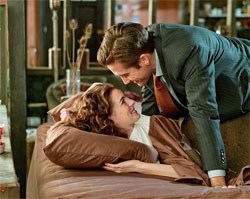
Anne Hathaway as Maggie, Jake Gyllenhaal as Jamie
In spite of their insistence on a sex-only, "I hardly even know your name" relationship, Jamie and Maggie (surprise!) gradually form a relational bond because, as much as they don't want to admit it, they're human. The unwelcome distress of emotional attachment briefly drives them apart—she doesn't believe he could actually love her, a Parkinson's patient—but then they realize that they actually do want commitment and connection. After a teary reconciliation scene, amplified by the on-the-nose emoting of James Newton Howard's score, the couple lives happily ever after, at least as far as we can tell from the maudlin closing montage.
Director Zwick tries to make the film more important and interesting than it actually is. In fits and starts, the film philosophizes about the health care industry (mostly in a brief monologue by Hank Azaria, who plays a doctor frustrated with insurance companies, lawyers, etc.) and attempts to comment on the late '90s wealth-creation zeitgeist. Then there is the fact that Maggie has Parkinson's, which affords a few intermittent opportunities for the film to somberly raise awareness of the various difficulties associated with that disease—that is, when it's not busy "raising" awareness of Viagra humor with nonstop male enhancement puns and gags.
Moments of cultural commentary or attempted gravitas aside, mostly the film seems concerned with showing Hathaway and Gyllenhaal in various stages of undress, as often as possible. Even for a film about Viagra and how meaningless sex can become an addictive, pain-reducing drug (get it? "Love and Other Drugs"?), the depiction of sex in Drugs feels excessive. Whatever ambitions this film has for being taken seriously are dashed by its uncreative reliance on titillation. Do we really need to see all of this? It's redundant, and by the time we arrive at a "pajama party/orgy/threesome" scene near the end, it's downright offensive.
They're in bed together. A lot.
It's too bad, because there's a lot of inherent intrigue in the world this film explores. The pharmaceutical and health care industries are full of interesting and provocative nuances, and the whole "Prozac Nation"/prescription drug culture deserves serious exploration. What are we to make of the increasing tendency in our culture to view the body as a machine-like device which can be controlled, contorted, and forced—via pills, surgeries, supplements—to do or be whatever we want it to do or be? That's an unexplored subtext of Love and Other Drugs that could have made the film much more interesting.
As it is, Drugs is a pretty surface level, skin-filled flick with entertaining but sometimes maddening performances from Hathaway and Gyllenhaal. The lead actors definitely have chemistry and are able to sell us on their characters' inherent (though vague) insecurities and broadly understood brokenness. But there is never a moment in Drugs where it isn't absolutely clear that what we are seeing is acting. The ping-pong pillow talk banter, clever puns, screaming matches and tearful moments of trembling-hand vulnerability are all skillfully performed. But it feels more performed than real. Among many other traits Drugs shares with Up in the Air is the sort of fast-talking theatricality that provides high per-capita cleverness in every dialogue exchange and yet never feels very true to how we actually converse in life.
They also might be falling love. But mostly they're in bed together. A lot.
Mirroring its characters' reluctance to emotionally engage, Drugs is a film that feels distant and closed-off, uninterested or perhaps just incapable of going too deep into the root issues driving its characters' conflicts. Is Maggie's fear of commitment really as superficial as her bohemian, "live in the moment" spirit and her fear of pulling someone else into her difficult future of living with Parkinson's? Is Jamie's problem really that he's just a hyper competitive, red-blooded American capitalist more interested in getting ahead than being tied down? The pat answers we get in the film are unsatisfying. Coupled with ubiquitous clichés (schlubby sidekick brother for comic relief, '90s music soundtrack to constantly remind us of the film's temporal backdrop, etc.), the lack of character depth and thematic curiosity makes Drugs a hard film to swallow. I'm not sure any responsible physician would recommend it.
Article continues below
Talk About It
Discussion starters
What do you think are the motivating factors that lead Jamie and Maggie to want to have a physical relationship but not an emotional one?
Who would you say is the most redeeming character in this film? Why?
Does the film have anything of value to say about relationships and why we shouldn't just "go it alone"?
The Family Corner
For parents to consider
Love and Other Drugs is rated R for sex, nudity, and language. It's resolutely a film for adults and not children, and flaunts that fact constantly with its pervasive depiction of sex and nudity (most topless and from behind). Almost all characters seen in bed together are unmarried, and the film seems to promote casual sex (including threesomes and homosexuality) as fun and normative.
The surprising argument that Saul of Tarsus was born into bondage.
Mark R. Fairchild and Jordan K. Monson
Love and Other Drugs
1 of 3
Anne Hathaway as Maggie, Jake Gyllenhaal as JamieThey're in bed together. A lot.They also might be falling love. But mostly they're in bed together. A lot.















 While we pray for peace, we need moral clarity about this war.
 But let’s not mistake it for calling.
 The surprising argument that Saul of Tarsus was born into bondage.