Asa Butterfield, Chloë Grace Moretz, Christopher Lee
Theatre Release
November 23, 2011 by Paramount Pictures
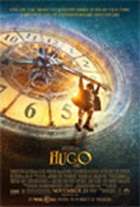
In the final sequence of Hugo, Ben Kingsley's character, a legendary French filmmaker, says to an audience, "Come dream with me." These simple words capture the spirit and heart of this new 3D adventure from Martin Scorsese. Filled with substantive and visual awe, the film tells of the power and wonder of film through one boy's difficult journey to redemption. It also confirms a renewed optimism in its director.
The story, based on the 2007 Brian Selznick novel The Invention of Hugo Cabret, centers on Hugo (Asa Butterfield), a boy living inside the walls of a 1930s Paris train station. After losing his father (Jude Law) in a tragic fire, the orphaned Hugo went on to live with a drunkard uncle, and later on his own. He spends his days secretly running the clocks at the station and stealing parts to fix a broken automaton that he believes will mysteriously connect him to his father, whom he greatly misses.
Hugo's story merges with that of Isabelle (Chloe Grace Moretz) and her godfather, Georges Melies (Kingsley), a toy store owner with a mysterious past. In the wake of a fateful event, Hugo and Isabelle, also an orphan, form a relationship that takes them through a series of adventures. Hugo sneaks Isabelle into a movie theater for her first film, a Harold Lloyd picture. Isabelle introduces Hugo to a bookstore and the world of literature. Coping with the absence of their parents and searching for their place in life, the two form a unique bond, which Butterfield and Moretz leverage with their youthful chemistry.
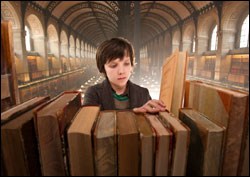
Asa Butterfield as Hugo Cabret
Eventually, their bond begins to unlock a profound mystery surrounding their lives. When Hugo finds the missing piece to his automaton, a symbolic key that Isabelle wears around her neck, he not only discovers a message from his father, but he also discovers a secret about Melies. A former filmmaker, Melies—a real historical figure—made hundreds of movies and helped pioneer the industry. But WWI cut his career short, and he was forced to leave everything behind. He ended up buying a toy store while bitter and depressed.
After learning this truth about Melies, Hugo and Isabelle seek to make things right. They develop a plan to help him realize the beauty and significance of his work, as well as the legacy he created. It's through this storyline, the last half of Hugo, that Scorsese unpacks the history and pertinence of film. Because before Hugo and Isabelle can do anything, they must first see and understand the magic of the medium for themselves.
Though initiated in their trip to the movies and Hugo's previous experiences there with his father, the children's epiphany emerges in the library as they scroll through the pages of a book on film. In looking for Melies, whom they eventually find, they walk through the history of film and the works of pioneers like D. W. Griffith and Edwin S. Porter. Alluding to the magnitude of these individuals and their art, Scorsese creates this scene as a visual spectacle with moving images that transform into actual scenes from movies, like the Lumiere Brothers' Arrival of a Train (1895). He pays homage to his predecessors while also paving the way for the future—here via 3D which he innovates in ways previously unseen.
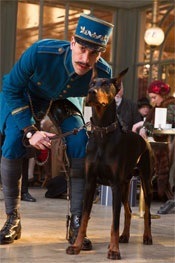
Sacha Baron Cohen as the Station Inspector
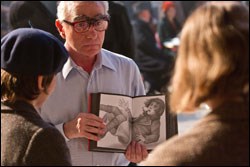
Following this sequence, Hugo and Isabelle unexpectedly meet the author of the book they've just read, film historian Rene Tabard (Michael Stuhlbarg). As he shares with them his love for cinema and his knowledge of greats such as Melies, he paints a beautiful picture of film, describing it as something special and miraculous. His words evoke the theories of the renowned French film critic, Andre Bazin, whose work began soon after the death of Melies. Bazin believed that every shot of film reflects God manifesting creation, a concept that Hugo also implies.
In this focus on the power and magic of film, including its preservation, Hugo also insists that cinema, particularly that of the past, matters because it reminds us of better times—a beacon of hope. Through Melies' story, one in which darker times overcame his work, we see that we can learn from the past and, in doing so, see the future with new eyes and newfound optimism.
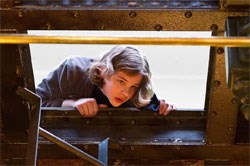
Chloe Grace Moretz as Isabelle
Given the last decade of Scorsese's career, which includes darker, bleaker films like The Departed, Gangs of New York, and Shutter Island, such optimism seems odd for the veteran. But it's also refreshing. The director who once trained to become a priest and then gave us dozens of accomplished films with moral and spiritual implications—Mean Streets, Raging Bull, The Last Temptation of Christ—appears to be back and perhaps more optimistic than ever. His famous words, "My whole life has been movies and religion," finally ring true again.
This renewed state of mind even merges into the aesthetics of Hugo. Whereas Scorsese once established himself as an innovator in regards to the technical aspects of film, he reestablishes himself in the same way here. Taking 3D where it's never gone before, bettering James Cameron's Avatar, he portrays a world rightly balanced between realism and fantasy, resulting in a surreal yet believable experience. From the captivating opening sequence that introduces the Paris train station, to an intense chase scene that weaves the camera through crowds of people and the engineering components of the station's clocks, the film comes to the screen as a visual masterpiece, marking the future of 3D.
Article continues below
Director Martin Scorsese on the set
Even more, all this beauty and depth arrives through Hugo's moving story. Paralleling the life of Scorsese, his storyline doesn't just give the film added substance. It ultimately connects us to it. Because of this, we don't simply get a lesson on the preservation of film or the value of history. We get a story about a boy dealing with the death of his father and finding his place in the world—redemption.
Our sister publication Books & Culture also reviewed Hugo here.
Talk About It
Discussion starters
The preservation of film is a thread that runs throughout Hugo. Why is the preservation of film important? What can we learn from films of the past? Why is history significant?
Hugo depicts film as a magical, almost supernatural, art form. Why? What does Andre Bazin's belief—that every shot of film is a representation of God manifesting creation—mean? Do you believe it to be true?
Through helping Melies, Hugo finds his place in the world, that his gift of fixing things does serve a purpose bigger than himself. What does this tell us about our unique skills and gifts? What does the Bible say about the way we were created?
The Family Corner
For parents to consider
Hugo is rated PG for mild thematic material, some action/peril and smoking. In a quick flashback, Hugo's father is shown dying in a fire. Throughout the film, Hugo references the absence of his father and the hurt he feels as a result of it. Hugo steals toys and food at the beginning of the film. There are several intense actions sequences involving Hugo running from a policeman. Because of the setting, 1930s Paris, people smoke throughout the film, but not the children.












 While we pray for peace, we need moral clarity about this war.
 Church movements need magnetic leaders. But the best leaders need more than charm.
 After this week’s UMC votes on LGBTQ issues, African Methodists should join American conservatives in the new Global Methodist denomination.