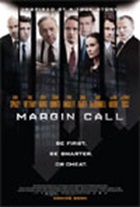
Margin Call is a disaster movie without any explosions. Or rather, it's a movie about the initial response and attempts to control what could become a calamitous disaster. It's like the first few minutes of Contagion, when a deadly disease—in this case, toxic assets poised to take down the entire global financial system—is discovered but has yet to infect too many people. But instead of hazmat suits and gas masks, the players here are all clad in bespoke Gucci pinstripes.
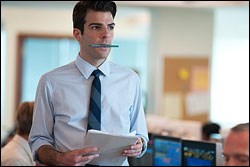
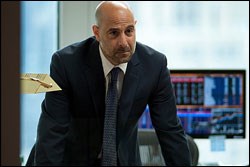
Margin Call is a fictionalized take on the first moments of the 2008 financial crisis. Set in a Wall Street investment firm over the course of 24 hours, Call dramatizes the inner workings and boardroom drama of a firm on the brink of collapse. The film begins at the end of a brutal workday in the unnamed firm; dozens of staff members are laid off, the first sign of trouble. One of those workers (Stanley Tucci) is on to something amiss in the firm. As security escorts him out of the building, he hands a flash drive to his young protégé, Peter Sullivan (Zachary Quinto), telling him to "be careful." Sullivan—a rocket scientist turned junior analyst, no joke—takes a look at the data and finds the reason for his boss's concern. The data shows that a serious storm is on the horizon for the firm—one that could jeopardize the company's future and seriously affect the market at large.
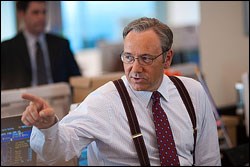
Kevin Spacey as Sam Rogers
The details of exactly what's wrong are never fully explained (nor is the meaning of "margin call," for that matter). To everyday viewers and nonsubscribers of The Wall Street Journal, the jargon and technical speak will just sound like mortgage-backed mumbo jumbo. But the gist of it is clear: the company has a heap of financial assets that are worthless, and if they don't sell off everything as soon as possible, the company will go belly up. But the problem is, if the firm's traders go on a selling spree and knowingly spread their toxic securities around to more vulnerable banks, the entire market could collapse.
Will the firm in question own up to their problem and suffer the consequences, or will they deceitfully sell off their rotten cache and try to save their own skin (at the expense of causing many others to suffer)? This is the central conflict of the film. During an all-nighter between the discovery of the problem and the decisive start of trading, the bigwigs at the firm debate the options before them. Senior partners are woken up, flown in by helicopter and high-level meetings are convened. Corruption, deceit, and dog-eat-dog ethics unfurl in a rapid-fire, dialogue-heavy descent into financial calamity.
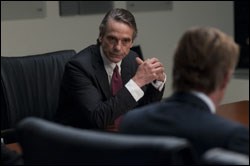
Most central to the film's conflict are Sam Rogers (Kevin Spacey) and head honcho John Tuld (Jeremy Irons), who more or less represent the film's protagonist and antagonist, respectively. As Rogers, Spacey oversees the trading practices of the firm. He's a company man but also committed to ethics; he's reticent to start a fire sale simply for the sake of keeping the firm afloat. As the amoral man atop the food chain, Irons spends the film trying to convince Spacey to forget about what's right and focus on what's best for the firm. Together Spacey and Irons represent the best of a strong ensemble of actors; their back-and-forth banter gets to the heart of the film's ethical concerns and its broader aim to understand the factors and mindsets that lead so many to this place.
Jeremy Irons as John Tuld
Written and directed by newcomer J. C. Chandor, Margin Call succeeds at giving audiences an authentic, believable glimpse into the inner workings of one of the too-big-to-fail Wall Street titans (Chandor's own father worked for Merrill Lynch for almost 40 years). It's a film less interested in explaining microeconomic details than taking a slice-of-life look inside the epicenter of economic collapse. This proves to be both an asset and liability. Viewers hoping to understand exactly what happened on Wall Street in 2008 won't learn much from Call. On the other hand, those of the Occupy Wall Street mindset will find much fodder here to bolster their anti-corporate, capitalism-is-evil cause. Bankers, traders, and One Percent types don't come out of this film smelling like roses.
Zachary Quinto as Peter Sullivan
Margin Call may or may not be a film with a political agenda, but it certainly does capture something of the skepticism many have toward the financial industry in these recessionary times. The disparity of rich and poor is a definite subtext. One memorable dialogue scene in an elevator underscores this: Two high powered figures in the firm have an entire conversation while a cleaning lady stands between them with her cleaning cart, silent and careful to not even make eye contact with the suited figures on either side of her. Little does she know that she's about to clean the offices of what will be Ground Zero of a global recession.
This sobering juxtaposition reminds us of the domino effect set in motion by the greedy activities inside a few floors of this Manhattan high rise. While the film is largely insular in its setting and subjects—most of the action takes place inside offices and among rich white men—the buzzing world outside is where the fallout will hit. Chandor includes many downward-looking angles and backdrops of the city outside, bustling and full of life, oblivious of the hammer about to fall from the boardrooms in the sky. The "little people" are distant abstractions in the film, conveniently out of sight and mind for those in the firm whose actions will cause widespread suffering.
Article continues below
Stanley Tucci as Eric Dale
Though Margin Call isn't the most thrilling of thrillers (it relies too much on stagy dialogue and long-winded soliloquies) and sometimes errs on the side of heavy-handedness (pay no attention to the silly "dying dog" metaphor that ends the film), it's a compelling enough insider look at an important, timely event. Buoyed by a strong ensemble cast and a smart script, Call raises vital ethical questions about the intersection of "doing what's right" and "making a lot of money"—questions that must be considered if any capitalistic society wishes to avoid a similar collapse.
Talk About It
Discussion starters
Which characters in this film act ethically, if any?
Why does Sam ultimately make the decision that he does?
How much of the problems in this film reside in human nature and personal greed? Are individuals to be blamed, or institutions and governments?
Consider the culture of American capitalism broadly. How are our day-to-day habits part of the problem that Margin Call suggests led to the financial collapse?
The Family Corner
For parents to consider
Margin Call is rated R for language. There is a lot of bad language in this dialogue-heavy film, including many f-words. Characters are also seen smoking and drinking, and two men are shown at a bar where a woman appears to be dancing on a table (though we only see her legs). In general the content of the film is very heady and probably not something children or even most teenagers would understand or find interesting.












 While we pray for peace, we need moral clarity about this war.
 But let’s not mistake it for calling.
 The surprising argument that Saul of Tarsus was born into bondage.