Terrence Malick's The Tree of Life is a magisterial symphony of sprawling scope and grand vision. Like the symphonies of the masters Malick clearly admires—Berlioz, Brahms, Bach, Mozart (all of whom show up in Life)—the film is a work of passion that consumed the reclusive writer/director for many years. Like the greatest composers, Malick's ambition here is nothing less than to capture the meaning of life, to create a lasting masterpiece that probes the biggest questions and reflects upon our human struggles, using the forms of cinematic beauty rather than the words of philosophy. Few filmmakers go near the "big questions" any more. But Malick's magnificent Life could change that. It's the sort of film that could awaken a cynical generation of filmmakers to rediscover the possibilities of the form.
Eschewing traditional cinematic narrative, Life is structured in movements. The film is bookended by allegro movements—sweeping montage visions of the universe coming into being and a grandiose finale evoking what could be interpreted as a Christian eschatological climax. In the middle is the adagio section—a slower-paced, intimate observation of one Texas family in the 1950s. Though the spectacles of the beginning and end are jaw-dropping (dinosaurs, molecular reproduction, asteroids, a cosmic light show), it's the middle section that reveals the most truth. Here, in one humble corner of a universe unimaginably large and complex, the true mystery of existence is manifest: A father, mother, children, love, death, hate, forgiveness, reconciliation. Together, this micro memoir and macro meditation form nothing less than a virtuoso triumph that will be talked about, remembered, studied, and treasured for decades.
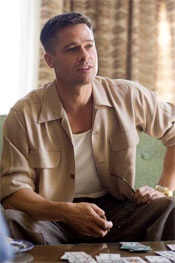
Brad Pitt as Mr. O'Brien
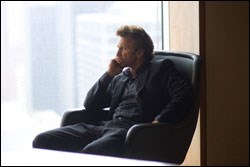
Much of Life takes place in the mind and memory of Jack O'Brien (Sean Penn), an architect in Houston, as he reflects upon the formative years of his younger self (Hunter McCracken) in Waco, Texas. Aside from the show-stopping "God's eye" sequence in the film's first third—which takes us from the first nebulae and forming galaxies to the earth's origins, the dinosaurs' extinction and beyond—Life is basically a kaleidoscope assemblage of Jack's poetic remembrances, dream-like reveries, hauntings, and hopes.
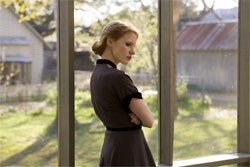
Most prominent in Jack's memory is his family: Mother (Jessica Chastain), Father (Brad Pitt), and two younger brothers. Jack's parents represent the film's broader dialectic of what Mother describes as "two ways through life: the way of nature, and the way of grace." As the stern, business-minded Mr. O'Brien, Pitt represents the way of nature, valuing a competitive, almost Machiavellian approach to life. He's big on the idea of ownership, control, and being a self-sovereign man ("You have control of your own destiny," he says). As the loving, compassionate Mrs. O'Brien, newcomer Chastain embodies the way of grace. She nurtures the kids, cares for them when dad's mad, and is quick to forgive. In parallel scenes of waking the boys up from bed—mother by playfully slipping ice cubes down the back of their pajamas; father by ripping their covers off—we see the contrast clearly.
There's an uncanny universality to Malick's intensely personal, autobiographical portrayal of family life and growing up, which is part of what makes this collection of seemingly banal narrative fragments come alive in such an affecting way. As I watched these vignettes of Jack's Texas childhood—playing with sparklers, running through sprinklers, drinking from a hose, swimming in the local pool, planting a tree with Dad—I remembered my own childhood adventures in Oklahoma. Like the kids in Life, I also played in the creek, threw balls on the roof, played outside on humid afternoons until Mom called me inside for a meatloaf dinner. I too struggled to assert my own obstinate power at the dinner table, to push the boundaries of control with my father. I too wrestled with sin, pride, belligerence, rebellion, and "wanting to be good" (as Jack prays to God one evening in his bedroom). I too loved my parents, and my sister, even when I was angry with them.
Love is a complicated, beautiful thing. And The Tree of Life captures the magnificence of it time and time again. One particularly moving sequence shows Jack injuring his younger brother with a BB gun, followed by a scene of reconciliation that includes few words ("I'm sorry") but expresses a world of truth in the eyes, the body language, the tender touch of the brothers as they share a moment of forgiveness. This is a spiritual epiphany for Jack, prompting him to understand more fully the working of God in his life: "What was it you were showing me? … Always you were calling me."
Mr. O'Brien with R.L. (Laramie Eppler)
Fragments of inner thought like this dominate the film's narrative style, which prefers whispery voiceover to actual dialogue. This has always been Malick's style, evident in each of his four previous films (Badlands, Days of Heaven, The Thin Red Line, & The New World), along with other trademarks: ubiquitous nature imagery, sunset lighting, elliptical editing, jump cuts, observant sound design (wind chimes, insect chirps, rustling leaves), ponderous shots of trees, baptismal water imagery, upward glances to the sky, and nods to the transcendent ("That's where God lives," says Mother). Aided by the immense talents of cinematographer Emmanuel Lubezki—whose camera floats around wistfully, with a child's eye toward the awe and wonder of discovery—Life certainly accomplishes the visual splendor Malick so passionately desires to convey.
Article continues below
In Life, as in his other films, Malick is trying to show us the glory: How the world around us—its majesty and miracle—cannot help but humble us. Another way of looking at the film's nature vs. grace dialectic is to understand it in terms of pride vs. humility. While "grace doesn't try to please itself," says Mother, nature "only wants to please itself … to have its own way." As fallen humans, we're prone to the way of pride — to demand freedom, control, to dominate rather than be dominated.
To survive in this world, you must have "fierce will," Mr. O'Brien tells his sons early on. But by the end of the film, after Mr. O'Brien loses his job, he comes to realize that he's been misguided, losing out on the glorious presence of life and love in the midst of his ruthless insistence on success. "I dishonored it all," he says. "Didn't notice the glory."
Sean Penn as the grown-up Jack
Mr. O'Brien is brought to his knees in humility, realizing that no matter how much we work and strive for things, we're still all fragile creatures in need of grace. Who are we but men? Though the name of Christ is absent in the film, Life is full of Christian sensibilities (Malick is Episcopalian) and biblical allusions, with stops in Genesis, Job, and Revelation. The film opens with a quotation from Job 38: "Where were you when I laid the earth's foundation?" Later, the pastor of the O'Briens' church gives a sermon on Job, pointing out the difficult truism that "misfortune befalls the good as well."
In the battle between nature and grace, grace always wins, in the sense that survival is, in the end, out of our hands. It's in God's hands. It's only by his grace that we can breathe in summer air, touch the butterfly, chase the bubbles, and swim in the creek. Even majestic creatures like dinosaurs are humbled, laid to utter waste by one massive rock flung to the earth. "The Lord giveth and the Lord taketh away," says Grandmother (Fiona Shaw) in one scene. "That's the way he is."
Article continues below
The Tree of Life manages to showcase both man's glory and his inestimable smallness. Life, in the end, is not about us making a mark. It's about tuning our ears to the symphony of life around us, paying attention to the bigger story, and doing our best to love each other and receive grace in the time we've been given.
Talk About It
Discussion starters
Why does Malick take a 20-minute detour through the history of the creation of the universe? What purpose does this serve for the story?
How are our lives shaped by the "way of nature" and the "way of grace"?
What does Jack learn in the sequence of hurting his little brother and then being forgiven by him?
What do you make of the film's final sequence? Is it a vision of the resurrection of the dead? A Christian vision of our eschatological hope?
The Family Corner
For parents to consider
The Tree of Life is rated PG-13 for some thematic material—mostly for its abstract, sometimes heady ideas. But there is little that is objectionable or of concern for parents. Aside from a few violent images (a child with burn scars, a BB gun accident), this is a very safe film to enjoy with children. It captures the zeitgeist of growing up and may connect with younger viewers. That said, the film is quite abstract and experimental at times; it's lack of narrative may lose some viewers. Either way, there is much of value here to be discussed (questions about God, faith, redemption, grace) for adventurous families willing to venture outside of familiar filmgoing territory.














 While we pray for peace, we need moral clarity about this war.
 As my doubts about his teachings grew, so did a secret fascination with Jesus.
 How groups like Hillsong learned to let go of the literal in favor of creative collaboration.españolPortuguês