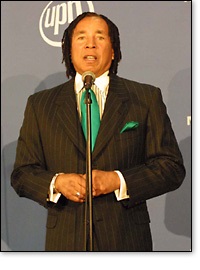
Smokey Robinson and the Miracles were Motown's hottest act in the '60s. These days, Robinson's gig takes him to churches and prisons, where he shares his Christian faith.
Motown legend Smokey Robinson, one-time leader of The Miracles ("Ooh Baby Baby," "The Tracks of My Tears," "The Tears of a Clown"), started out in early soul and R&B genres in 1958, and has scored hit singles in every decade since. But aside from some scattered concert tours in recent years, Robinson, 64, is more often speaking at churches and charities, making his Christian faith more public. And now along comes his first spiritually themed album, Food for the Spirit, ending a five-year recording hiatus. We recently had a nice chat with Robinson, just a day after Motown's latest televised anniversary special. Here's what the member of the Rock and Roll Hall of Fame had to say …
What are your feelings when you're able to reunite with the Motown family?
Smokey RobinsonThat's always wonderful, man! One thing I can say about the Motown acts is that we were a family. That's not a myth. And we still have that same attitude, those of us who are still here. When we see each other, it was like it was just yesterday because we have that love and that brotherhood and that sisterhood that has lasted throughout the ages. It's always good to see any of them, especially those you haven't seen in a long time.
What's your relationship with Motown, despite working on non-Motown projects?
RobinsonMy relationship is everlasting. Once you're a Motown artist, you're always a Motown artist. People still look at Michael Jackson as being a Motown artist. Once you're a Motown artist, that's your stigmatism, and I was there from the very first day. Motown will always be a heavy-duty part of my life because those are my roots. I don't ever balk at being considered a Motown person, because Motown is the greatest musical event that ever happened in the history of music.
Those records we recorded back in the early days, they're played all the time now. The majority of them would be hits if they were released today. That's because we did not set out to make black music. We set out to make quality music that everyone could enjoy and listen to. I think we've accomplished that and way beyond.
How's it feel to be a legend?
RobinsonYou know what, I'm probably one of the most blessed people there's ever been, and I thank God for it. Through his grace, I'm allowed to live this life that I love so much. As a kid, this is what I wanted my life to be. Not in my wildest dreams did I ever dare to dream that it would be this.
Tell me about the new direction you're forging with an inspirational record.
RobinsonOriginally I was not writing songs for myself. I know everybody in the gospel world just like I know everybody in the secular world. Yolanda Adams is my sister [in Christ]. She's my friend just like Kirk Franklin, The Winans and Shirley Caesar. I was originally writing these songs for them, but eventually the Lord impressed upon me to sing them for myself. And as most people probably do not know, I have this wonderful relationship with God and with Jesus. I've been speaking at churches for years, as well as juvenile jails, rehabs and hospitals, and I always talk about my faith. That is a declaration of my relationship with God.
You'd said this is an "inspirational" record rather than a gospel record. Why?
RobinsonThe only thing that is different are the words, because the music is the same as I've always done. I didn't want to try to be gospel because I'm not. There's so many wonderful gospel people out there, and I don't necessarily want to compete with those people. So I wanted to sing inspirational music, and that's exactly how I approached it—only the words have been changed to declare my relationship with God.
What's the inspiration behind the title, Food for the Spirit?
RobinsonAs human beings, we're very materialistic and have all this stuff—furs and cars and diamonds and money. We're very physical creatures, and we worry about how we look sometimes more than our spiritual selves. Now I'm a believer in the hereafter, so I know that when you leave this place, none of the stuff you've accumulated is going. It will still be here and even these bodies, they're going to turn back to dust and ashes. The only thing you're taking out of here is your spirit and your soul, so we need to be conscious to try and develop that part of ourselves, because we're all spiritual creatures.
What has been your road to faith?
RobinsonI have known God all my life since I was a small child. My mother was a churchgoing lady, so I always heard about God at home. Even as a child I wouldn't do certain things because I thought God was watching me. I didn't find out until later in my life who Jesus is, when I heard my mom and her friends talking about Jesus. All I knew as a child was that Jesus was the son of God, but I didn't know Jesus personally until I became an adult. I've had that relationship and that saving grace for a long time in my life, so it's not something new for me.
How do you share that in your speaking sessions?
RobinsonIt's often been said that when you accept Jesus Christ as your Lord and savior, then you're saved. But when I go speak I tell people that "those of you who accept Jesus are saved, but you're not safe." I go to rehabs and talk to people who have been in there 40 or 50 times and they've done drugs for 20 years. I tell them if you don't get your spiritual self together, you're going to come here 51 times.
Article continues below
There's a perception that entertainers are especially prone to falling into drug use. Why do you think that's the case?
RobinsonCome on man, you're being naïve here! That has no relationship to show business whatsoever. Drugs are in every walk of life—doctors, lawyers, preachers, the guy who works for IBM, teenagers on the street, teenagers in school. Show business is not exclusive to drugs!
I agree, but there certainly seem to be a lot of stars cracking under the pressure, perhaps more than someone who doesn't live life in the spotlight.
RobinsonYou just live under a microscope [as a celebrity]. I could be out in front of a public building, and some guy could go out and relieve himself in front of everybody, and nobody would say anything. But if I go out there and spit, it's going to be in the newspaper. So you live under this scrutiny. But to say that people in show business are the heaviest users, that's bullcrap, man!
How can the media play a role in cutting down on the scrutiny?
RobinsonBy letting people have normal lives. When artists are doing something to entertain or making a film or concert, it's okay to take pictures of them. But when they're trying to live their private lives, let them have a private life.
How have you avoided temptation, despite the distractions of your profession?
RobinsonYou know what, life is full of temptations. We're all going to be victims of temptation at several points in our lives. The beauty of Jesus is when you do fall into temptation, he's there to pick you up and he has already paid the price for you to fall.
Learn more about Smokey Robinson and his latest happenings at www.smokeyrobinson.net. Click here to read a review of his album, Food for the Spirit. You can listen to sound clips and buy his music at Amazon.com
As a physician, I witness countless first and last breaths. As a Christian, I am constantly reminded of how God breathes life into us through his Spirit.











 While we pray for peace, we need moral clarity about this war.
 Church movements need magnetic leaders. But the best leaders need more than charm.
 As a physician, I witness countless first and last breaths. As a Christian, I am constantly reminded of how God breathes life into us through his Spirit.





