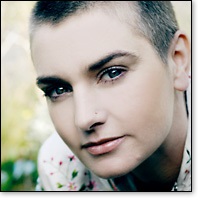
Or something. And God is in all of us, and he doesn't judge. Such is the wobbly theology of Sinead O'Connor, whose new album is being pitched to the Christian market.
Most people remember Sinéad O'Connor one of two ways: as that angelic, lovelorn figure in the video of her smash "Nothing Compares 2 U," or for tearing up a picture of the pope on Saturday Night Live. Her 20-year career has been marked with pop stardom and accolades, but also with controversy and misunderstanding. Even as she takes the stage at Joe's Pub in New York, one can sense the polarity. The venue only seats 150, enough to house a handful of fans and some of the biggest papers in town. But O'Connor, 40, isn't there to impress anyone. Her priority is her new album Theology (Koch), a two-disc set inspired by the Old Testament—and a project that is, interestingly, being pitched to the Christian market by publicists (one of whom arranged this interview). At the show, O'Connor plays none of her hits; it's just her and another guitarist, performing Theology in its entirety. In a flowing red dress, O'Connor looks almost motherly—serene, radiant, self-assured. Her voice is still powerful, and, combined with the ancient text, it's nearly prophetic. But just as the audience begins to heed her admonition, O'Connor, between songs, makes a crude joke about the female anatomy. By show's end and a few f-bombs later, we're all convinced: old Sinéad hasn't gone anywhere.
What's your religious background?
Sinéad O'Connor I was born in 1966 in Ireland, which was at the time a Catholic theocracy, which can sometimes have negative connotations. My family were all strict Catholics—not in a ram-it-down-your-throat way, but in a kind, loving way. So it was a very Catholic upbringing, went to Catholic schools, an extremely religious environment.
Did religion ever become a lifestyle to you, or was it more of a tradition?
O'Connor I would say that I'm religious by culture and nationality. It wasn't that I was dragged to mass; I went willingly because I liked going. Religion is not so much a lifestyle because I don't necessarily actively practice it. I don't go to church regularly, but I don't think you have to in order to conduct a relationship with God. Having said that, I do enjoy the times that I do go to church. I believe you can find God all over the place.
Any reason why you don't attend regularly?
O'Connor I have difficulties with aspects of religion, just as there are things about myself that I like and don't like. I think there's an area of weakness in Catholicism, the way that it's all very hierarchically structured. There isn't equanimity between the audience and the performer, even in the symbolism. In the old days, the mass was conducted in Latin and the priest had his back to the congregation, the idea being that he was somehow leading people to God, while the people were giving their energy to the priest for him to be able to do that. But now when the priest is facing the audience, the symbolism is that the audience is being dictated to and the priest has his back to God.
The hierarchies, not just of Catholicism but a few different religions, see themselves as being above everybody else, which has created this kind of exclusionary thing. The hierarchies are dictating whom God can love and whom God can't love, whom God should love or shouldn't love.
Some faith traditions aren't used to questioning the status quo. Was that the case with Catholicism in Ireland?
O'Connor It wasn't politically correct, because it's a frightening force for some people, a theocratic force. I think people are afraid to challenge it because if they do, they get treated as if they were disrespecting God. You can be misunderstood when you challenge Catholicism, or any religion for that matter. People take it to mean that you don't agree with God or somehow hate religion.
I don't think people have the vocabulary yet to challenge it in a fashion that's not going to appear offensive and disrespectful. I also think that the hierarchy doesn't really give a s---. They don't really want to hear what might serve people better, or what might serve them better as a business.
In Ireland, people felt so let down by the sexual abuse scandals in the church, particularly by how the hierarchy of the church handled that, or rather mishandled it—years of trying to deny that it ever happened, and then years of trying to buy the families to shut them up.
So, many people in Ireland have become very disillusioned with Catholicism. For the most part, they don't believe that Catholicism gives a s--- about them, and therefore they don't give a s--- about Catholicism.
Is that why you ripped up a picture of the pope on Saturday Night Live?
O'Connor Oh, yeah. It only came to light in the States that there had been abuse of children within the church in [the U.S.], ten years after it came to light in Ireland—which was around the time that this happened on Saturday Night Live. Americans couldn't possibly believe that these things were going on in the church.
Article continues below
The problem is that many of the priests think they are God. But God and religion are two different things. I also believe the Catholic church has had a massive crisis of faith for the past 15 years or so. If the priests believed in God and they had done their job right, they would've fessed up immediately about the sexual abuse stuff.
The reason they were afraid to fess up is because they knew their congregations would slaughter them, which means they haven't taught forgiveness—they haven't actually taught the Christian lessons to their own congregations. If they had taught forgiveness and understanding, and really been honest and said, "We f---ed up here, help us out," people would have a lot more respect for them.
If they believed in God, they would've gone through this sexual abuse scandal a lot easier because they would've actually asked and employed God in order to sort things out. So they're still swimming through it with no life support.
OK, let's move on to your new album, Theology. You've recorded pop, folk, reggae, and world music. Why make a religious album now?
O'Connor I wouldn't necessarily call it a religious album. I would say it's a theological album. The record is largely based around the books of the prophets and some Psalms. Loads of different religions yap, yap, yap about God said this, God said that. A lot of people interpret what they think God says. But the only time God actually speaks for himself is in the books of the prophets. That's what kind of interests me. I'm interested in the idea of separating God from religion.
Part of wanting to make a record is that I get pissed off looking around the world and seeing a lot of things that are going on, violent things, particularly because of how a few people interpret particular Scriptures. I don't believe God supports war or the use of violence. I wanted to dig out Scriptures that would show the opposite to be true.
Is Theology a vanity project, a one-off affair? Or have you found your niche?
O'Connor Hard to tell. I don't have any plans beyond Theology. I know it sounds completely corny, but I'm hoping that somehow putting out this record will somehow then open up what I'm going to do. I would actually like to work in the inspirational arena. That's something that I would like to do. But I don't know what's going to happen. [Eventually] I'd like to be writing spiritual songs for other people.
Article continues below
Are you a Christian?
O'Connor Yeah, by birth and by culture.
Is Theology an album for Christians?
O'Connor I wouldn't say it's just for Christians. It's 99.9 percent based in the Old Testament. To say that it's an album for Christians would imply that it's not for other people. But I think it's a record that would appeal to all kinds of religions.
What does Jesus mean to you?
O'Connor I've had a lot of faith in Jesus ever since I was a little kid. I always joke with my friends that I have a cab company called "Jesus Cabs." And I tell my friends, "If you ask Jesus for anything, it will happen. But you have to believe that it's going to happen."
What about now? Where do you stand in your faith in Jesus?
O'Connor I think everybody has an individual relationship with Jesus. I kinda really do believe in this Trinity thing, that God and Jesus and the Holy Spirit are all one thing. I understand Jesus as being an interceder, someone you ask when you really need a big favor from God. I also feel that Jesus is inside everybody. It's almost like an energy or a thing that lives inside of us.
How about his role as a Savior?
O'Connor I grew up in violent circumstances [in a later e-mail, O'Connor clarified that she was abused as a child by a family member], and Jesus was a Savior to me insofar that he would make me forget what was going on. But to say that Jesus is a Savior can sometimes translate as, "Unless people know doctrine, they're not going to be saved." I don't believe that. I believe God loves everybody. And at the end of the day every creation of God goes on to God and his love equally. So I have difficulties with the implication that because somebody on the other side of the world doesn't know Jesus, they don't get saved.
So there's no such thing as Jesus being the one way, truth, and life?
O'Connor I believe that God, Jesus, and the Holy Spirit and that whole kind of thing is one particular energy. If you want a put a picture of a body on it, then fine. But I call it an energy. Some people paint a picture of Jesus. But to me, he's an energy. That energy is the same no matter where you are in the world or whose side you're on. If you call it Allah or you call it God or you call it Buddha, it's all the same. I thing God saves everybody whether they want to be saved or not. So when we die, we're all going home.
Article continues below
So it doesn't matter your lifestyle, we're all going to heaven.
O'Connor Yeah, I don't think God judges anybody. He loves everybody equally. I think there's a slight difference when it comes to very evil people, but there are not too many of those in the world.
God's character is very human; he goes through the whole gamut of emotions that a person might go through.
By human, do you mean fallible?
O'Connor People often say, "If there's a God, why does he let bad things happen?" We expect God to be perfect, but if we're made in God's image, then perhaps God isn't perfect. And that's OK. But I also believe that partly we are God. We are part of God and God is something that's in us and all around us.
Listeners of Christian music have a high moral standard for artists in the genre. Are you ready for that part of this industry?
O'Connor I think everybody knows who I am. I'm not trying to act like I'm a perfect person. I'm not going to be personally insulted if anyone doesn't want to have anything to do with me. If someone turns their back on me because I'm not a perfect person, then it's not my problem. It's their problem. If we're all going to turn their backs because they're not perfect, then we're going to be very lonely.
You have no qualms about swearing or smoking. How do you feel about the prospect of losing the respect of the faith community because of those things?
O'Connor If I did, actually I wouldn't mind, because I'm trying to be myself. God loves everybody the way they are, that's the way I see it. God made me the way I am. If somebody else doesn't like it, it doesn't matter. I could always get a job doing something else. I don't fear poverty.
For more about Sinéad O'Connor, you can read our Glimpse of God piece on her most recent album Theology, by clicking here











 While we pray for peace, we need moral clarity about this war.
 But let’s not mistake it for calling.
 A first cohort of scholars consider whether God is calling them to executive leadership.





