Editor's note: The 2003 film Luther releases to video today. Since Christianity Today magazine already reviewed the film when it hit theaters, we asked Peter Chattaway to compare and contrast three different film versions—from 1953, 1973 and 2003—about the famous Reformer.
It can be very fascinating to see how filmmakers approach the key people and moments of the past—especially when several films are made about the same historical subjects, yet portray those subjects in such vastly different ways. When the films in question are produced decades apart from one another, they become documents not only of the historical eras they explore, but of the times in which they were made. Three films about Martin Luther produced over the past half-century offer an intriguing case in point.
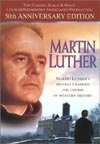
Martin Luther(1953) directed by Irving Pichel
This film, released last year in a 50th-anniversary DVD with a few bonus features, was produced by American Lutherans at the dawn of the Eisenhower era, at a time when films such as The Ten Commandments and A Man Called Peter reflected the heightened religiosity of the United States, and at a time when audiences were willing to be educated about the past, sometimes through films that adopted fairly didactic forms.
To put Luther's story into a broader and perhaps more familiar historical perspective, the film packs in as many references as possible to contemporary persons and events, such as Columbus's recent discovery of America, the painters Michelangelo and Raphael, the martyrdom of Jan Hus a century earlier (as well as the martyrdoms of Wycliffe and others), and the role that Philip Melanchthon played in developing early Lutheran theology.
The film was directed by Irving Pichel, whose next project, Day of Triumph, was the first feature-length film about the life of Christ to be made in English since the silent era. Luther himself is played by Niall MacGinnis, an Irish actor who was evidently good at playing Germans; several years earlier, he had played a Nazi who considers joining the Hutterites in The 49th Parallel. For the most part, MacGinnis's Luther is calm and reassuring, and many scenes and characters exist mainly to give him a chance to spell out his theology.
For example, the film devotes ample time to a debate between Luther and Catholic scholar Johann Eck, which the other films omit. Later, as the Reformation begins, iconoclasts storm into a church, where they are intercepted by Luther; without moving a muscle, Luther stands there and chides the peasants verbally, after which they all lower their eyes, ashamed, and meekly skulk away. When the Peasants War—more on this violent historical episode in a moment—takes place a few years later, Luther gently reprimands his parishioners in a short sermon that makes frequent use of the word "love."
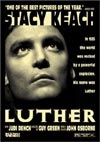
A very different sort of Reformer takes the screen in Luther, Guy Green's 1973 adaptation of the John Osborne play. This film, released as part of a series of adapted plays, came out at a time when filmmakers were questioning the myths and heroes that previous generations had upheld, and it presents a more disturbing version of Luther partly by patterning much of its dialogue after Luther's own writings.
As performed by Stacy Keach, this film's Luther is aggressive and cunning, but deeply conflicted, and the filmmakers are more interested in probing his psychology than in taking a stand for any particular form of theology; a lengthy sequence near the beginning explores Luther's relationship with his father (Patrick Magee), and hints at the effect this may have had on Luther's own ways of looking at God. This film's Luther also refers regularly to flatulence, excrement and outhouses—as indeed the historical Luther did.
The film looks at Luther's life and teachings through the prism of the Peasants War, an uprising that was partly inspired by Luther's opposition to church authorities, yet was stamped out when Luther—who still believed in social and ecclesiastical order, even if he disagreed with the forms they took under Catholicism—called on the German princes to "smite, strangle, and stab" the peasants, "just as when one must kill a mad dog."
At the beginning of the film, an armored peasant (Julian Glover) enters Luther's church, pushing a cart with a dead body, and accuses Luther of causing chaos in Europe while living in comfort with his wife, a former nun (Judi Dench). The peasant then smears blood over Luther's white vestments and says, smugly, "Now you even look like a butcher." Much of the rest of the film is then narrated in flashback from this peasant's point of view.
Osborne's play does not take sides in the dispute between Luther and the Pope, so much as it presents two evils and lets us decide which is the lesser of the two. As seen here, the Catholic Church represents unity and order, but at the cost of complacency and corruption, whereas Luther's Reformation represents intellectual freedom and the right to follow one's conscience, but at the cost of chaos and bloodshed. And right to the very end, Luther is not sure whether he has been doing God's will or only what seemed right to himself.
Article continues below
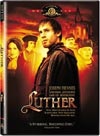
Luther (2003) directed by Eric Till
Fast-forward to the present day, and yet another cinematic take on the monk who changed the course of western civilization.
The latest version of Luther is perhaps the most ecumenical of the films, coming as it does four decades after Vatican II and just a few years after the Catholic Church and the Lutheran World Federation signed a "Joint Declaration on the Doctrine of Justification." It is the only film to make any reference at all to the Greek Orthodox, and thus to those Christians who were entirely uninvolved in the Reformation; and it goes out of its way to present Catholic characters who are at least somewhat sympathetic.
For example, when Johann von Staupitz (Wings of Desire's Bruno Ganz) releases Luther from the Augustinian order to which they belong, he frantically explains that he is doing this to save Luther's life; if Luther had remained under his authority, von Staupitz says he would have been obliged to turn him over. In contrast, when von Staupitz expels Luther in the 1953 film, he gives Luther a stern reprimand for disgracing their order.
Similarly, Cardinal Cajetan (Mathieu Carrière) gives Luther an impassioned defense of the need for Christian unity, and after Leo X dies, he privately confides to a fellow church hierarch that he wishes the Pope had been the sort of "spiritual giant" that Luther was; this is quite different from the equivalent figure in the 1973 film, who seems all too ready to accept the immorality, sexual and otherwise, that flourishes among the bishops.
The 2003 film is also more entertaining, for lack of a better word, than the other Luther films produced so far. Directed by Eric Till (whose resume includes everything from Bonhoeffer: Agent of Grace to the Canadian TV spin-off Red Green's Duct Tape Forever) from a script by Camille Thomasson and Bart Gavigan, this film emphasizes action, action, action—characters often run to and fro, Pope Julius II is seen riding a horse through Rome in gilded armor, and Pope Leo X takes part in a conspicuously metaphorical boar hunt.
The constant movement spills over into the film's portrayal of Luther himself. The film begins with Luther's panicked promise to become a monk if he survives a lightning storm, and Luther's paranoia and possible epileptic seizures are intensified by Till's use of tight close-ups and restless camerawork. In addition, in one of the DVD bonus features, Joseph Fiennes (Shakespeare in Love) says he tried to emphasize Luther's doubts.
Article continues below
Despite all this, the new film does go out of its way to protect Luther's heroic stature; he may have his demons, but he never does anything particularly bad. Tellingly, the film alludes to the coarseness of German culture but puts the vulgar or scatological comments in the mouths of others, not Luther; and while the film admits that Luther played a part in the Peasants War, it softens his role in that conflict, as he mourns the bloodshed and wishes that both sides were not so prone to misunderstanding his message.
The end titles tell us that Luther paved the way for "religious freedom," but this is a remarkably misleading note on which to conclude the story, for two reasons. First, Luther's emphasis on personal conscience over traditional doctrine helped pave the way for the individualism and heightened skepticism of the modern era. (Indeed, Luther himself challenged the canonicity of the Epistle of James and a few other Scriptures.)
Second, the historical Luther did not want to achieve "freedom," but to reform the Church, and by the time of the Augsburg Confession in 1530, with which this film ends, he had already begun to denounce fellow Protestants, such as the Zwinglians and Anabaptists, who disagreed with him on various teachings.
Luther and the movement he founded were full of such contradictions, but, just as earlier films picked and chose those parts of his story that either built up the faith of Protestants or challenged their assumptions, the new film aims to affirm the tolerance and diversity of our own times. Each generation, it seems, gets the Luther that it needs.












 While we pray for peace, we need moral clarity about this war.
 How Jesus rescued a New Age psychic from spiritual darkness.
 The surprising argument that Saul of Tarsus was born into bondage.