A new documentary depicts charismatic kids who are articulate and take faith seriously. But have they been "indoctrinated"? Is it a fair representation of evangelicals? Or too political? We asked the directors.
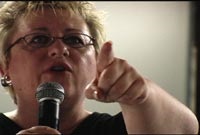
The children who go to Becky Fischer's Kids on Fire summer camp may be too young to vote, but they're hardly politically unaware. In addition to the usual praise and worship at their Pentecostal services, the children offer prayers for President George W. Bush—by actually laying hands on a life-size cardboard cut-out—and burst into tears while asking God to fill the U.S. Supreme Court with "righteous judges."
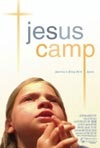
Jesus Camp, a new documentary about Fischer's camp, opens this week in several U.S. cities, and will expand in the weeks ahead. The film made news last month when Magnolia Pictures acquired distribution rights to the film and tried to have it yanked at the last minute from Michael Moore's Traverse City Film Festival; the distributor said it wanted conservative evangelicals to see the film, and did not want the film to be tainted in their eyes by association with a liberal like Moore.
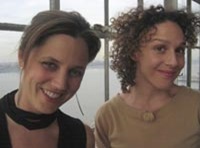
Directors Heidi Ewing and Rachel Grady
Similarly, filmmakers Heidi Ewing and Rachel Grady—whose previous film, the award-winning The Boys of Baraka, concerned inner-city kids from Baltimore who attend a school in Africa—say they say they have tried to be as objective as possible with Jesus Camp, and to let the campers and the film's other characters speak for themselves. These include National Association of Evangelicals president Ted Haggard and liberal Christian talk-show host Mike Papantonio; Fischer herself has already endorsed the film.
The filmmakers spoke to Christianity Today Movies from their office in New York City.
You seem to have a thing for movies about precocious kids.
Ewing: Kids are great subjects, because they're honest and they're extremely candid, and usually they are not as self-conscious when it comes to the camera. It's not just that we want to make films about children, by any means, but it's wonderful to have children as subjects in films, for that reason.
Were you initially looking to make another movie about kids, or were you looking more for a political subject, and the kids camp just happened to be a way to get into that?
Grady: Actually, we were looking for a film that focused on children and faith, and we were inspired by Devon Brown, who was in The Boys of Baraka. Neither of us had ever met a child that was so devoted and focused on his church, and it just made us think, Are there other kids out there like this? So initially, we weren't looking for a film that focused on even the evangelical movement in general; we were looking for a film that would focus on children and faith in a general way. But when we found Becky Fischer's camp, the film took a different turn.
Ewing: And even after we found the camp, the events that transpired in the country while we were shooting—namely the nomination and confirmation of two different Supreme Court justices—that really was an event that the people in our film and the evangelical community at large were really chattering about. To ignore the political seemed almost irresponsible as filmmakers, and so the film definitely started to take a much more political turn when the people in our film brought the political into the religious in the churches. So that just sort of naturally occurred.
Grady: We just lucked out, really. We were looking for some sort of place where children that were seeking a more deep faith would go, such as a camp or a school, and basically stumbled upon her website and found it fascinating. Heidi reached out to her, and we went and met her and interviewed her and filmed her working with the kids in her community, and we thought we had a movie.
Ewing: And even before we ran across her website, I had been making some phone calls to different evangelical churches, asking about their children's programs, and her name actually came up a few times: "Oh, you should talk to Becky Fischer."
You talk about the range of evangelicals you came across. Would Mike Papantonio [a radio talk-show host who appears throughout the film, and at one point debates Fischer] self-identify as an evangelical?
Grady: No, he's not evangelical. He's a Methodist, he goes to a mainline church, but he's quite devoted to his church.
Did you try to contact, shall we say, liberal evangelicals—people like Jim Wallis or somebody like that—to set up a dialectic within the evangelical community, instead of between evangelicals and non-evangelicals?
Grady: Well, we definitely wanted to have a conversation within the Christian community at large, maybe evangelical or people who hail from the mainstream or mainline religious affiliation. We definitely felt like we wanted to have that dialogue. We ended up, I guess you would say, "casting" Mike, because he is a radio personality, and we already had the radio device going in the film. So for us it was very organic and it made sense, creatively. It wasn't forced.
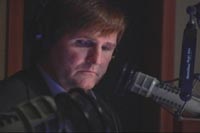
Radio host Mike Papantonio
Ewing: We also didn't want to set up some kind of talking-head, point counter-point, in the film; that's not the style of film we make. But I feel that Mike was a good choice because he echoes what a lot of liberal evangelicals have said about the politicization of the evangelical movement. And of course we follow the liberal evangelicals as they have slowly started to come out, publicly—and there's not that many, in the press—and say that they're uncomfortable with the political nature of the evangelical movement.
Article continues below
While Mike is not officially a born-again Christian, he does echo a lot of the concerns that these gentlemen have, and we thought this was a more creative way to vent those concerns, because he is a Christian. He just thinks that the politicization of the church is going to be the downfall of it, and he doesn't like that association. So officially, no, he's not a born-again, but he does, I think, speak very well for the concerns of Christians that don't like the political nature of the evangelical movement, or at least of the far right part of that movement.
One reason I ask is because one online columnist, in an item on Jesus Camp, said, "Does anyone know an evangelical who voted for John Kerry?" Well, I do. So this film may perpetuate a certain stereotype?
Ewing: But really, Peter, if you look at the numbers, the vast majority vote Republican. So to find the needle in the haystack, you know, I don't know if that's our responsibility. I don't know if that's very accurate, to portray that there's a lot of liberal evangelical Christians that vote Democratic, either. If you look at the numbers, conservative people, religious, will usually vote conservative politics.
Grady: And there's nothing wrong with that.
Ewing: No!
Grady: And I don't think that's even Mike Papantonio's beef. I think his concern is that the church is not the place to be having those conversations.
Ewing: And he doesn't think that a religious group should be affiliated with a political party either. So I think right now, people definitely see the two as hand-in-hand, and I'm kind of glad to see that some evangelicals are coming out and going against the grain and saying, "You know what? We're not all in agreement." But that is sort of a newer trend of pastors who have the courage to come out publicly and speak out against this giant behemoth.
Grady: And in fact, when they do speak out [as GregBoyd recently did], it gets on the cover of the New York Times, because it's unusual. But I think it's part of a general trend that's happening in this country, and I think that our film happens to have good timing. Hopefully it'll ride the wave of this conversation and will be a catalyst for more conversation, amongst all Christians.
Article continues below
What about the criticism that some have made, that the film, by focusing on Becky Fischer and her community, focuses on a more extreme form of evangelicalism? For example, she tells the children that Harry Potter is evil, but many evangelicals have openly said that the Potter books are good?
Ewing: I think it's hard, as a filmmaker, to be all things to all people, and we look for compelling stories, smaller stories that can help tell a greater story. We look for compelling characters who are articulate and fascinating. And we were interested in what Becky was doing. We identify her as a Pentecostal, and I think it's impossible to make a film that represents all Christians. I just think that that's a criticism that we're going to get, regardless.
The Harry Potter issue? We heard a lot about that, actually. We listened to a lot of Christian radio programs. I think I even heard on the Dobson program once, and American Family Radio, conversations about Harry Potter being a real big issue. So it wasn't just in Becky's church that we had heard this criticism of Harry Potter. And of course not all Christians feel that way, but the Christians in our films do. It was something the kids were often talking about, and it was sort of like forbidden fruit, so we wanted to include that.
Grady: And also, that's why it was important to us to include a figure like Ted Haggard, who really represents the more mainstream evangelicals. And obviously as the head of the National Association of Evangelicals, he represents a large chunk of the community. And the people in our film are constituents of him, so there is a connection.
Nine-year-old Tory Binger lets the tears flow
Did anything that happened on camera catch you by surprise, for example, the speaking in tongues?
Grady: It's one of those things that is sort of surprising initially, and you get used to it very quickly. Heidi and I have both filmed spiritual ceremonies of all different kinds of religions. Heidi made a film where they do body piercing and things that are much more shocking, really. But I guess it became a little more exotic because we had never seen Americans being so devout and so charismatic in their worship. But it's one of those things. It wears away very quickly, and I think both of us feel that everyone is entitled to worship however they want. I don't judge anyone for how they want to express their faith.
Ewing: We had a lot more scenes like that, that focused more on the practice of the charismatic faith. And we started to shy away from including a lot of details and explanation of all of these things, because we didn't want to marginalize charismatics. But again, it's just a practice. In the end, they all believe in the same Bible and they all listen to the same radio and read the same publications as evangelicals who don't speak in tongues, so we felt like they had a lot more in common with the greater evangelical movement than they didn't. That's why we didn't start focusing on a lot of their differences.
Article continues below
We actually kind of held back on some of the material we had, that might distract people and confuse people and freak people out too much. We felt that we actually toned it down a bit.
Some of the kids talk about what's fulfilling in life and what's not fulfilling; do you think they have any valid critiques of our society, or do you think they have just been "indoctrinated"?
Nine-year-old Rachael Elhart is one of the featured kids
Grady: The kids that we focused on are, I think, too young right now for us to answer that. Two of the kids are nine, and one is a 12-year-old boy. We have a scene in the film where one of the kids is describing the majority of society as being trashy. I think we need to wait 10 or 20 years to see what he has to say about society. I think at this point, all 12-year-olds or nine-year-olds repeat what their parents tell them. I did.
Ewing: At the same time, I did notice some very admirable qualities to the children in our film. They're extremely articulate, they're smart, and they do good things for other people. They think about others, and they lack vanity I've seen in other kids. So on one hand, they're being raised very well. And it's complicated, because one might not agree with the adult that this person might become, or the direction this child is going. However, as children, they're extremely pleasant, and have a lot of things going for them. So I think, again, this whole film falls into a really big grey area. Which is what I think makes it a good movie.
American Bible Society study finds majority don’t trust technology with spiritual matters.
Adam MacInnis
On Fire at Jesus Camp
1 of 6
Directors Heidi Ewing and Rachel GradyPentecostal children's minister Becky FischerRadio host Mike PapantonioNine-year-old Tory Binger lets the tears flowNine-year-old Rachael Elhart is one of the featured kids














 While we pray for peace, we need moral clarity about this war.
 Alcoholism among women is rising. Can the church help?
 American Bible Society study finds majority don’t trust technology with spiritual matters.