Imagine picking up the morning paper and reading this headline: "U.S., Iraqi Soldiers Lay Down Weapons in Day-Long Ceasefire." You learn that this truce was not ordered from on high, but initiated by the soldiers themselves, who actually put down their guns and approached each other with gestures of peace. They put their mistrust aside and shared coffee, chocolates, and cigarettes, looked at family photos, and even played soccer, right there on the desert sand.
You can't believe what you're reading.
Nor could people believe it almost a century ago when such an event actually did occur in the midst of arguably the most hellacious combat in history: World War I. It was 1914 in German-occupied France. The invading army and the Allies were literally dug into trenches, sometimes just 20 feet apart. To raise your head above the sandbags was to risk having it blown off. The opposing soldiers could hear one another, and, if they dared, even look into each other's eyes. Separating the two trenches was a small patch of earth dubbed No Man's Land—littered with shells, shrapnel, and the corpses of the slain.
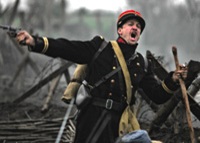
Guillaume Canet as Audebert, the French lieutenant
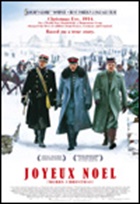
Such is the landscape in which Joyeux Noël (French for Merry Christmas) takes place. Nominated for an Oscar for Best Foreign Film, it's the true story of that Christmas cease-fire, when men on both sides really did lay down their weapons and fraternize with each other.
Several years ago, I was spellbound by Stanley Weintraub's Silent Night: The Story of the World War I Christmas Truce. It seems like the stuff of urban legend, but it really happened. It also seems like it can only be explained as "a God thing," and indeed, how else could something so extraordinary take place without divine intervention?
When putting together the story for Joyeux Noël, writer/director Christian Carion—who grew up in France near where the truce took place—said "the tricky part of writing the script was how to make the viewer believe that these incredible events were true." But after doing exhaustive research, Carion had himself a story—and now the world has been treated to a soul-stirring feature film.
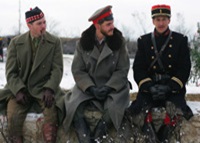
The three lieutenants—Scottish, German, and French—discuss the truce
In Joyeux Noël, we meet key characters on all sides of the story—a pair of Scottish brothers and their parish priest, who accompanies the boys to the front lines; the three field lieutenants for the Scottish, French and German battalions; and, interestingly, a German tenor and a Danish soprano who'd met and fallen in love through pre-war opera performances.
The soprano may have been a fictional addition for the film, but there really was a German tenor who played a vital role in the story. German emperor Kaiser William II had ordered thousands of Christmas trees sent to the front lines to boost the men's morale. On Christmas Eve, they placed the trees, with candles lit, in parapets atop the trenches, in clear sight of the enemy. And then—in the film and in the true story—the tenor, an enlisted man who'd been fighting alongside his comrades, began singing "Schtille Nacht" ("Silent Night"). The Allied troops obviously knew the tune, and soon, all sides joined in on the singing from their trenches, each in their own language. Soon, men were climbing out of their earthen dugouts, sans weapons, and toward one another—toward the enemy!—to join together in celebrating the birth of a Savior they all had in common, politics and the war be hanged.
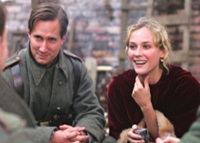
In Joyeux Noël, arrangements are made for the soprano, Anna Sörenson (Diane Kruger of Troy and National Treasure), to join her beau in singing to the men on the front lines—a twist that seems far-fetched even in this unbelievable tale. Kruger's role adds nothing to the story, and her lip-synching is terrible. Fortunately, the actual singing, by French soprano Natalie Dessay, is glorious, as is the voice provided for the tenor by Mexican opera star Rolando Villazon.
The men playing the three lieutenants—Guillame Canet as Audebert, the Frenchman; Daniel Brühl as Horstmayer, the German; and Alex Ferns as Gordon, the Scot—are well-cast, especially Canet, whose character tries to courageously lead his men despite his fears—and his longing to be home with his pregnant wife.
Benno Furmann as a German tenor and Diane Kruger as a Danis soprano
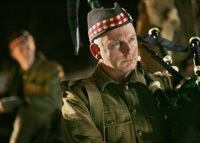
But the film's key character is Palmer, the Scottish priest. Gary Lewis brings a quiet strength and calmness to the role—just the traits you'd want from a spiritual leader on the front lines.
Palmer is at the heart of the film's most powerful scene when he leads a Christmas Eve mass for all of the gathered men—French, Scottish, German. After Anna sings "Ave Maria," Palmer begins the mass in Latin, and the camera pans across the soldiers' solemn faces as they respond in the ancient tongue.
Afterward, Palmer asks Gordon, the Scottish lieutenant, what he put in his report to HQ regarding the day's remarkable events. Gordon replies, deadpan, "I wrote, '24th of December, 1914. No hostilities from the German side tonight.'"
Palmer, a twinkle in his eye, pauses a moment to take in the magnitude of that understatement, then says, "Well that's the truth. Tonight, these men were drawn to that altar like it was a fire in the middle of winter. Even those who aren't devout came to warm themselves, maybe just to be together, maybe just to forget about the war."
Article continues below
Gordon replies, "The war won't forget us." Indeed, hostilities resumed right after Christmas. Men who had shared cigarettes, chocolate and cognac—and laughter and tears—began shooting at each other again. Four years later, the war ended with 8.5 million dead, and almost thrice that many wounded.
And it would be years before the Christmas Truce would be remembered as an event to celebrate. Generals on all sides were outraged. Many who had taken part in the truce were taken off the front lines, reassigned, or even court-martialed. Many were called cowards for fraternizing with the enemy.
Gary Lewis as Palmer, the Scottish priest
After the truce, Palmer is shown tending to the wounded behind the lines. His bishop arrives to tell Palmer he's being sent back to his parish in Scotland. Palmer replies: "I belong with those who are in pain and have lost the faith. I belong here." The bishop says that when Palmer had requested permission to be with the boys from his parish on the front lines, "I personally vouched for you. But then, I heard what had happened, I prayed for you"—indicating his indignation that Palmer had consorted with the enemy.
Palmer, taken aback, says, "I sincerely believe that our Lord Jesus Christ came to me in what was the most important Mass of my life. I tried to be true to his trust, and carry his message to all, whoever they may be."
What follows is an interesting exchange—loaded with theological implications—between Palmer and the bishop. We won't give away the substance of it here, but it's worth paying close attention. After that exchange, the bishop stalks off to address "the soldiers who are replacing those who went astray with you. May our Lord Jesus Christ guide your steps back to the straight and narrow path." Palmer retorts, "Is that truly the path of our Lord?"
Writer/director Carion might ask the same question, noting that he often thought about "the soldiers who courageously fraternized. At the time, they were considered cowards. For me, they were neither heroes nor cowards. They were merely men who accomplished something incredibly human."
Incredibly human? Perhaps. But not without a touch of the incredibly divine.
Article continues below
Talk About It
Discussion starters
Do you find this story believable? Why or why not? Do you think it could happen today, in modern warfare, perhaps even in Iraq? Why or why not?
Do you think the men from these armies hated each other while they were fighting? Did they simply stop hating during the truce? Many called them "cowards" for fraternizing with the enemy. What do you think?
Talk about places where you saw God "show up" in this film. What parts of the movie do you think could only be attributed to divine intervention?
When the dead soldiers are buried on Christmas Day, the Scottish lieutenant says it's fitting that the burials would occur on the same day Christ was born. What did he mean? Do you agree?
In the bishop's sermon to the replacement soldiers at the end of the film, he called it a "crusade, a holy war," saying the Germans are not "children of God" and even calling for the killing of all Germans. What do you think? Discuss.
Were the Germans soldiers themselves "evil"? After all, they were invading non-hostile countries and killing innocent civilians. If the soldiers weren't evil, then who, if anyone, was? Is it evil to kill someone who invades your country, in self-defense? Why or why not?
What do you think happened to Palmer, the Scottish priest, after this story ended?
The Family Corner
For parents to consider
Joyeux Noel is rated PG-13 for war violence and a brief scene of sexuality/nudity. The violence is not very graphic, compared to most contemporary war movies. There are a few relatively tame curse words. The brief scene (less than a minute) of sexuality/nudity shows a couple making love, and includes a very brief glimpse of a woman's bare breast, mostly hidden in shadow.
Joyeux Noël, a French film written and directed by Christian Carion, was nominated for Best Foreign Film at the recent Academy Awards. The movie brings to life the astonishing story of a Christmas Eve truce struck between armies in World War I.
Mainstream critics are mostly positive, although a few that feel compelled to lob grenades.
The rage of the mob is a poor substitute for real community.
Russell Moore
Joyeux Noël
1 of 4
Guillaume Canet as Audebert, the French lieutenantThe three lieutenants—Scottish, German, and French—discuss the truceBenno Furmann as a German tenor and Diane Kruger as a Danis sopranoGary Lewis as Palmer, the Scottish priest













 While we pray for peace, we need moral clarity about this war.
 We’ve got little information on Jesus’ appearance and personality. But that’s the way God designed it.españolFrançais
 The rage of the mob is a poor substitute for real community.