The Brits have an odd celebration on the fifth of November called Guy Fawkes Night (alternatively known as Bonfire Night), which commemorates the so-called Gunpowder Plot in 1605, a failed attempt to blow up Parliament and assassinate King James I. Fawkes and his co-conspirators were thwarted, executed for treason and attempted murder, but his legacy lives on through what some describe as the British equivalent to Independence Day in America.
For most, Guy Fawkes Night is an excuse for fireworks, serving as a testament to the defeat of terrorism. Others, however, feel it celebrates terrorism, and more cynical celebrants view Fawkes as a hero and excuse for doing away with politicians; the public even voted the man into the BBC's 2002 list of the 100 Greatest Britons. Four centuries later, V for Vendetta seems poised to cause a similar stir of mixed reactions—an impressive fireworks display with anti-government sentiments.
Natalie Portman as Evey
The film's story takes place roughly twenty years from now. Britain has transformed from monarchy to a 1984-styled totalitarian regime led by Adam Sutler (John Hurt resembling Hitler). Society is ruled with an iron fist of fear. Art and self-expression are censored. Homosexuals, minorities, and Muslims are shipped off to internment camps. Nightly curfews are enforced by corrupt secret police. Even real butter is saved for the rich and elite.
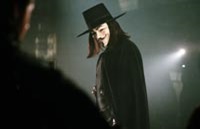
But the social climate is changed dramatically on November 5, when a mysterious dark avenger wearing a Fawkes mask and going by the codename V (Hugo Weaving) introduces himself to the public through a bombing complete with fireworks and the "1812 Overture." The next day, V appears on a television broadcast, encouraging the people of Britain to rise up against their oppressors by joining him to witness the destruction of Parliament on Guy Fawkes Night the following year. In the months that follow, V begins to knock off various heads of state, while law enforcement—led by detective Finch (Stephen Rea)—attempt to uncover a pattern in the deaths that might lead to the vigilante's identity before the bomb threat is carried out.
Caught in the middle of all this is Evey (Natalie Portman), a young television production assistant rescued by V when police catch her outside past curfew. Turns out that Evey has a shady past of her own, and she soon finds herself a fugitive. After aiding V in turn when he raids her workplace, she's forced to seek refuge in his Shadow Gallery, an underground cultural repository filled with media and artifacts reclaimed from the government censors. Evey finds herself drawn to V's incredible charm, yet also fearful of his dark plans and slightly mad persona, unsure whether to trust his hospitality or to escape and foil his plans.
Evey experiences a few close shaves in the film, none closer than this one
Alan Moore wrote the original graphic novel in the '80s as a response to Margaret Thatcher conservatism, and in time it has become regarded as a classic. Ten years later, Andy and Larry Wachowski adapted it into a screenplay, only to get sidetracked with The Matrix trilogy before they could film it. Having temporarily satisfied their desire to direct, the Wachowskis handed the reigns to James McTeigue (their assistant director from The Matrix movies), content to oversee V for Vendetta as the film's producers.
It's all still very much from the makers of The Matrix, retaining some of the Wachowskis' famed visual flair while staying true to the spirit of the graphic novel. Moore had his name removed from the project, understandably wary of Hollywood after the poor adaptation of another of his works, The League of Extraordinary Gentlemen. But Moore should be proud of this one. The Wachowskis have made the story more cohesive by smoothing out some of the details and clarifying some of the more abstract themes, while also punching up the dialogue with more heart and humor. V and Evey share some wonderful exchanges together, and V's alliteration-heavy introduction is a nice touch that instantly reveals him as both appealing and unhinged.
The filmmakers also pull some strong performances from the leads. Portman shows impressive emotional range as always, fully committing herself to a role so clearly outlined in the source material—including the much-publicized onscreen head shaving. Weaving also pulls off a difficult part, forced to act behind a mask for most of the film, yet infusing the part with plenty of charisma through gestures and his melodious voice. And it's great to see Rea back in action, perfectly playing the skeptical, world-weary cop with sad eyes and patient demeanor.
Hugo Weaving as V, the man in the mask
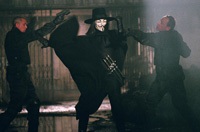
What's most striking about V for Vendetta is how it favors thought-provoking dialogue and ideas over non-stop, sloppy action. For sure, there are some cool sequences, particularly a bloody slow-motion fight between V and a dozen soldiers that recalls the famed lobby scene from The Matrix. But like that film, this movie relies on a lot of explanation and pontification, primarily focused on the mystery of V's past and the nature of true freedom against the backdrop of political repression. Some sequences of dialogue resemble King Arthur's discussion of politics with Dennis in Monty Python and the Holy Grail (i.e., long, dry, and tiresome), but there are also flashes of wit and brilliance. This is a comic book film that is refreshingly intelligent, relying on poetry and literary dialogue for thrills as much villain-busting action.
Article continues below
Sadly, the movie also comes off as misguided. What are we to take from this story? Social injustice and denial of human rights are indeed wrong, but do the creators honestly believe that conservatism is the start of a short path to fascism? Are we really one step away from sending minorities and homosexuals off to death camps? Do they really believe democratic governments would covertly inflict a plague upon schoolchildren to incite fear and provide cause for militia rule? Apparently so, as the Wachowskis have added small references to wire-tapping, avian flu, "rendition," homeland security, and Abu Ghraib-styled black hoods to loosely connect the story to current events.
Especially frustrating are the numerous cheap shots at Christianity, clearly seen as part of the oppressive force. The motto of Sutler's government is, "Strength through unity, unity through faith," its symbol a modified crucifix. Sutler himself is described a man with deep religious convictions who rose to power with the iron fist of fear. At the film's start is a completely unsympathetic, rabid television pundit that's part Bill O'Reilly, part Pat Robertson, viscously blaming society's problems on godlessness and lack of religion. Oh, and then there's the timeworn cliché of the high-ranking official who also happens to be a pedophile priest who likes to play "confession" with little girls.
V kicks some Brit bum, but this isn't primarily an action film
We might all feel differently if Nazis really did have a stranglehold on our society, but is violent anarchy really the answer—correcting one extreme with another? V for Vendetta seems to be equating "terrorist" with "revolutionary," and despite some small attempts in the script intended to show V as morally ambiguous, the reality is that he's still depicted as the charming and sympathetic hero whose courageous actions we are to embrace at the film's end. It's surprising in this post-9/11 that the film actually tries to win over the audience by standing up for Muslim terrorists, defending the Koran, and instilling the belief that the destruction of an important building can serve as the catalyst for change.
Article continues below
It's unfortunate, because the film has much to admire and enjoy, but what could have been a meaningful parable about individual freedoms comes off as heavy-handed politicizing that doesn't quite add up. Though the film will earn its fans, many will go in expecting to be entertained by action, only to leave feeling vilified by thin propaganda. V for Vendetta may not exactly deliver what it advertises, but it does stay true to its title.
Talk About It
Discussion starters
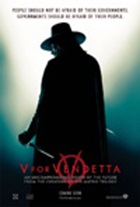
V tells Evey that people shouldn't be afraid of their governments, but rather that governments should be afraid of their people. Do you agree? Why or why not?
The totalitarian Britain depicted in the film clearly needs reform. Is violence a necessary tool for instigating change in such a society? What's the difference between a terrorist and a revolutionary?
What do you suppose is meant by the phrase, "God is in the rain," in the film? Do you feel it's more in keeping with Christian beliefs or other religions?
Consider the growth of Evey's character. How is she able to overcome fear to become stronger? What keeps her going when she is imprisoned? Is this similar or different to a Christian's transformation in spirit? Do we find strength from brokenness in the same way?
Is V's quest for justice justified by any means? Why or why not? What are some alternative plans he could have enacted?
Do you agree with the political suppositions of the graphic novel and film? Are our democratic societies on the path to oppression and totalitarianism?
The Family Corner
For parents to consider
V for Vendetta does include some language, but primarily earns its R rating for a few scenes of strong violence, primarily the bloody results of V's proficiency with knives and swords. Though based on a "comic book," this is not a movie for kids. It's clearly geared to adults considering the political themes and adult situations rooted in social injustice, prostitution, homosexuality, and death camps. Kids would likely be bored with this film's emphasis on dialogue over action anyway.
Does "V" stand for "victory," "virtue," or "vile" and "vapid"?
Article continues below
Some members of the Christian media are treating V for Vendetta as an offensive and "vile" piece of work, while others are celebrating it as a film about moral responsibility, featuring an inspirational Christ figure. Who's right?
There's no denying that the plot is made of volatile elements. The famed graphic novel by Alan Moore and David Lloyd was composed as a fantasy commenting on the policies of British prime minister Margaret Thatcher in the 1980s. But Larry and Andy Wachowski have joined with newcomer James McTeigue to update the story—and their revisions have resulted in a subversive, dangerous tale.
V, the rebellious hero played by Hugo Weaving (The Matrix, The Lord of the Rings), is winning viewers' affections by lashing out against this fascist authority. Donning a Guy Fawkes mask, he strikes back at the empire, using knives and explosives. Natalie Portman portrays the disillusioned citizen who just might learn to be a terrorist herself, and together they aim higher and higher, until London's Parliament building becomes their ultimate target.
Liberation stories are usually cause for celebration. And the government in this fantasy is certainly oppressive and cruel, practically begging its citizens to revolt. But these heroes are awfully quick to embrace violence, without much talk about other forms of protest. Should this behavior be encouraged? (Vendetta's filmmakers sidestep the issue of whether bombing buildings might claim innocent lives.)
Many critics defend Vendetta as a timeless sci-fi tale, and it does have the basic structure of a myth about the consequences of oppression. But the filmmakers have gone to too much trouble to make it clear who they hate and what they want viewers to do about it. Can we agree with the storytellers, that fascism is evil, even if it is carried out under the sign of the cross? Sure. But are they guilty of encouraging their own brand of intolerance? Absolutely.
Vendetta's storytellers associate their villains with resistance to Islam, with enforcement of "homeland security," and with objections to homosexuality. It leaves no middle ground: If you are associated with these things, Vendetta implies that you are also in favor of censorship, bigotry, hate, torture, and Holocaust-style executions. While it isn't hard to find evidence of abuses of power in today's democratic governments, it's a bit of a stretch to compare England and the U.S. with the Nazis, and to suggest that we're just a hair's breadth from routinely executing those who are not conservative Republicans.
Article continues below
If you're bracing for the May release of The Da Vinci Code, which portrays the church as a conspiracy to dupe humanity, well, this V beats Da Vinci to the punch, revealing the church as a partner-in-crime with a devilish government. And, of course, the bishop is reveling in pedophilia behind the scenes. Here's another film campaigning for "tolerance" while it wants us to believe that unfortunate exceptions are, in fact the rule. It reinforces cruel caricatures and throws fuel on the fire of intolerance toward Christians. There is no attempt made to suggest that Christianity might be, at heart, about something more desirable than oppression and sexual prejudice.
Is it a coincidence that V's Zorro-like signature looks suspiciously like an inverted version of the symbol for anarchy?
Catholic film critic Steven D. Greydanus (Decent Films) gives the film an "F," saying it's "ironic that a story that romanticizes a Catholic extremist's acts against an anti-Catholic regime would itself be so anti-Catholic … Is V a terrorist or a freedom fighter? I don't really care enough to debate the point. Let's just say the prospect of a guy in a mask bent on blowing up historic London landmarks to score political points against an evil Christian government guilty of oppressing Muslims doesn't make me feel much like cheering."
But another Catholic film critic, Harry Forbes (Catholic News Service), defends the film, calling it "a reasonably intelligent political allegory, the usual improbabilities aside, with emphasis on character development, ideas, and even a bit of romance, not mindless violence. The vigilante exploits are handled with relative restraint given the genre. … Though vengeance is, of course, unequivocally incompatible with Catholic teaching, the film makes clear that every one of V's victims was, at least, a perpetrator of some heinous action. V is, at heart, a high-tech Zorro or Robin Hood."
He acknowledges that the film is somewhat critical of "America's war," but adds, "[D]espite the subtext, this is very much a fantasy world." Overall, he says, the film is "absorbing" and it "stops short of imparting a universal anti-authoritarian message."
Article continues below
Adam R. Holz (Plugged In) is not so impressed. "At the highest level, Vendetta's prevailing theme of overthrowing—what is by everyone's definition—oppression is a cause most would agree is a worthy one. But below the surface lurk some troubling questions. Levelheaded moviegoers will not, of course, imitate the violent acts they see here. Nevertheless, V makes blowing up buildings look very cool and very justifiable. It's hard to measure or predict the impact such images and ideas might have in today's culture, where blasting buildings to make political statements has become a raw reality."
He adds, "Vendetta not-so-subtly implies that our current government is on course to end up like the one in the film." And he concludes, "They suggest … that the presence of religious people in government necessarily results in abuses such as the murder of homosexuals and people of other belief systems in the name of security."
Michael Karounos (Christian Spotlight) writes, "The movie is preachy to say the least, and harps on three major themes and one minor one: 1) the evil of America; 2) the government control of media; 3) the evil of Christianity; and 4) the innocence of Islam."
He addresses these themes one by one, saying, "What is remarkable about such Leftist fantasies about the presumed guilt of the United States is that all of those evils are in existence today and employed by regimes which were enemies of the United States, such as Saddam Hussein's Iraq."
Maurice Broaddus (Hollywood Jesus) identifies V as "a Christ figure … a person of judgment … and compassion, who calls for a revolution in living and thought." He concludes, "V for Vendetta is so literate, with such a powerful use of language … this easily felt like one of the best movies I ever read. … I don't know if the subversive message of a harlequin terrorist will resonate with an audience; however, anarchy has always been fashionable."
Similarly, Matthew Hill (at the same site) also compares V to Christ: "Not just the Christ of the WWJD bracelets or fish bumper stickers, but the radical, world-changing Christ who was put to death for who he was … but it was all part of his plan, see, like V's dominoes, to create even more radical, world-changing people to be part of his revolution."
But James Harleman (also on that site) had a different view: "The changes to Moore's tale involving how the evil government comes to power seem like obviously shoe-horned critiques against the current U.S. administration, perhaps even playing off the modern myth that the terrorist attacks on 9/11 were staged. While I'm certainly not opposed to intelligent criticism of this or any administration, this imposition and others on the story just seem to distract us from the tale itself."
Article continues below
Matt Wiggins (Relevant) says McTeigue has made "an ambitious movie that does many things very well but falls flat in the emotional aspect. It is a movie that will divide audiences but, more importantly, it will force them to ask questions. It is one of those movies that calls us to greater awareness of and participation in the forces that drive our lives. If nothing else, this makes it a movie worth watching."
Andrew Coffin (World) writes, "Originally conceived as an extreme, anarchistic response to an extreme, fascist government in the near future, V for Vendetta has been translated, with a terrorist hero at its center, into a vicious, thinly veiled attack on American conservatives and Christians."
Natalie Portman as EveyEvey experiences a few close shaves in the film, none closer than this oneHugo Weaving as V, the man in the maskV kicks some Brit bum, but this isn't primarily an action film















 While we pray for peace, we need moral clarity about this war.
 We’ve got little information on Jesus’ appearance and personality. But that’s the way God designed it.españolFrançais
 How groups like Hillsong learned to let go of the literal in favor of creative collaboration.españolPortuguês