The Number 23 should be a provocative psychological thriller. It should be a good movie. It has an intriguingly creepy premise. It has a stylized (albeit disjointed and inconsistent) look and tone. And it has good performances—especially by Jim Carrey in his first dark, thriller role. You want to like it as you watch it.
But when it's all over, it's ultimately unsatisfying. It's not that the film lacks anything. But in fact, it's the opposite. It has too much. Of everything. Directed by Joel Schumacher (Phone Booth, Batman & Robin), The Number 23 tries to carry too many themes, fit into too many genres and tell too many stories. Its promise is drowned out by a din of various themes, moods and storylines. Its thrills and tension are dampened by boring scenes of too much talking and repetition.
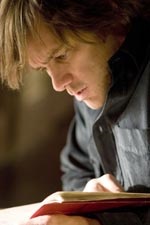
Jim Carrey as Walter Sparrow, obsessed with the number 23
At the center, obviously, is the number 23. The movie plays off a seemingly long-established numerological theory (called the 23 Enigma) that the number 23 plays some mythical significance in the universe. After all, the human body has 46 chromosomes (23 from each parent). Geometry is based on 23 natural laws. The Earth's axis is tilted 23.5 degrees (and the .5 is simply two plus three). And like 13, the number 23 is often associated with bad luck, tragedy and death. It's cursed, some say, and can be linked to notorious historical figures and tragic events. For instance, the World Trade Center was attacked on 9/11/2001 (9+11+2+0+0+1 = 23).
As many believers in the 23 Enigma find (reportedly including William S. Burroughs), once you start noticing the coincidences of where the number shows up, it becomes an obsession. It's seemingly everywhere. Is it because the number has some secret control of your life? Or is it because you are simply finding what you want to find?
Theses are the intriguing questions that set up The Number 23. Jim Carrey plays a pet detective—OK, a dog catcher—named Walter Sparrow who reads a book (about a detective) that his wife (Virginia Madsen) stumbles on in a used bookshop. Written by the mysterious Topsy Kreets, the book tells the story of Fingerling (also played by Carrey), a detective who is pulled into a world of obsession and paranoia after a suicidal woman reveals why her life has spiraled out of control: an obsession with the devious number 23. Like the young woman, Fingerling becomes obsessed with the number. He sees it in everything. And it seems to be leading him down a park path—toward murder.
Virginia Madsen plays Walter's wife
As Walter reads, he becomes convinced the book is about him. After all, his full name can be decoded to the number 23. And he was born on February 3. Soon, Walter too becomes obsessed with this number. And like Fingerling, he feels it's leading him down a dark path. He dreams of murder. His life spirals out of control. Can he solve the mystery of this book before it destroys him? Can he find the author to figure out its true meaning?
The basic story is compelling, but the movie tries to tell too much story. By weaving in so much back story (almost half of the movie is telling Fingerling's tale) and veering off in multiple directions (there's this bizarre dog and cemetery worker that keep popping up), the film has a hard time unraveling itself in the end. For instance, you know those Big Surprise sequences in thrillers that use flashbacks, voiceovers and background to explain the ending's shocking reveal? This one seems to last for almost 15 minutes. (The Sixth Sense's was about a minute.) And still, the explanation quickly falls apart when you stop to think about it.
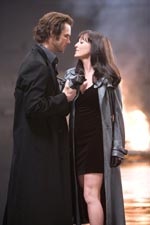
Carrey and Madsen as their literary alter egos, Fingerling and Fabrizia
The plotlines are so tangled up that it seems as if the movie has dozens of different themes it wants to discuss—including destiny, evil, superstition, belief, choice, paranoia, the love of family, true justice, responsibility, redemption, obsession, omens, past sins, second chances, etc. In fact, with all the various messages it wants to tell, the movie doesn't seem to know how to handle its centerpiece—the number 23. There's a vague notion that the number isn't just something you become obsessed with, but that it's some sort of living, knowing evil that comes after you—like the videotaped evil in The Ring. But that storyline just disappears. In the end, Walter shrugs off the whole 23 thing and says, "It's just a number." What? He spent 94 minutes obsessed and then it's just another numerical figure? Where'd that come from?
Truth be told: When the movie presents its full story, you realize the movie didn't even need the number 23. It's just there. Instead, the movie's real crux is reminiscent of Stranger than Fiction: A man finds himself as a character in a book and must find the author to avert the serious consequences in the tale's ending.
A paranoid Walter sees the number 23 around every corner
Of course, The Number 23 has a much different tone than Stranger Then Fiction. Walter's story for the most part has a tone comparable to the The Shining—normative but eerie and increasingly unhinged. And Fingerling's story is given a very stylized look, like comic book sagas Sin City and 300. Both tones work well—until they begin to lose focus. The tone is diluted because Schumacher doesn't seem to know what genre the film is. He knows how to do creepy thriller—he captained Flatliners. But here, he seems unsure what tone to set. Sometimes he wants horror movie. And then more of an M. Night Shyamalan thriller feel. And then Fight Club. And then, the movie ends with about 10 minutes of feel-good family drama with swelling music and a Full House hug-filled closure. Seriously.
Article continues below
The changes are jarring. Bits meant to be creepy and foreshadowing draw unintended laughter. Prepped for a tragedy, audiences guffaw at The Family Sparrow turning detective and saving the day.
The convoluted plot and tone are unfortunate because there are good pieces of story here. The film seems to be itching to talk about big questions about hidden sin and how one deals with past mistakes. Can the past stay buried? If one is a killer, are they always a killer? And what is the right way to respond to sin done unto others? A character reeling with guilt makes the decision to face the consequences for his/her sin—instead of committing suicide—by conceding, "To die in the street would have been the easy way out, but it would not have been justice."
Fascinatingly, the movie ends with the words of Numbers 32:23 printed on the screen: "And be sure your sin will find you out" (KJV). The problem is that it seems to only be up there for its 23 connection and carries little weight because this theme is so watered down amongst the 20 other messages.
Or is it 23 other messages?
Talk About It
Discussion starters
What do you think Numbers 32:23 means? What do you think it means in the context of this film? In what way do sins find someone out?
A character says, "You're not a bad person who got better. You are a sick person who got well." What's that mean to you? What's the difference? How would you define someone who becomes a believer and repents their past sin life? Have they become "better?"
There's much discussion about seeing connections between seemingly random occurrences. A character says, "You've concerned yourself with minutia. If the book was about the number 15 or 150, you could see the same patterns. You're looking for the number 23, so you find it." How is this true for you? How do you seem to find what you want in life because you are looking for it? Does it mean it's not there?
One character tries to connect looking for the number 23 with people who pray to God. Do you think people see God's hand in things when it's not there—just because they want to see it? How do you know when it's really God?
Article continues below
How is this movie redeeming? What Christian values do you see in the end? Is true justice served?
The Family Corner
For parents to consider
The Number 23 is rated R for violence, disturbing images, sexuality and language. The Lord's name is taken in vain along with all the big swear words. There's very graphic, bloody and sudden violence—throats being slit and bodies dropping on pavement. There's no nudity, but there are several sex scenes that show a lot of action—and degrees of perversion such as violent sex.
compiled by Jeffrey Overstreet from Film Forum, 03/01/07
Director Joel Schumacher is once again inspiring film critics to grumble about his work.
The Number 23, which stars Jim Carrey and Virginia Madsen, is a thriller that asks a lot of questions … too many questions, perhaps. And when it comes time for answers, they just don't satisfy.
Todd Hertz (Christianity Today Movies) says, "The Number 23 should be a provocative psychological thriller. It should be a good movie. It has an intriguingly creepy premise. It has a stylized (albeit disjointed and inconsistent) look and tone. And it has good performances—especially by Jim Carrey in his first dark, thriller role. You want to like it as you watch it."
Alas, it just doesn't work for him. "It's not that the film lacks anything. But in fact, it's the opposite. It has too much. Of everything. … [T]he Number 23 tries to carry too many themes, fit into too many genres and tell too many stories. Its promise is drowned out by a din of various themes, moods and storylines. Its thrills and tension are dampened by boring scenes of too much talking and repetition."
David DiCerto (Catholic News Service) says, "The movie closes with a quote from the Book of Numbers … 'Make no mistake about it; you will be punished for your sin,' which sums up the script's underdeveloped theme of fate." But does that make it a great film? "Despite an intriguing premise, director Joel Schumacher's neonoir tale is all style and little suspense, with a muddled plot and a contrived twist payoff. And 23 is also the number of letters in this advice to the wise: Take a pass on this vapid dud."
Article continues below
Lindy Keffer (Plugged In) says, " … [I]t doesn't matter a whit that it ends with a strong ethical message about taking responsibility for one's actions and setting a good example for one's children. Yes, the film's conclusion is a huge relief, both morally and psychologically. But in order to make it so, director Joel Schumacher … goes to great lengths to vividly portray every nook and cranny of the insanity and depravity that set the stage for it."
Christa Banister (Crosswalk) says, " … Schumacher does his best to set up the story in creepy, blood-red splendor, but not even Carrey's obvious ode to Jack Nicholson's chilling performance in The Shining can make the film's premise come off as anything more than just plain silly."
Mike Smith (Past the Popcorn) says, "In brief, the story is creative and unique, Carrey's acting is Oscar-caliber, and as we would hope, the story takes a surprising turn. But the turn that it takes is inconsistent with the film's internal logic, and the climax is a non sequitur."
The plan would organize UMC churches in four global regions, with each given more leeway around same-sex marriage and other theological issues.
Yonat Shimron – Religion News Service
The Number 23
1 of 4
Jim Carrey as Walter Sparrow, obsessed with the number 23Virginia Madsen plays Walter's wifeCarrey and Madsen as their literary alter egos, Fingerling and FabriziaA paranoid Walter sees the number 23 around every corner















 While we pray for peace, we need moral clarity about this war.
 As my doubts about his teachings grew, so did a secret fascination with Jesus.
 The plan would organize UMC churches in four global regions, with each given more leeway around same-sex marriage and other theological issues.