We all love having someone to talk to, or someone to listen. Talking through things has gotten the world through many, many crises. Perhaps this is why radio talk shows are so popular: they give us a place to be heard, or to hear what others are saying, or just to participate in a process (dialogue, chatting, venting) that is crucial to making progress—or just making sense—of the crazy world we live in.
Talk to Me is about this process, and the liberating experience of giving voice to the thoughts and concerns of the soul—however gritty or painful they may be to express.
The pseudo-biopic film, directed by Kasi Lemmons (Eve's Bayou) follows Ralph Waldo "Petey" Greene (Don Cheadle) as he rises from the ghetto (literally: prison) to radio and comedic stardom in Washington, D.C. In jail on an armed-robbery charge, Greene entertains his fellow convicts on the prison radio system, eventually using his popularity and quick wit to bring about an early end to his sentence. Once outside of jail, Greene cons a radio station programmer, Dewey Hughes (Chiwetel Ejiofor), into giving him a chance on air at WOL, "a respectable R&B" AM radio station in the nation's capital. Greene horrifies the station manager (Martin Sheen) with his "tell it like it is" attitude and propensity to attract the censors, but soon Greene's morning show is the station's most popular, with Greene himself quickly becoming the populist voice of urban D.C.
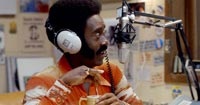
Don Cheadle as radio talk show host Petey Greene
The film takes a look at Greene's success through the lens of the turbulent racial and political context in which he rose to fame. He filled a need for his listeners—a straight talker for the disenfranchised and disillusioned, in an age when nothing was certain and no talk (especially in D.C.) was trustworthy.
Talk to Me, as its title indicates, is a very verbose film. There is a ton of talking, yelling, some arguing, and a high volume of just about every expletive in the book. In this way, the film feels almost like a stage play. Certainly it is a film in which the actors—as they rattle off the rhetorically-refined cadences that define their fast-talking characters—are given the stage to really shine. And shine they do.
Cheadle, one of the best actors working today, really basks in the black-and-proud badness of Greene, and Ejiofor (Children of Men) is equally forceful as Greene's polar opposite. An early scene in a pool hall between Cheadle and Ejiofor—in some ways the focal scene of the film—is one of the best-acted interplays I've seen this year. The rest of the cast play their supporting roles well, though Greene's girlfriend (played with a bit too much energy by Taraji P. Henson) is in too many scenes, and dominates the space when she is present. Still, we never really get a sense of her character or her relationship to Greene, and mostly she's just there to showcase the fro-and-halter fashions of 1960s-70s America.
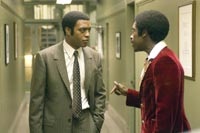
Dewey Hughes (Chiwetel Ejiofor) gives Petey his first big break
Indeed, the film's largest problem seems to be its inability to really get inside its characters. Cheadle does his best with Greene, but we never really go deep into his psyche. You never know exactly what drives his passion or what he really cares about. Sure, there are some great scenes where Greene's layers are peeled back a bit. One such is a sequence after Martin Luther King, Jr. is assassinated—and D.C. erupts in riots—in which Greene gets on the airwaves and tries to articulate the complex and conflicting emotions running through black America at that dark moment. Then, much later, there is an intense scene when Greene performs on the Tonight Show with Johnny Carson and unleashes a bitter indictment on white America's minstrelization of black comics. It's a scene straight out of a Spike Lee film.
Unfortunately, as in so many Spike Lee films, the thick racial undertones and social complexities of Talk to Me's setting frequently overshadow the characters who are trying to make sense of it all. What is most compelling about this film is not the tension of the times, but the way that people like Greene respond to it; how they comment on it in the public sphere. His character is most clearly illuminated to us not in his interactions at the bar or in the bedroom, but when he's behind the microphone taking calls or calling out Berry Gordy for pimping black musicians to white audiences. Unfortunately, the former scenes occupy much of the film, whereas we only have a few scenes of the latter kind—when we can watch Greene in his on-air element.
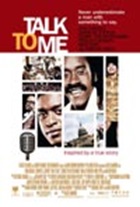
Taraji P. Henson plays Petey's girlfriend, big fro and all
Even so, the film—if it falls short of what it might have been—does provide a compelling portrait of a particularly tumultuous time in American history and how the media and entertainment of the day adapted to and helped foster the many changes that were going on.
If there's a primary theme to the movie, it's that in troubled times, dialogue and open discourse is essential. Petey Green, as so many great radio personalities have done over the decades of the medium's existence, provided a unifying voice and comfort to a people who needed it.
Article continues below
Throughout the film, Greene reminds people that he's "just a con," that we're all just cons, trying to be real but forcing ourselves to adapt to society's standards and to meet the cultural requirements for "progress" and "respectability." In some ways, Green must limit himself in order to make a difference (for one thing, he can't curse on air—something he loves to do). He must be open to change (ridding himself of drugs, for example) if he is to find his redemption, and here we find the film's most uplifting message: anyone, even ex-cons, can be used to do great things. It is something Christians should know better than most—that sometimes the most unlikely suspects are the most apt to change the world.
Talk About It
Discussion starters
Petey Greene comes across as a crass, street-wise individual. Do you think his less-than-clean record and rough way of speaking undermines what he has to say?
What does this film say about redemption—about coming from bondage (literally) and ultimately achieving great things?
Do you think God can use people like Petey Greene to proclaim his message? How might these kinds of people be better or worse-suited than others to communicate important truths?
The Family Corner
For parents to consider
Talk to Me is rated R for pervasive language and some sexual content. The language is absolutely pervasive, with the utterance of "f" words only outdone by cavalier uses of the "n" word. Even so, the language feels authentic, and if you can handle it, the film is probably worth seeing in spite of its crudity. Younger teens and children should not see it. There are important history and cultural lessons here for mature teenagers, but use discretion. Other than language, there are some scenes of sexuality, and some brief male nudity (comical). Over all, the film's offensive components fit and serve the story, and none of it feels exploitative or excessive.
The surprising argument that Saul of Tarsus was born into bondage.
Mark R. Fairchild and Jordan K. Monson
Talk to Me
1 of 3
Don Cheadle as radio talk show host Petey GreeneDewey Hughes (Chiwetel Ejiofor) gives Petey his first big breakTaraji P. Henson plays Petey's girlfriend, big fro and all














 While we pray for peace, we need moral clarity about this war.
 But let’s not mistake it for calling.
 The surprising argument that Saul of Tarsus was born into bondage.