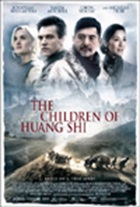
Jonathan Rhys Meyers, Radha Mitchell, Chow Yun-Fat
Theatre Release
June 13, 2008 by Sony Pictures Classics
The Children of Huang Shi is a bit of an odd duck for a summer release—a thoughtful, true-life historical drama tucked conspicuously into a season of explosions, guns, computer generated monsters and invincible superheroes. That it will be lost among the thunderous cacophony is a foregone conclusion. That it deserves to be is, perhaps, the only surprise.
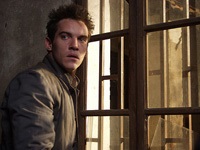
George Hogg (Jonathan Rhys Meyers) is a young, wet-behind-the-ears British reporter who sees his big break when the Japanese invade China in 1937, brutally subduing the population. Managing to get behind enemy lines, he begins documenting the apocalyptic destruction of the city of Nanking and the mass execution of its residents. It isn't long before George is captured. At just the moment when it appears his head is to be separated from his body, the cavalry appears in the form of Chen (Chow Yun-Fat) and his fellow communist insurgents.
Jonathan Rhys Meyers as George Hogg
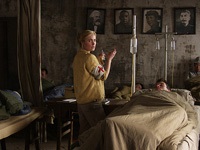
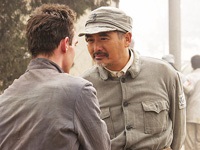
Chen, an engineer whose expertise is in constructing buildings, now finds himself blowing them up to prevent their use by the Japanese. He introduces George to Lee Pearson (Radha Mitchell), an American Red Cross medical worker who suggests George hide out in a children's orphanage in the rural village of Huang Shi to recover from wounds he's incurred.
The disinclined George finally acquiesces to her suggestion, but, upon arrival, finds the community in tatters. The boys, whose only adult supervision is a harried cook, have reverted to an almost feral state, more savages than children. George's presence is greeted with hostility, especially by the orphanage's alpha male, Shi-kai (Guang Li), who does everything he can to make George's stay intolerable. George perseveres and gradually begins winning the children's trust. As he adjusts to his surroundings, they adjust to him, and before long the orphanage becomes a place of laughter and love.
Radha Mitchell as Lee Pearson
Their idyllic community is threatened when Chinese nationalist troops reveal that the Japanese are drawing near. The immediate threat is not from the Japanese, however, but from the nationalists who wish to conscript the young boys into their army. To prevent this from occurring, George and Lee gather the children together and flee during the middle of the night, setting out on what will become an arduous 600-mile journey through China's vast interior toward the remote Gobi desert where neither the Japanese nor the Chinese resistance can find them.
The Children of Huang Shi is apparently being heavily promoted in China, and no surprise: the film highlights an important and largely ignored (by the West) segment of China's history and one for which the wounds are still remarkably fresh. Somewhere between 20 to 30 million Chinese died at the hands of the Japanese invaders between 1937 and 1945, creating a degree of animosity between the two countries that persists to this day.
Children is the latest in a long line of films dealing with a Westerner injected into an exotic, foreign land with which he falls and love and is called upon to save, including Dances With Wolves, The Painted Veil, The Last Samurai, and director Roger Spottiswoode's own Shake Hands With the Devil. Popular templates, they nonetheless create troubling questions of nationalism, xenophobia, identity and colonialism, even when, as with Huang Shi, they are based on fact. All too often, these films, good as some may be, present the glamorous white man as the only person smart, brave or resourceful enough to rescue nonwhite innocents incapable of saving themselves.
Chow Yun-Fat as Jack Chen
It's not that The Children of Huang Shi is a bad film. It is simply routine and conventional storytelling with long explanatory stretches where we should be shown, rather than told, what is occurring. The film's plot points seem continually contrived for melodrama but not emotional effect. The screenplay gets most of the historical beats right, but none of the sentiment. Even tragedy seems bleached of emotion.
Though The Children of Huang Shi often looks beautiful, especially during scenes in which the children trek from one stunning landscape to another—from towering mountains to vast deserts—we never feel the weight of the journey. The march never seems as long or as hard as it obviously was in real life and doubtless was intended to be on film.
None of the principals are fleshed out in any way that would make us care about them or their plights. The film toys around with the idea of generous character development, though it never seals the deal. It indicates a love triangle between George, Lee and Chen but when the inevitable love story between George and Lee comes to fruition, it is too little, too late.
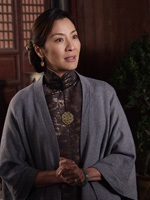
Michelle Yeoh as Madame Wang
Rhys Meyers does well with the material he is given, but his forthright hero lacks nuance (a common problem for many cinematic heroes, especially those of the historical variety). He slips from ambitious reporter to selfless savior with too much ease. Still, his performance—manly yet paternal—is deeply touching. Watching him cradle the heartbroken boys, tussle their hair and plant affectionate kisses on their foreheads is a beautiful fatherly image.
Article continues below
Radha Mitchell cannot compete. Her performance is consistently just off bubble, the acting equivalent of a bike-ridding child not quite ready for the removal of the training wheels. She can get from point A to point B, but it's not always pretty. Michelle Yeoh, magnificently regal, shows up as the wealthy merchant Madame Wang and makes up for much of Mitchell's inadequacies in a series of all-too-brief appearances.
Bereft of emotion, vibrancy or even much cinematic style, The Children of Huang Shi ends with a series of interviews with the actual boys depicted in the film, now elderly men. Their brief segment, no more than five minutes in length, packs more emotional punch than the two hours that precede it and reveals that a documentary of the events depicted in the film would have been a far more moving and captivating experience than this run-of-the-mill drama.
Talk About It
Discussion starters
George Hogg comes from a long line of pacifists, yet his experiences in China change his perceptions. Do you agree or disagree with his conclusion? What does Christ say about violence?
George transforms from self-serving journalist to selfless caretaker over the course of the film. How does this arc mirror the Christian life?
Lee tells George that, "someone needs to make (the boys) care whether they live or die." Why does she phrase it this way? Why not simply tell George that someone needs to make the boys feel loved?
The Family Corner
For parents to consider
The Children of Huang Shi is rated R for disturbing and violent content involving wartime atrocities. The film stops just short of nudity during a scene in which Meyers is de-liced. There is a brief scene of lovemaking, involving no nudity. Several characters are shown smoking opium pipes. Language is extremely moderate.












 While we pray for peace, we need moral clarity about this war.
 How Jesus rescued a New Age psychic from spiritual darkness.
 The surprising argument that Saul of Tarsus was born into bondage.