Georgiana Spencer, the Duchess of Devonshire (Keira Knightly), was the original people's princess. Like her direct descendent, Princess Diana of Wales, Georgiana was a woman of ravishing beauty, glamorous style, burnished intellect, and populist mystique. A political mover and shaker, Georgiana used her popularity with the masses to draw attention to the great social causes of her day, and proved that she was more than a match for the aristocratic, male-centric world into which she was born. And yet, for all of her success and popularity, the one man who seemed beyond her seductive charms was the one man she yearned for the most—her husband, the Duke of Devonshire (Ralph Fiennes).
They were married in 1774 when he was 26 and she only 17. It was an arranged marriage to be certain, but the vivacious Georgiana looked on her mother's (Charlotte Rampling) shrewd brokering not with fear and trepidation, but a chance to love and be loved. But her husband is a dull cold fish, utterly disinterested in her or her pursuits. He shows more affection to his dogs than he does his own wife. Desperate for a male heir, he shows ore affection in his e cares only for Georgiana's submission and the fertility of her womb. When she grants him two daughters and a pair of stillborn sons, his apathy turns to revulsion. To punish her, he engages in numerous affairs and even orders his wife to raise a daughter he sired by a servant girl.
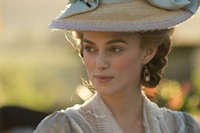
Keira Knightley as Georgiana, The Duchess of Devonshire
Crushed, Georgiana turns her passions elsewhere. A fashion plate who still possessed a common touch, Georgiana used her status with the general public to promote the politically liberal issues of her day, including the abolishment of the slave trade. She became friends with everyone from political leaders to playwrights. "The Duke is the only man in Devonshire not in love with his wife," one character tells another. When Georgiana befriends Bess Foster (Hayley Atwell), the spurned wife of a physically abusive husband, and invites the poor woman to live with her, she cannot conceive of the agony her charity invites—soon the Duke takes Bess into his and Georgiana's marriage bed.
So it is of little surprise that when Georgiana encounters a beloved childhood friend, Earl Charles Grey (Dominic Cooper)—who would later become the Prime Minster of England, but is, for now, just a young, aspiring statesman—she falls madly in love and begins a torrid affair that sets all of London talking. Astonishingly, Georgiana finds tremendous freedom in being a fallen woman. But her happiness cannot last. The cuckolded husband, blind to the hypocrisy of his actions, delivers an ultimatum: either Georgiana gives up her lover or she will be banished, never to see her children again.
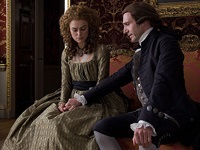
The Duchess with the Duke of Devonshire (Ralph Fiennes)
The Duchess, based on Amanda Foreman's biography, Georgiana, Duchess of Devonshire, is a fine, stately period piece, complete with a ravishing score by Rachel Portman, exquisite costumes, luxurious cinematography, and enough harlequin bodice ripping to convince even the most ardent skeptic that period films are not all staid and boring.
Director Saul Dibb employs his camera with a marvelous attention to detail. In a scene where Georgiana is undressed by her husband on her wedding night, Dibb shows us the marks and indentations from the tight-laced corset that crisscross her back. The porcelain Knightly is simply radiant, Atwell brings a needed sense of warm-bloodedness to the proceedings, and the angular Fiennes is a study in superb contradictions.
Georgiana is obviously a woman out of her time. She regrets that her fashion is the only means by which she can express herself safely. She is told by her mother that conversation and quality time with her husband is secondary to obedience, if not irrelevant altogether. She seeks female empowerment not for the sake of power alone, but simply to discover what true equality—and love—feels like.
Dominic Cooper as Grey
As played by Knightly and directed by former documentarian Dibb, Georgiana is a feminist prototype. This being the 18th century, our heroine's feminism does not express itself in vitriolic speeches or corset burnings. Georgiana still knows her place. Her fight is for elemental equality. She is a magnificent bird trapped in a gilded cage of a loveless, sadistic marriage. For Georgiana, privilege is the cage that blocks her freedom, and the chauvinism of that era the cage's bars. She can see a way to her freedom, but she was born with clipped wings.
The filmmakers hope we see parallels with Georgiana and the life of Princess Diana, who somehow found a way to channel her pain into good. And they are there, to be sure. Dibb and Co. accomplish their goal of transforming an unorthodox 18th century noblewoman into a 21st century heroine relevant to contemporary moviegoers. The Duchess of Devonshire (and the Princess of Wales) stand in for women down through the ages who have confronted the brutality of male power and pushed back with colossal, if transitory, force. Those who stood their ground so long ago, the film suggests, paid a heavy price. But without their sacrifice, the rights of women today would be but an illusive dream.
Article continues below
Even as The Duchess elevates Georgiana to hero status, it is not shy about showing the wages of her decisions and, indeed, even her sins. We are shown Georgiana in the midst of her highs and her lows. This is not a film with a perfect, Hollywood ending. The consequences of Georgiana's actions are revealed with tragic detail. Even if we sympathize and, for a moment at least, admit to understanding Georgiana's impulses, The Duchess never lets us forget that for every action there is a reaction, and that the successes of today are build on the sacrifices and broken dreams of yesterday.
Talk About It
Discussion starters
Do you ever find yourself watching a film like The Duchess and feeling empathy for characters who are breaking God's laws? How do we reconcile compassion with spiritual obligation, especially when the shattered happiness of another human being is at stake?
In one scene, Bess tells Georgiana that there is nothing that a mother wouldn't do for her children. Georgiana seems skeptical. How does Bess' comment come back around to inform Georgiana's decision to put her children's needs above her own desires?
There is a running motif throughout the film of children at play. Why do you feel these images are used and to what effect? What are the filmmakers trying to say about freedom vs. slavery?
The Family Corner
For parents to consider
The Duchess is rated PG-13 for sexual content, brief nudity and thematic material. There are several sex scenes in the film (including one hinting at lesbianism, and another at rape) that, while provocative, do not involve nudity. Rear female nudity is glimpsed very briefly during an alternate scene. While we do not see sex, we often hear it. The Duchess is not a film for children—its mature themes, chewing over the reasons for and consequences of adultery, are problematic.














 While we pray for peace, we need moral clarity about this war.
 But let’s not mistake it for calling.
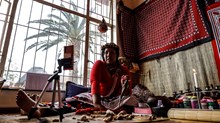 Churches are combating syncretism among millennials and Gen Z amid a rise of social media healers who call on ancestral spirits.