






Not Your Father's Christian Community Development

For the past three years, I've managed the bookstore at the Christian Community Development Association (CCDA) annual conference. Each year I see old friends and make new ones, all the while putting new books into the hands of conference participants. It's a place where I can observe which voices are shaping ideas about what Christian community development is and how it should be practiced in neighborhoods. Authors like founder John Perkins, Bob Lupton, Amy Sherman, and Wayne Gordon represent the longstanding tradition of CCDA.
However, I have noticed over the past few years a growing interest in food, ecology, and Native American communities—topics not always considered part of Christian community development. Books by the late Richard Twiss (a Native American and a popular speaker at the last two conferences) and Wendell Berry, for instance, were among the top sellers at last fall's gathering. I wondered: Did the book-buying habits of conference participants suggest that the vision behind Christian community development is changing?
CCDA was founded in 1989 by John Perkins, who described the mission of CCDA in terms of three Rs: Reconciliation, Relocation and Redistribution. Noel Castellanos, current CEO, notes that the three Rs "articulate a biblical approach to living out kingdom values and the gospel in urban poverty situations." Central to the CCDA mission was racial reconciliation, a goal shaped by Perkins's experience growing up as the son of a sharecropper and having his brother killed by a white police officer. Relocation—both the movement of suburbanites into urban areas, and the return of urban youth to their neighborhoods after college—emphasized that places, even ones that seemed under-resourced, are worth developing from the inside. Redistribution was likewise primarily a local virtue, manifested as Christians shared their resources as the early Christians had in Jerusalem (Acts 2). Perkins has described redistribution in terms of economic development: Christians investing in each other's lives in order "to start local enterprises that meet local needs and employ indigenous people."
"For years, CCDA has said [that] the path to building healthy and sustainable neighborhoods is doing church there as well as doing compassion and development work," notes Castellanos. "But . . . there was another element missing: the confrontation of injustice."
Castellanos attributes this broadening to the on-the-ground experience of CCDA's almost 10,000 members and 1,000-plus member organizations, most of whom are in urban neighborhoods (although there is a growing presence in rural places). Historically, CCDA members have sought justice and mercy within the scope of their own neighborhoods. But as they have listened to their neighbors, they find they are affected by social and economic policies far beyond their zip codes. For instance, Castellanos says, many members have found that "banks aren't lending in the same way to [their neighborhoods] as they do in other communities." Education and immigration are national issues that have real-time implications in neighborhoods with a CCDA presence. CCDA is coming to realize its own collective power to advocate on public policy issues that affect the neighborhoods where members live. "We weren't looking for issues to get involved in," says Castellanos. "We were simply looking at [the systemic challenges] facing our neighborhoods."
Among CCDA's new, systemic action points:
The DREAM Act: In June 2012 the Obama administration announced it would stop deporting most youth who meet the DREAM Act criteria and to create channels through which they could receive work permits. "The action by DHS and the Obama administration to offer deferred action from deportation for Dreamers," said Castellanos, "along with the ability to work legally, is a hugely important step toward fixing our current immigration system." This new policy opens up economic and educational channels for undocumented youth, including those living in many neighborhoods where CCDA members work.
Creation Care: In 2011, CCDA launched a workshop track at its annual conference dedicated to health and the environment. One of the coordinators of this workshop track was environmentalist Rusty Pritchard, the president and co-founder of Flourish, who lives with his family in urban Atlanta, where he is involved in community development. In a recent interview, Pritchard emphasized that addressing environmental issues is an important facet of caring for our neighbors and places. Air pollution, for example, makes breathing difficult for children. "Those are things that are part of the landscape that are broken, where shalom doesn't exist, and I think it's really important for Christians to take responsibility for those places where they live and do what they can to restore them."
Diversity, Leadership, and Theology
As an extension of Perkins's work in Mississippi, CCDA was focused in its early years on reconciliation between white and black Christians. One Spanish speaker served on the original CCDA board, says Castellanos, but it took a while for the Hispanic voice to grow in prominence. "I've been to every conference since 1994," says Castellanos, "and I began to invite my [Spanish-speaking] friends to the conference and others started to do the same," and eventually there was a significant Latino contingent.
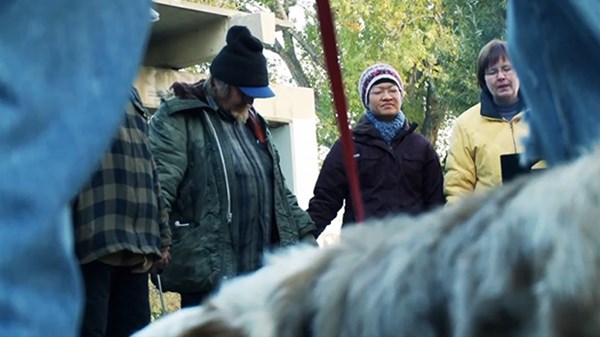
Native American voices have also begun emerging within CCDA. The late Richard Twiss, a CCDA board member who belonged to the Sicangu Lakota Oyate from the Rosebud Sioux Reservation in South Dakota, was one of the most memorable keynote speakers at both the 2011 and 2012 conferences. At the close of his 2012 talk, he challenged CCDA members to consider an indigenous Christianity, with the poignant words of Cayuga theologian Adrian Jacobs: "Weep with us and sing with us, the pain will be so deep that its only consolation is in our creator. The great sin against our dignity is answered by a love that brings arrogant violence to its knees." Leroy Barber, vice chairman of the CCDA board, notes a correlation between this diversifying of CCDA's membership and its forays into advocacy described above. "The broadening of CCDA's conversation beyond just blacks and whites," he says, has led to "the advocacy part of CCDA growing with [exploration of] issues like immigration, education, and violence in our cities."
Barber and Castellanos note that leadership development has become another key focus as Perkins's life work draws to a close. This effort, Barber says, "has allowed the CCDA founders and long-term board members to begin to hand down the mantle of leadership to a new generation." The leadership development initiative, which began in 2009, focuses on cultivating leaders through an annual cohort of 20-25 leaders, who receive mentoring and training. Young leaders between ages 25 and 40 are nominated to participate in this cohort by member organizations, and the first few leadership cohorts have reflected the present racial and ethnic diversity of CCDA. "More than half of any annual cohort," says Barber, are "persons of color: a mix of Asians, African Americans, and Latinos."
CCDA has always had education as a primary part of its mission, offering a variety of training related to Christian community development, referred to as the CCDA University. "We've always been committed to a biblical approach that embraces a very robust social engagement," says Castellanos, "[Our calling] came out of our study of the Bible—not from attending Saul Alinsky meetings." But more recently, CCDA has been working to deepen its theological engagement, resulting in forming a theology working group on the CCDA board in 2011. Craig Wong was a CCDA board member at the time when the theological working group commenced. "CCDA practitioners were hungry for a larger narrative for what they do," he says, "and influenced by the larger evangelical mainstream, and American culture at large, CCDA historically focused on the 'how-tos' rather than the 'whys.' There simply weren't many theological offerings at the annual CCDA conference."
One of the first achievements of CCDA's theological working group was the CCDA Theological Journal, edited by Chris Jehle, Soong-Chan Rah, and Brandon Wrencher and freely distributed through the CCDA website. "This journal will serve," says Perkins, "to continue to cement the unity between biblical reflection and gospel-centered community action and development." Including papers by academics – including Rah, Daniel Carroll R., and Curtiss Paul DeYoung – and practitioners, the journal was promoted at last fall's annual CCDA conference, and that conference also saw the launch of a new workshop track related to theological engagement, including workshops on how ecclesiology and Christology inform community development.
Rah hopes that CCDA's new theological reflection can be a healing and reconciling presence in a larger Christian community that hosts "(1) a rift between proponents of personal evangelism and proponents of social justice and (2) a growing suspicion and lack of engagement with academic endeavors." CCDA members are encouraged to read the journal and participate in the theological workshops at the annual conference. The hope is that their theological rooting will help him explain their work to others, discern best ways to develop their neighborhoods, and help them explain their experiences to shape the theological questions that academics are asking.
Like all healthy organizations do, CCDA has continued to mature and build upon the legacy of its founder. The broadening of its vision, combined with deeper theological engagement, will prepare it for bearing witness both to local neighborhoods and wider evangelical community, as its members joyfully cooperate and encourage one another in their efforts to seek the health and well being of their places.
C. Christopher Smith is the editor of The Englewood Review of Books and presently is co-writing a book entitled Slow Church (forthcoming, Likewise/IVP). He blogs at SlowChurch.com.

Rethinking the $3,000 Missions Trip

Furniture Fit for the Kingdom

Faith in a Fallen Empire
 RSS
RSS
 TWITTER
 FACEBOOK
Comments Are Closed
Displaying 2–6 of 7 comments
See all comments
Jim Ricker
The book of Amos in particular will help remove the idea that redistribution of wealth accumulated through immoral advantage over people is quite biblical. We can all debate whether or not a government and a people without a specific covenant with YHWH should mandate the wholesale redistribution of wealth by its own power but, the Scriptures put the idea that it is socialism or started with Marx or Hegel to rest. Amos 2: "Thus says the Lord, For three transgressions of Israel, and for four, I will not revoke the punishment,because they sell the righteous for silver, and the needy for a pair of sandals..." Amos 4: “Hear this word, you cows of Bashan, who are on the mountain of Samaria, who oppress the poor, who crush the needy, who say to your husbands, ‘Bring, that we may drink!’The Lord God has sworn by his holiness that, behold, the days are coming upon you, those who trample the head of the poor into the dust of the earth and turn aside the way of the afflicted..."
Rick Dalbey
Derek, this is a social movement, this is an economic movement, this is a justice movement, this is social engineering, it is just not the gospel. It has more kinship with the French revolution or the soviet revolution of 1918. Where are the healing of Jesus? The blind seeing, the crippled healed? Where is the deliverance of Philip? Demons cast out? Where is the prophecy of Philip's 4 daughters or Agabus or Cornelius or the 12 Ephesian men? Where are the gifts of the Holy Spirit? Where are the 3000 saved under Peter's first sermon? The crippled healed under Peter. Does this look like the Bible or Dr. Zhivago? Does this look like Ephesians, Galations, Romans, Phillipians, Titus, Corinthians, Revelation or are we making it up as we go along. When we strip out the supernatural from Christianity it becomes a social movement.
Derek C
@Rick, could you clarify? Are you critiquing the article or CCDA? What is the link to what happened in China? Are you saying the CCDA does not reflect the Father's heart? How are they off theologically?
Hannah N.
Thanks for this. It's great to see how John Perkins' vision is being embraced and evolving with the next generation.
Rick Dalbey
Relocation and wealth redistribution. The two key platforms of the Chinese Maoist revolution in 1949. Use the power of the collective to confront injustice. Reform greedy capitalist banks. “Bring arrogant violence to its knees.” The CCDA. Oh yeah. The headline has it right, Not Your Father's Christian Community Development.