






Before Saving the World, Go See Your Family

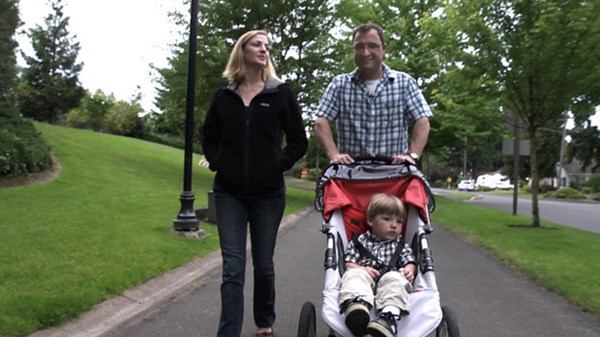
When a day at the office means rescuing 11-year-old sex slaves and lobbying at the Capitol for people with no health insurance, finding "work-life balance" can be tricky. At least for Shoshon and Stephanie Tama-Sweet, two Christian activists who have inspired much coverage from This Is Our City. Shoshon is the executive director of the Oregon Center for Christian Voices (OCCV), a small nonprofit that's led recent legislation making it harder to prostitute children. Stephanie is a lobbyist with a major health-focused nonprofit, traveling to the Capitol in Salem to push for greater health coverage for uninsured children. Through trial by fire, including a season of depression, they have learned together that working for the shalom of the city is often much more effective and sustainable when pursued in pairs.
In October, when the City project debuted its Portland coverage, Stephanie and Shoshon spoke with film producer Nathan Clarke about how their own partnership has strengthened both of them to labor more effectively, and hopefully, for neighbors suffering in their city.
Q: Stephanie, when did you first realize there was an issue [with Shoshon]?
Stephanie: Late this spring, I started to notice that things were more difficult for us. There's a cyclical nature to my job working in the legislative session. Every other year for about six months I put in a lot of hours, and that's always hard on a relationship. Then with Shoshon being in the legislative session too, stress levels were up, and we had less energy. And this was the first time doing it with a kid [3-year-old son, Ben].
One time that was particularly hard, Shoshon was participating in a parents' night with a group called Parents of Murdered Children. It was brutal. And I remember him coming home that night and saying, "We've got to figure something out." That was late March.
Shoshon: A lot of the difficulty was realizing, this is darkness. I'm dealing with darkness …. It's not that the actual work is just exhausting or so unrewarding. It's being in constant direct contact with stories and people and lives that have been really damaged. Most people's response to that is either to shut down or to distance yourself from it to the point where it's like, "Well, that's a terrible thing, but it's not my problem." You shove it off and go about your Starbucks day.
The word I would use is despair—a profound sense that things are not getting better.
Q: Were there gospel truths or Bible verses that were important for you as you encountered those dark realities?
Stephanie: One way that you keep going forward is [believing] that this darkness is not what God desires for individual lives and for communities. Just knowing in the core of your being that God has this other way that he made the world to be, and that we can be part of bringing that about, is incredible.
Then in a very practice sense, [knowing] that we've made progress. I'm really proud to be part of the work that OCCV has done from both recognizing underage trafficking as an issue to passing legislation about stickers to passing legislation that changes the definition of prostitution for a state. We're looking at extending that even more.
Q: What are things the two of you have done in your relationship that have helped?
Shoshon: We found a great counselor. She's a Christian and is great at setting up a safe space where we can talk to each other and with each other.
Stephanie: We never went to premarital counseling. But both of our roles are fairly public, and even in church or at OCCV, it's hard to be vulnerable with people. Shoshon can't go to the staff of OCCV or to the board chair and talk about the hard realities or our needing spiritual support. We have good friends and a great support system, but sometimes you need somebody who's external.
Shoshon: I sailed up from Astoria up to Seattle with some friends, and then Stephanie came back out and we were out for another week. While we were sailing up the coast, we came around this big sea stack, one of those giant columns of rock that are out in the water.
We were going 3 miles an hour and came around the corner, and there was a gray whale and her baby 30 feet from the boat. They came up and sprayed, and we could see them swimming together. They're checking us out and we're checking them out. You get these moments of, "Wow! God just made this awesome, incredible world," and realizing that is really restorative. Have you ever seen phosphorescence in the water? It's these microalgae that bio luminize; they spark when they're agitated. You can run your hand through the water, and it looks like galaxies of stars are streaming behind your fingers.
So spending time to commune silently with God, or to talk to God, or to sense that God is filling up the world again, is hugely helpful.
Q: You guys seem to have a partnership. There's a sense that you have similar purposes.
Stephanie: The process we had this spring has reminded me and deepened the sense that the most important people in my life are my family. I feel like both of us are called to ministry in the broad sense, but our family comes before that. You actually can't even do ministry well unless you're taking care of things at home. I feel incredibly blessed to have Shoshon as a partner in life, from having fun together to doing our work together in the world. I certainly couldn't do it at the same capacity without having a partner who understands and supports and prays with and puts up with me.
I just finished a short book by Henri Nouwen. He talks about how God sent people out two by two. He could have sent them out one by one, and obviously God called lots of individuals to ministry. But in general, he sent people out two by two. You can conquer so much more, do so much more, love so much more, when you have somebody who's partnering with you.
I feel that way about Ben and our coming child, too, that we're all part of it together.
Shoshon: It's just something that works out for our family.
I think a lot of us who are in our 20s and 30s and have decided we are to try to do God's work—for us, there is a learning curve of realizing, "Whoa, that impacts my family; that impacts my kids." You can't just say John 3:16 and then magically disappear. The costs are real, they're there.
Stephanie: Shoshon came back from being out on the boat and said, "I don't know if I care about this stuff anymore. I don't know if I need to do it." A day later he comes home and has this newspaper article [about trafficking] and says, "Can you believe this?"
I'm like, "I thought you didn't care about any of this stuff."
"But somebody has got to do something about this person." I just kind of laughed because I knew it would come back around.
We feel incredibly blessed to have each other and to have jobs and to have food on the table. Then you realize that other people don't have it. And it just demands that you share it.

Rethinking the $3,000 Missions Trip

Furniture Fit for the Kingdom

Faith in a Fallen Empire

 RSS
RSS
 TWITTER
 FACEBOOK
Comments Are Closed
No comments
See all comments