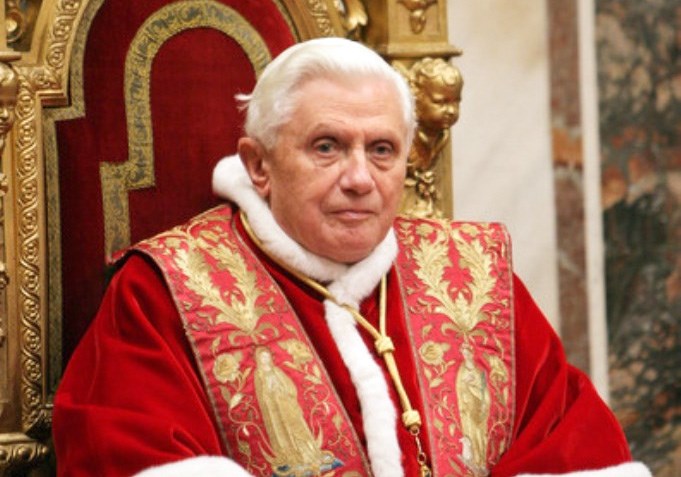
You don't have to be a Catholic to be interested in Pope Benedict XVI's teachings and legacy. After all, the pope is a global figure with political and cultural influence that extends beyond his church. As thoughtful Christians, Benedict's papacy can help us better understand the Catholic faith as well as our own.
The simplest analysis of Benedict's eight-year papacy would recall that he did not welcome female priests, did not support the use of contraceptives, did not pause the church's campaign against abortion, and did not change its stance on homosexuality… same as anyone elected head of the Roman Catholic Church would have done.
These points alone are enough for some to consider his papacy far from female-friendly, but devoted Catholics, particularly women, push us to think more deeply about Benedict. In blogs, these women write how much they surprisingly came to love him.
"I love the fact that Pope Benedict is a scholar and prolific author," wrote one Catholic blogger, who "scandalously" admitted she was more saddened by Benedict's resignation than Pope John Paul II's death.
Benedict offered the church robust commentary on the role of the Catholic faith in a changing world. And because his writings allowed followers to interact with him more regularly and more intimately than with previous popes, many Catholics—women especially—felt closer to him.
Open communication is the great un-doer of hierarchy. As with many patriarchal institutions, there are fair criticisms to be made over the historic and current role of women in the Catholic Church. Within the structure and positions of the church, Benedict offered today's Catholics the theological grounding behind the church's teachings through his writing.
His true distinctives were his theology and his willingness to share it in speeches, documents, and even tweets. Despite his tough reputation as "God's Rottweiler" and his relatively short papacy, Benedict embraced open communication, bringing theological insight to the masses, including sometimes-marginalized groups like women and minorities.
Unlike his predecessor, Pope John Paul II, Benedict "preferred to write books and issue encyclicals rather than travel," Catholic priest Thomas Reese told The Washington Post. John Paul went for the big screen with grand political gestures; Benedict's writing made him popular in a different, more personal way.
Elizabeth Scalia, Catholic blogger for Patheos' The Anchoress, wrote, "Benedict has always been the more accessible tinkling piano, simply inviting one to come closer. His copious writings have been almost avuncular in their gently-voiced but brilliant instruction, and somehow it always felt like he belonged 'to me.'"
Many women crave that personal connection that Scalia describes. We are communicators. We like to hear stories. We like emotional ties. Benedict's theological exploration provided beautiful explanations on the nature of God and the mission of the church.
For non-Catholics, elements of the pope's faith and his role may be mysteries, but Benedict's core beliefs on God are not. He emphasized the church's "new evangelization"—an approach that should resonate deeply with us.
"Christianity is not a new philosophy or new morality. We are Christians only if we encounter Christ... Only in this personal relationship with Christ, only in this encounter with the Risen One do we really become Christians," he said in 2008. "Therefore, let us pray to the Lord to enlighten us, so that, in our world, he will grant us the encounter with his presence, and thus give us a lively faith, an open heart, and great charity for all, capable of renewing the world."
He wrote accessibly about Jesus' birth, life, death, and resurrection, in a book series highlighted by USA Today:
He may have been best known to everyday readers, Catholic or not, by his best-selling trilogy, written in a conversational style, on the life of Christ. The first volume, Jesus of Nazareth, on his life and ministry, came out in 2007 with a humble opening line: "Everyone is free, then, to contradict me…"
Beyond his books, Benedict also wrote three, lengthy encyclical letters. We are lucky to live in an age when you don't have to be a Catholic scholar with special credentials to study the church's latest teaching documents. The encyclicals are posted online, for anyone to access, in up to a dozen languages.
Benedict's encyclical called "Charity in Truth" made headlines as an economic directive addressing a globalizing world, but as Francis Beckwith explained for CT, it was more than that. Benedict explained why doing good for people and loving people requires our faithful consideration of what God made them to be.
"Development, social well-being, the search for a satisfactory solution to the grave socio-economic problems besetting humanity, all need this truth. What they need even more is that this truth should be loved and demonstrated," Benedict wrote.
Article continues below
In these letters, he also highlights women in the life of the church. Of course, there's the Virgin Mary. He describes her humility and love shown though "quiet gestures" in his encyclical, "God is Love." He also brings us the example of St. Josephine Bakhita, a 19th-century Sudanese slave who became a nun, in "Saved in Hope."
But Benedict's more-personal methods of communication also extended into the online realm. Before Benedict debuted his own Twitter account, he already was singing the praises of the web and its potential for the church.
"Church communities have always used the modern media for fostering communication, engagement with society, and, increasingly, for encouraging dialogue at a wider level," he said at the church's World Communication Day in 2010. "Yet the recent explosive growth and greater social impact of these media make them all the more important for a fruitful priestly ministry."
The previous year, he encouraged young people to take the lead on the church's use of technology.
"Young people in particular, I appeal to you: Bear witness to your faith through the digital world!" he said. "Employ these new technologies to make the Gospel known, so that the Good News of God's infinite love for all people, will resound in new ways across our increasingly technological world!" (As a side note, I also watched Benedict become the first pope to chat with astronauts in space. How's that for high tech?)
The innumerable commentaries across blogs and social media—even the jokes about Benedict passing on the Twitter password to the next pope—are evidence of the importance of technology and communication during his eight years as the church's Holy Father.
Benedict's writings remind us that a legacy doesn't depend solely on our traditional notions of change, politics, or conservative and liberal labels. The pope's prolific expression of faith—whether you agree with the content not—enables and enlightens us to know more, and that's a good thing.













 While we pray for peace, we need moral clarity about this war.
 As my doubts about his teachings grew, so did a secret fascination with Jesus.
 Beyoncé’s right. Whether listening to Cowboy Carter or reading theology, diversity is a good thing.





