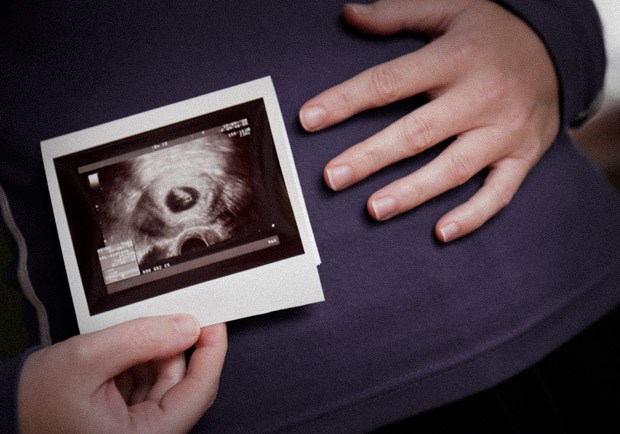
Christians across many different stripes—racial, denominational, class, to name a few—are known for being outspokenly pro-life. We have made a name for ourselves as protestors at abortion clinics, servants at crisis pregnancy centers, and advocates seeking to pass legislation for the unborn. We are relentless in our pursuit for the right to life of all human beings, and rightfully so.
But are we overlooking one key flaw in our zeal for protecting life?
In a recent column at Patheos, Ellen Painter Dollar writes about what she calls the "liminal nature" of embryos, otherwise known as their in-between status. She describes embryos as occupying a space between one state of being and another. In turn, she sees this as most evident in the way our culture, even our pro-life culture, responds to miscarriage and frozen embryos. She writes:
The liminal nature of embryos and the importance of naming and considering their in-between nature more fully are apparent in two phenomena: cultural responses to miscarriage, and how parents perceive their unborn children, whether they are embryos in a laboratory freezer or images on an ultrasound screen.
She highlights two families, both pro-choice, and how they responded to their pregnancy situations, one a miscarriage, the other a prenatal diagnosis of abnormalities. In each situation, the parent, though pro-choice, recognizes the emotion that comes with a loss without acknowledging that a human life was lost. But Dollar also points out that some pockets of the pro-life community likewise don't acknowledge that a human life was lost.
She has a point. Miscarriage is a silent sorrow that many couples walk through alone. To my shame, I remember telling a friend who suffered a miscarriage that "these things are really common," as if that fact eliminated her loss. I knew a woman who dismissed another's miscarriage as minor because "how can she be so upset when she wasn't that far along?" Such statements weren't coming from abortion advocates. Instead, they came from people like me, who would be first to stand up for an unborn baby at the hands of an abortion doctor. Ministering to parents in the throes of grief—namely, by acknowledging that a human life was lost—has proven more difficult for many of us Christians.
Knowing how to respond well to miscarriages is not a new predicament. For years miscarriage was scarcely mentioned, a sorrow that many women faced in isolation, even in the church. That trend is slowly changing, and that's to the good. While we shouldn't follow all of Hollywood's cues, celebrities are now more inclined to share their own stories of pregnancy loss. In an effort to remove the shroud of secrecy associated with miscarriage, Lisa Ling openly shared about her loss over two years ago. When the Duggars lost their baby last year, some criticized their public response, but others identified with it. In a world where our private lives are increasingly public, the once very-secret reality of miscarriage is finding its way into public discourse.
With such knowledge comes even greater responsibility. In some cases, even with the most open environments, responses to miscarriage and embryo loss find little more than an obligatory hug and a quick, "I'm sorry for your loss." What Dollar and others recognize is that our inability to respond to the loss reveals an inconsistency in our pro-life position.
But is the answer to the problem really to define these embryos as simply being in a holding pattern between nothingness and life? Are they merely potentials for life? Or can we define our terms in a more responsible and accurate way?
I would like to suggest another way. Perhaps the most pro-life thing a Christian can do is to begin applying pro-life rhetoric with the same vigor to the woman in the pew next to her who recently miscarried her child.
It's been many years since I uttered those heartless words to my grieving friend. Having now lost one child of my own through miscarriage, and having since walked with a number of women through miscarriages, none of us would say that what we lost was the "potential" for life. It was so much more than that. Our lost baby took with it the many dreams and hopes that began forming in our minds the moment we knew of the baby's existence. What was lost was a life that will never be replicated.
It's really important to never delegitimize the life that was once growing inside of a grieving mother or was once frozen in an IVF clinic. To her (and to God), this life was never a mere blob of tissue or a fetus. He or she was a life. Treating the baby as such gives meat to the bones of our fight for the unborn. And if we want to be consistently pro-life, we must care about every life, from the tiniest dot on an ultrasound machine to the embryo in the petri dish.
As Christians, we must never treat pregnancy loss as some fluke accident that at least proves pregnancy is possible. We should be the first to grieve over every baby lost, regardless of the gestation, circumstance, or result of their death. Our zeal for caring for the mother who grieves over her abortion should carry over into our care for the mother who loses her child through miscarriage.
Are you pro-life enough? It seems like a heartless question considering all that Christians are doing to turn the tide on abortion in this country. But it's worth considering. Does our language to the grieving mother stay the same regardless of how her baby was lost? Maybe then our critics might see that we mean what we say.


The Feel-Good Faith of Evangelicals

Don't Let Women's Ministry Turn People Into Projects

Bless These Hands That Instagram My Food


Comments
Displaying 110 of 25 comments
See all comments
Jamie Rohrbaugh
I can't imagine the loss of a child and I don't want to. Whether the child has been born yet or not is immaterial. The loss is still a total loss, a future and a hope snuffed out before time. I grieve for those families who have experienced this. As for our Christian response, doesn't Romans 12:15 tell us to weep with those who weep?
Pamela Mathews
The loss of miscarriage is real and painful. I've been there. But if we want to talk about ethical/theological inconsistency: If life really begins at conception, we should also be working through the issue that 50% of pregnancies do not make it to term, with many women/couples not even being aware they were ever pregnant? Should we be mourning all of those deaths, even if unknown? Do all those embryos go to heaven? Or maybe there actually is some progression of life from fertilization through viability?
erin gentry
Thank you so much for this post. My husband and I miscarried October 2012 - our first child - after trying to get pregnant for two years. Like you, I'm sure I said something hurtful (without intending to cause pain, of course) to a miscarriage mama, but now that I've been there, I see the loss for what it is: earth shattering. Important. Deeply wounding. Difficult to heal from emotionally. Etc. I understood those things on an intellectual level before, but walking through that grief has truly opened my eyes to not just the pain for the parents, but to the insensitivity and mysterious lack of importance that many in the church seem to lend to miscarriages. Today I blogged my thoughts on your fantastic article (http://thejinglejangle.blogspot.com), linking up to this entry and asking my friends/readers for a healthy dialogue on the topic. I hope that deeper understanding and kinder words are brought about from it. Thank you again for your thought-provoking, important, timely article!
erin gentry
Thank you so much for this post. My husband and I miscarried October 2012 - our first child - after trying to get pregnant for two years. Like you, I'm sure I said something hurtful (without intending to cause pain, of course) to a miscarriage mama, but now that I've been there, I see the loss for what it is: earth shattering. Important. Deeply wounding. Difficult to heal from emotionally. Etc. I understood those things on an intellectual level before, but walking through that grief has truly opened my eyes to not just the pain for the parents, but to the insensitivity and mysterious lack of importance that many in the church seem to lend to miscarriages. Today I blogged my thoughts on your fantastic article, linking up to this site. Hopefully a better dialogue is started and responses are kinder. http://thejinglejangle.blogspot.com/2013/01/on-grieving-miscarriag e-as-christians.html Thank you again for your thought-provoking, important, timely article!
S Griffin
I feel all across the board people need to realize the hurt families have after miscarriages and not criticize those women who are grieving the loss of their unborn. Their pain is real.
J Thomas
There is never a time when a person will revisit the loss of a child (no matter which state of development) and feel no sense of loss. The parsing of developmental stages into palatable language does not, despite the effort, relieve the memory of loss. We're talking about a powerful emotion that echoes through the limbic system enough to generate its own properties of recoil and emotional avoidance. The question of who the child would have been will never cease to linger. As with any loss, the only thing that changes is our ability to deal with the loss in a matter that doesn't continue to tear at the heart.
NoVA Reader
(cont from below) Sorry I could not fit this in the last post - (link to a meta-analysis of IVF and major malformations completed in 2011 by Case Western. http://www.ncbi.nlm.nih.gov/pubmed/21625967)
NoVA Reader
(continued from below) And, the studies on the negative effects of the children are also inconclusive – you often have older mothers using IVF, multiple births, pre-term births…the best studies have to account for all those factors. And even those that do show little to no increased risk. But, again, the Catholic/Christian position is that all life is sacred – including those with disabilities, disease, genetic disorders, etc. so this discussion could be expanded far beyond the controversy of IVF. Whether parents should conceive a child knowing it could have an increased risk of any type of disorder is an ethical issue that could apply to any parent - Christian, Catholic, atheist, or otherwise. And if you deem it unethical to conceive a child with increased risks – what does that mean for older mothers? Those foregoing birth control even as they age? Should all parents have genetic tests prior to their attempts to conceive? Those who undergo IVF are required to.
NoVA Reader
I'm not Catholic so in my case, I'll claim ignorance and poor catechism. :) But I stand by my position that these perceptions persist, even among the Catholic faithful, even if they are misguided. Regarding the discussion on AR and health risks, I have experienced OHSS - uncomfortable but almost always temporary. Regarding increased cancer risk for the mother - the studies are far from conclusive and the majority show no increased risk in breast or uterine cancer. But, in either case, I'm not sure that negative health risks for the mother are the correct basis for foregoing AR techniques. Especially since the Catholic position against birth control results in multigravidity - and the health risks associated with a high number of pregnancies and childbirth are MUCH more established than any health risks associated with IVF.
Kamilla Ludwig
NoVA, In answer to your question, in all seriousness, there are three basic explanations for that: 1) Ignorance 2) Poor catechesis 3) Rebellion If you really want to understand the Catholic position on these matters, you need to start with three documents: 1) Humanae Vitae 2) Donum Vitae 3) Dignitas Personae From there, it would be a hood idea to,look at the health effects of pursuing various ART procedures - effects on both the woman and her future children, including OHSS and cancer for the woman as well as a doubled risk of serious birth defects for children conceived via ART. I know CT isn't Catholic but it's time for Protestants to recognize that HV was the single most prophetic religious document of the 20th century. (Not fond of the new design that removes formatting when comments are posted)
*