Imagine getting in your car to head to the grocery store and realizing that despite the countless times you've made the trip, you no longer know how to get there. Or picture this scenario: you're convinced you're living in your childhood home with your parents, only to have a stranger announce that this is actually an assisted-living facility, and your parents are long dead. Or worse yet, imagine having someone call you Mom and being certain you've never seen this person's face in your life.
This is the reality for more and more adults in the U.S. The Department of Health and Human Services launched a new website, alzheimers.gov, in response to a skyrocketing number of older adults with symptoms associated with dementia and Alzheimer's disease. According to the most recent numbers, 35 million Americans now suffer from dementia, including approximately 5 million with Alzheimer's.
As medical advances and technology help us live longer, we as a culture—and specifically as Christians—are faced with increasingly complex end-of-life issues. Memory-related illnesses are among the most devastating—both for those with the diagnosis and for those who love them.
As people who champion the core value that human beings are made in the image of God (Gen. 1:27), Christians have historically made a bold, if not always graceful, stance regarding beginning-of-life issues. The Christian pro-life message has its nuances depending on which niche group you talk to, but at its core, the stance is fairly straightforward: life begins at conception. Personhood is granted not through what babies contribute but through the inherent value bestowed on them by their Creator— Imago Dei.
But for the 35 million people who are gradually being stripped of their personhood one memory at a time, there doesn't seem to be much of a unified rallying cry. Most of us would give verbal assent to the idea that life ends at death, not before, and we shake our heads at European countries such as Switzerland, where physician-assisted suicide is legal and clinics enable those with debilitating diseases such as Alzheimer's to "die with dignity."
But in practice, does our own culture demonstrate a similar devaluing of personhood? Do our actions indicate that deep down we believe life is worth less when an older adult can no longer live independently or contribute to society? Do we consider people less valuable the day they can no longer feed and toilet themselves, the day they fail to recognize the face that stares blankly back at them in the mirror? How can someone have dignity if they don't even have a sense of their own identity?
I am one of the millions of adults in the United States with a family member who suffers from dementia, which means that this is more than just a philosophical dilemma for me.
As I've watched my grandfather suffer and experiment with various medications over the years, I know all too well there is currently no remedy for dementia or Alzheimer's—and no drug to cure it. The medicines available simply alleviate the symptoms for a limited time. As one trial drug after another has fallen short, scientists are looking to other options to stave off the insidious effects of this memory-stealing disease. One of the most recent concepts is called a brain pacemaker, which jolts a patient's brain with mild electric stimulation in an attempt to keep neural networks active, thereby preventing memory loss.
The brain pacemaker is still in very early stages, and until further research is done, no one knows if it will be effective or how long the benefits might last. The procedure isn't for the faint of heart, either, as it requires that holes be drilled into the patient's skull for the precise implanting of the wires. Perhaps the nature of the treatment is telling: we are willing to try anything. As extreme as the procedure is, it offers what dementia sufferers and their families are desperate for: a glimmer of hope.
When I was a child, I was in awe of my grandfather's superpower-like ability to retain information. He grew up in an era when education by rote was in vogue, and even after seven decades, he could still conjure up poems by William Wordsworth, quote chapters of Scripture, and recite everything from schoolyard ditties to scientific theorems.
The dementia crept in slyly at first, disguised as the typical forgetfulness that comes with aging or excused away by tiredness or stress. But at my brother's wedding, when he got behind the wheel and couldn't remember where he was or what he was supposed to do, we realized something more significant was happening. Denial was no longer an option.
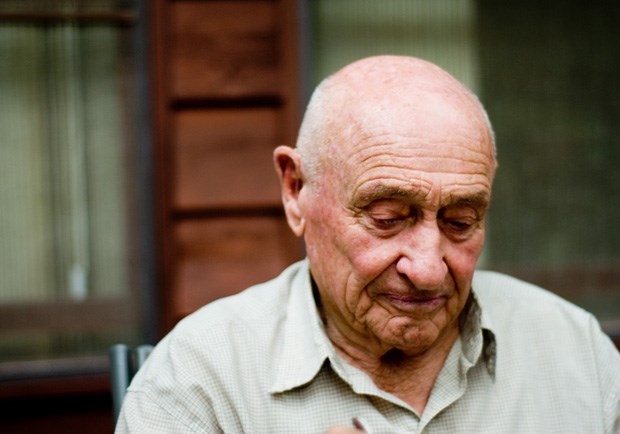
Over the past 10 years, my family has watched Grandpa progress through the stages of dementia: gradually being robbed of his short-term memory, losing the once-familiar words and names, being stripped of the ability to recognize even the people he loves most.
Article continues below
At a recent family gathering, we had an impromptu sharing time, where we all went around the room and shared how we'd seen God at work in the previous year. When it was Grandpa's turn, there was an awkward pause as he sat there, the proverbial deer in the headlights. Should I step in, I wondered, and save him from the embarrassment of being put on the spot to do something that was now beyond his capabilities? Or would that only make him feel more shame?
I looked at Grandpa and winced as his face contorted with frustration. A decade earlier, he would have been facilitating this whole conversation. Now he opened his mouth several times, but each time no words would come out. His eyes started to brim with tears, and I turned my head. I couldn't bear to see him suffer like this.
Just as I was getting ready to jump in and deflect the spotlight to the next person, I heard a familiar yet unexpected sound—the deep baritone of Grandpa's voice. Somehow, for the moment at least, he knew every word of the familiar hymn he'd sung for the past eighty years, since those Sundays when he'd sat it in that tiny church in rural Montana.
What a friend we have in Jesus
All our sins and griefs to bear…
Jesus knows our every weakness
Take it to the Lord in prayer.
Perhaps one of the reasons we as a society are uncomfortable with the end of life is because we don't like what aging shows us about our own weakness. We don't want to be reminded of our frailness, our own vulnerabilities, and it scares us to think that someday this could be us—that one day we'll wake up to the same terrifying fog in our brains and end up putting this burden on own families as well.
And on top of all the logistical changes wrought by memory-related illnesses, we face spiritual questions. We aren't sure if the person we love is still inside somewhere, if their soul is still alive. We don't know what Imago Dei means for someone who is no longer the person they used to be.
But perhaps this is precisely the entrée for Christians to speak into this issue. The apostle Paul said, "If our hope in Christ is only for this life, we are more to be pitied than anyone in the world" (1 Cor. 15:19). What better way to embody our theology of life and death than to imbue dignity to the elderly and memory-challenged, with the certainty that we are more than merely our bodies, more than merely our minds?
Article continues below
I would present this challenge to all of us followers of Christ: we need to claim a theology that affirms life—not just for the preborn but also for the elderly. And while that may seem a daunting challenge, I believe change can start small, one person at a time.
1. Start a conversation. What does it look like to grieve the gradual loss of person while maintaining their inherent worth? Where does the mind end and the soul begin? What are the theological implications for the care we choose for our parents and grandparents?
2. Show dignity. The next time you encounter someone with dementia or Alzheimer's, find a way to show them worth as a valuable person made in the image of the Creator.
3. Offer comfort. When you hear about someone who is struggling to care for and make decisions for a loved one with a memory-related illness, show them support—both practical and emotional.
These end-of-life issues are multifaceted, and the answers won't be easy in coming. But we are being given a unique opportunity to speak truth into our culture at such a time as this. And we are not left to face this challenge alone. The words of Grandpa's song stand as a poignant reminder of that truth:
Are we weak and heavy laden,
Cumbered with a load of care?...
In his arms he'll take and shield thee;
Thou wilt find a solace there.
Stephanie Rische is a senior editor of nonfiction books at Tyndale House Publishers, as well as a freelance writer for publications such as Today's Christian Woman, Christian Marriage Today, and Significant Living magazine. She and her husband, Daniel, live in the Chicago area, where they enjoy riding their bikes, making homemade ice cream, and swapping bad puns. You can follow Stephanie blog, "Stubbing My Toe on Grace," at stephanierische.wordpress.com.












 While we pray for peace, we need moral clarity about this war.
 As my doubts about his teachings grew, so did a secret fascination with Jesus.
 The plan would organize UMC churches in four global regions, with each given more leeway around same-sex marriage and other theological issues.





