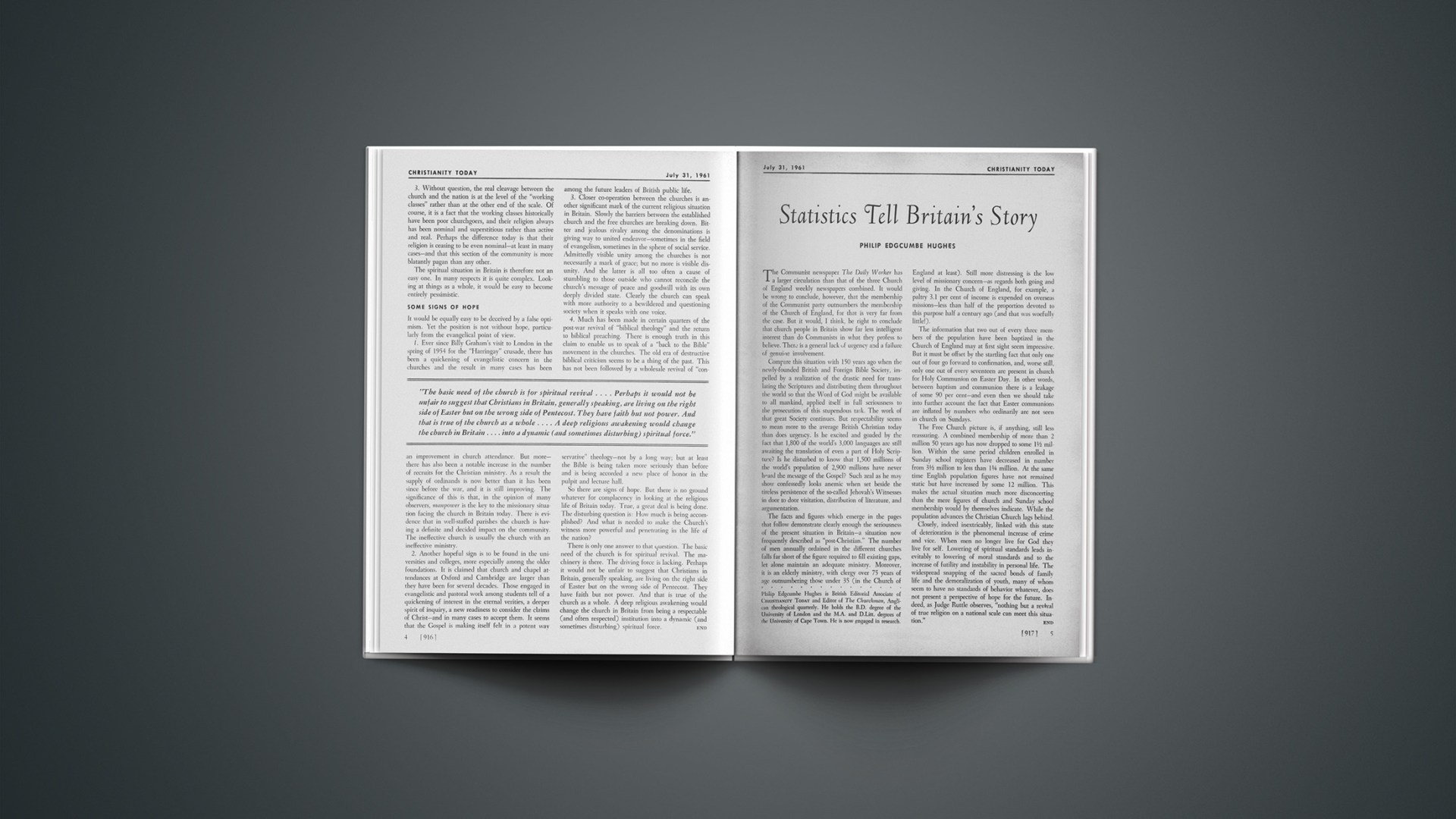

The Communist newspaper The Daily Worker has a larger circulation than that of the three Church of England weekly newspapers combined. It would be wrong to conclude, however, that the membership of the Communist party outnumbers the membership of the Church of England, for that is very far from the case. But it would, I think, be right to conclude that church people in Britain show far less intelligent interest than do Communists in what they profess to believe. There is a general lack of urgency and a failure of genuine involvement.
Compare this situation with 150 years ago when the newly-founded British and Foreign Bible Society, impelled by a realization of the drastic need for translating the Scriptures and distributing them throughout the world so that the Word of God might be available to all mankind, applied itself in full seriousness to the prosecution of this stupendous task. The work of that great Society continues. But respectability seems to mean more to the average British Christian today than does urgency. Is he excited and goaded by the fact that 1,800 of the world’s 3,000 languages are still awaiting the translation of even a part of Holy Scripture? Is he disturbed to know that 1,500 millions of the world’s population of 2,900 millions have never heard the message of the Gospel? Such zeal as he may show confessedly looks anemic when set beside the tireless persistence of the so-called Jehovah’s Witnesses in door to door visitation, distribution of literature, and argumentation.
The facts and figures which emerge in the pages that follow demonstrate clearly enough the seriousness of the present situation in Britain—a situation now frequently described as “post-Christian.” The number of men annually ordained in the different churches falls far short of the figure required to fill existing gaps, let alone maintain an adequate ministry. Moreover, it is an elderly ministry, with clergy over 75 years of age outnumbering those under 35 (in the Church of England at least). Still more distressing is the low level of missionary concern—as regards both going and giving. In the Church of England, for example, a paltry 3.1 per cent of income is expended on overseas missions—less than half of the proportion devoted to this purpose half a century ago (and that was woefully little!).
The information that two out of every three members of the population have been baptized in the Church of England may at first sight seem impressive. But it must be offset by the startling fact that only one out of four go forward to confirmation, and, worse still, only one out of every seventeen are present in church for Holy Communion on Easter Day. In other words, between baptism and communion there is a leakage of some 90 per cent—and even then we should take into further account the fact that Easter communions are inflated by numbers who ordinarily are not seen in church on Sundays.
The Free Church picture is, if anything, still less reassuring. A combined membership of more than 2 million 50 years ago has now dropped to some 1½ million. Within the same period children enrolled in Sunday school registers have decreased in number from 3½ million to less than 1¼ million. At the same time English population figures have not remained static but have increased by some 12 million. This makes the actual situation much more disconcerting than the mere figures of church and Sunday school membership would by themselves indicate. While the population advances the Christian Church lags behind.
Closely, indeed inextricably, linked with this state of deterioration is the phenomenal increase of crime and vice. When men no longer live for God they live for self. Lowering of spiritual standards leads inevitably to lowering of moral standards and to the increase of futility and instability in personal life. The widespread snapping of the sacred bonds of family life and the demoralization of youth, many of whom seem to have no standards of behavior whatever, does not present a perspective of hope for the future. Indeed, as Judge Ruttle observes, “nothing but a revival of true religion on a national scale can meet this situation.”
Samuel M. Shoemaker is the author of a number of popular books and the gifted Rector of Calvary Episcopal Church in Pittsburgh. He is known for his effective leadership of laymen and his deeply spiritual approach to all vital issues.