Ideas

Foundations and Tax Reform

Tax reform is desperately needed, but before any major changes are made in the present complex structures, due consideration must be given to all possible consequences. The Founding Fathers established our government with a system of checks and balances so that power would be diffused rather than concentrated. Over the decades new institutions have arisen, usually of necessity, which serve as checks on one another.

More and more spending is coming under the aegis of the government, often because of default in the private sector. The value of foundations is that they are a source of income outside the government for many activities that do not obtain support from private investors.

No one approves of every activity of every foundation, and certainly foundations that are set up primarily to evade taxes and provide other personal benefits for those who establish and run them should not enjoy special privileges. However, restrictions upon the freedom of foundations to perpetuate themselves and distribute their funds as they see fit, within certain limits, can only have the effect of further centralizing power in the government and curtailing one of the checks and balances our system has evolved. It is impossible to keep political considerations out of government administration of funds. Foundations, however, are able to support politically and socially unpopular ventures.

We much prefer the risks of allowing activities of which we disapprove to receive foundation support to the dangers of tending to make the government the sole significant benefactor from which support can be obtained. Abuses by some foundations do not warrant restrictive legislation against them all. Instead we should encourage and strengthen these institutions that help to maintain decentralization of power in the face of trends to concentrate it.
Also in this issue

The CT archives are a rich treasure of biblical wisdom and insight from our past. Some things we would say differently today, and some stances we've changed. But overall, we're amazed at how relevant so much of this content is. We trust that you'll find it a helpful resource.

'Co-belligerent' Reconciliation

Editorial

The Role of Lebanese Christians

Editorial

Justice and the Chicago Eight

Editorial

Capitalism in the Soviet Union

Editorial

The Book for All Seasons

Editorial

Speeding Up Desegregation

Editorial

Man's Judgement

Belfast Imbroglio

Ministry, Computer Style

The Complete NEB

Denominational Regrouping

Fruitful Shakedown for 'Evangel' Craft

Prayer Day for Captives

Ouster in Missouri

New York Council: Problems in the Immediate Family

John Wesley College: Disengaging the Nazarenes

Indonesian Phenomenon

Inaguration Ceremonies: Dividends for Dollars

Latin, Litter, Limitations

ACCC: No Longer Doing Its Founder’s Will

News Briefs from November 21, 1969

Scientology: Religion or Racket?: Second of Two Parts

Joseph Martin Hopkins

The Quaker Movement West

What’s the Mutter with Astrology?

Religious Cartoons: Needling Inconsistencies

Roman Synod: Speaking with Candor to the Pope

Book Briefs: November 21, 1969

Editorial

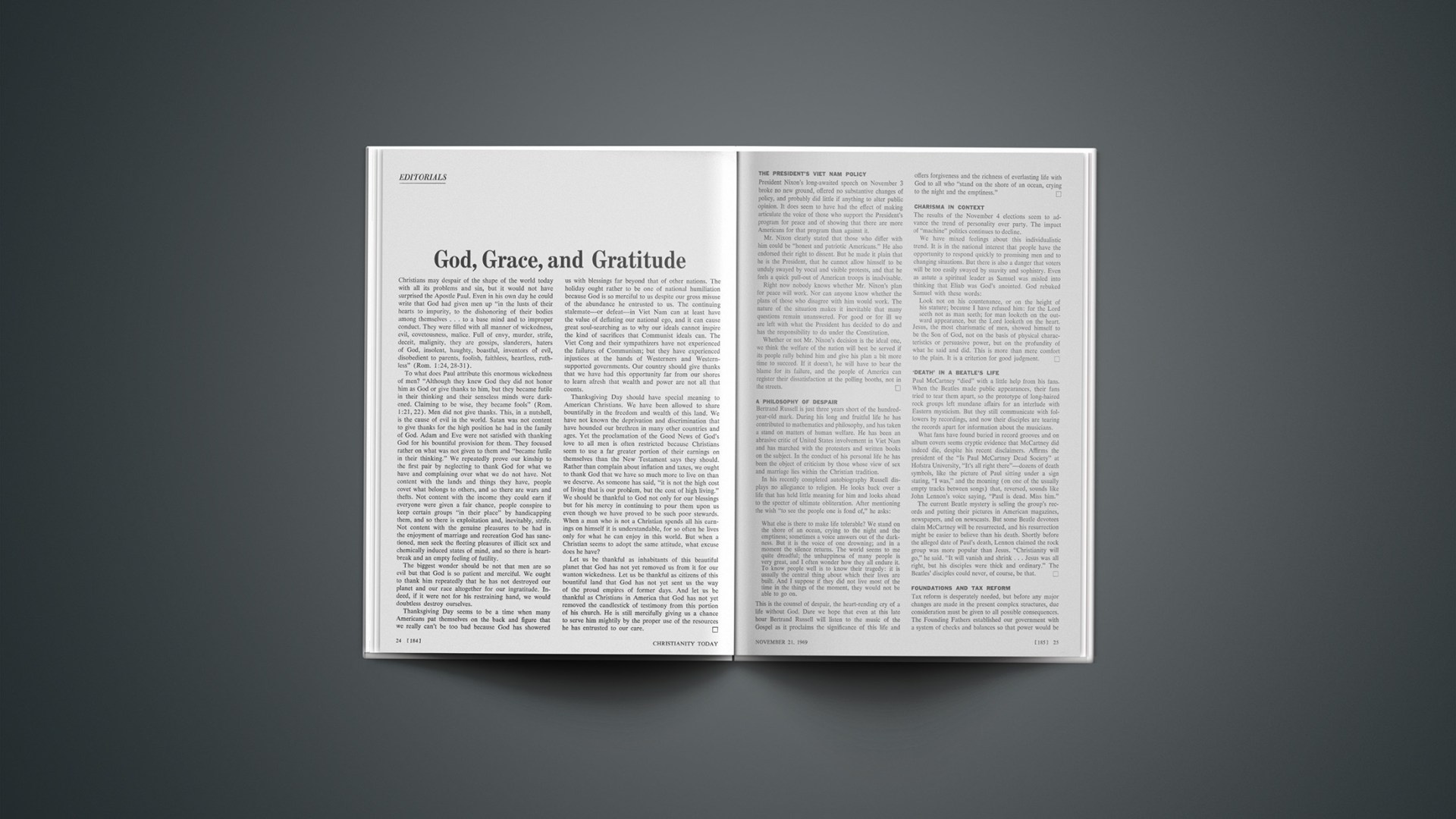
God, Grace, and Gratitude

Testing for Maturity

That Searching Look

Eutychus and His Kin: November 21, 1969

Who Needs History?

Richard L. Tobin

Editor's Note from November 21, 1969

’Tis the Season to Be Gluttonous

Stanley Paregien

The Human Experience of Death

Thomas Howard

The Nonsense of Liberal Catholics

James P. Degnan

Poverty: The Psychological Effects

The Heritage of Plymouth

Editorial

The President’s Viet Nam Policy

Editorial

A Philosophy of Despair

Editorial

Charisma in Context

Editorial

'Death' In a Beatle's Life

View issue

Our Latest

Death of a Eulogy

Matthew D. Love

Christian funerals are increasingly secular. But how can Christians go quiet on the gospel at these of all moments?

The Vanishing Gifts of Boredom

The Bulletin with Christine Rosen

How technology steals uncomfortable yet formative human experiences.

Christianity Today: A Declaration of Principles

Where we stand at seven decades—and how readers can help.

Being Human

Steve Cuss & Clarissa Moll: How Your Communication Style Fuels Reactivity—and How to Change It

Communication styles that reduce anxiety: rigid vs fluid, rapid vs deliberate

Reexamining Thomas Jefferson

Thomas S. Kidd

Three books on history to read this month.

From Panic Attacks to Physical Discipline

Justin Whitmel Earley

How one new year turned my life around spiritually and physically.

When the Times Were ‘A-Changin’’

CT reported on 1967 “message music,” the radicalism on American college campuses, and how the Six-Day War fit into biblical prophecy.

Where Your Heart Is, There Your Habits Will Be Also

Elise Brandon

We won’t want to change until we know why we need to and what we’re aiming for.

Apple PodcastsDown ArrowDown ArrowDown Arrowarrow_left_altLeft ArrowLeft ArrowRight ArrowRight ArrowRight Arrowarrow_up_altUp ArrowUp ArrowAvailable at Amazoncaret-downCloseCloseEmailEmailExpandExpandExternalExternalFacebookfacebook-squareGiftGiftGooglegoogleGoogle KeephamburgerInstagraminstagram-squareLinkLinklinkedin-squareListenListenListenChristianity TodayCT Creative Studio Logologo_orgMegaphoneMenuMenupausePinterestPlayPlayPocketPodcastRSSRSSSaveSaveSaveSearchSearchsearchSpotifyStitcherTelegramTable of ContentsTable of Contentstwitter-squareWhatsAppXYouTubeYouTube