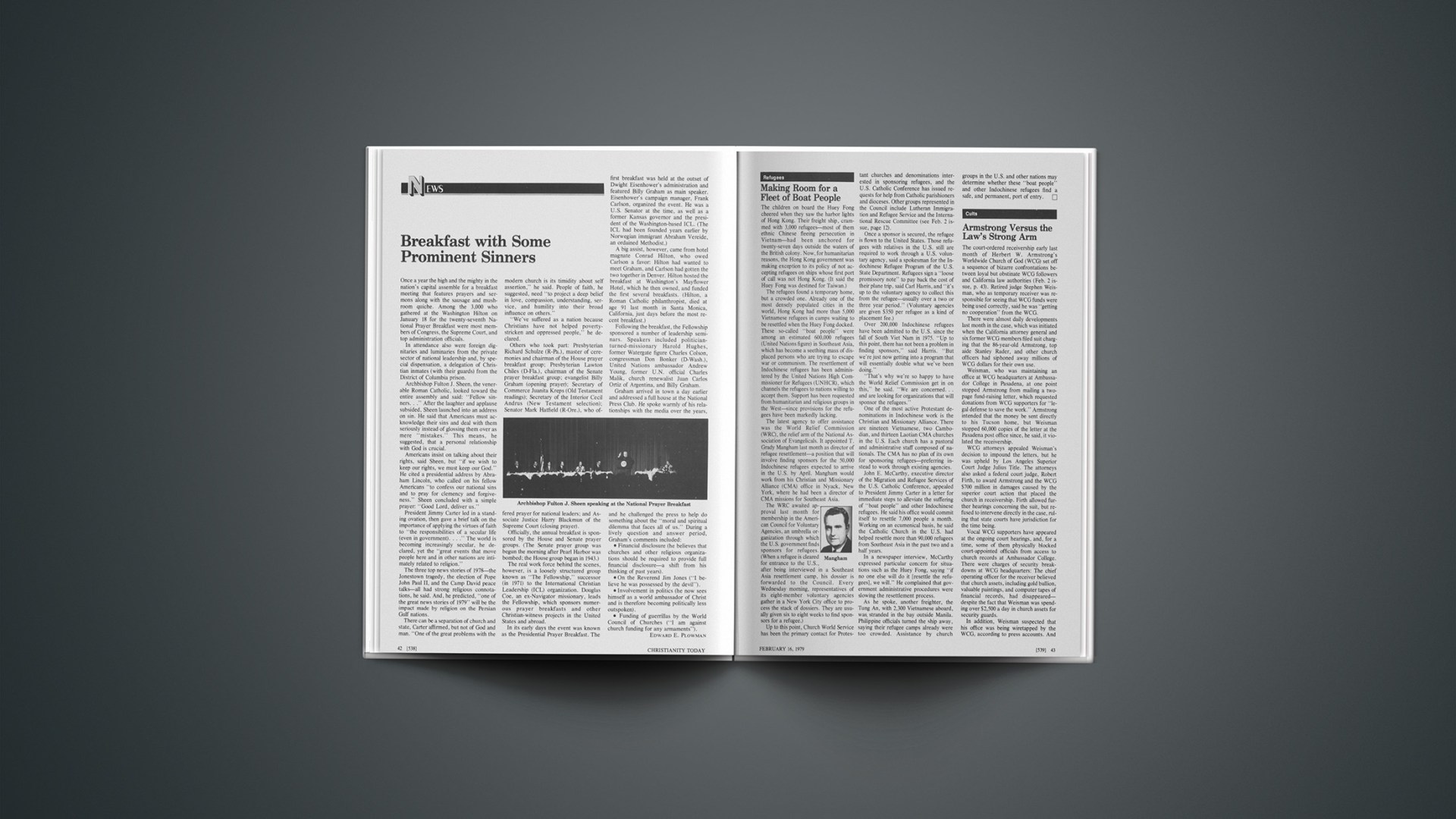

Once a year the high and the mighty in the nation’s capital assemble for a breakfast meeting that features prayers and sermons along with the sausage and mushroom quiche. Among the 3,000 who gathered at the Washington Hilton on January 18 for the twenty-seventh National Prayer Breakfast were most members of Congress, the Supreme Court, and top administration officials.
In attendance also were foreign dignitaries and luminaries from the private sector of national leadership and, by special dispensation, a delegation of Christian inmates (with their guards) from the District of Columbia prison.
Archbishop Fulton J. Sheen, the venerable Roman Catholic, looked toward the entire assembly and said: “Fellow sinners …” After the laughter and applause subsided, Sheen launched into an address on sin. He said that Americans must acknowledge their sins and deal with them seriously instead of glossing them over as mere “mistakes.” This means, he suggested, that a personal relationship with God is crucial.
Americans insist on talking about their rights, said Sheen, but “if we wish to keep our rights, we must keep our God.” He cited a presidential address by Abraham Lincoln, who called on his fellow Americans “to confess our national sins and to pray for clemency and forgiveness.” Sheen concluded with a simple prayer: “Good Lord, deliver us.”
President Jimmy Carter led in a standing ovation, then gave a brief talk on the importance of applying the virtues of faith to “the responsibilities of a secular life (even in government).…” The world is becoming increasingly secular, he declared, yet the “great events that move people here and in other nations are intimately related to religion.”
The three top news stories of 1978—the Jonestown tragedy, the election of Pope John Paul II, and the Camp David peace talks—all had strong religious connotations, he said. And, he predicted, “one of the great news stories of 1979” will be the impact made by religion on the Persian Gulf nations.
There can be a separation of church and state, Carter affirmed, but not of God and man. “One of the great problems with the modern church is its timidity about self assertion,” he said. People of faith, he suggested, need “to project a deep belief in love, compassion, understanding, service, and humility into their broad influence on others.”
“We’ve suffered as a nation because Christians have not helped poverty-stricken and oppressed people,” he declared.
Others who took part: Presbyterian Richard Schulze (R-Pa.), master of ceremonies and chairman of the House prayer breakfast group; Presbyterian Lawton Chiles (D-Fla.), chairman of the Senate prayer breakfast group; evangelist Billy Graham (opening prayer); Secretary of Commerce Juanita Kreps (Old Testament readings); Secretary of the Interior Cecil Andrus (New Testament selection); Senator Mark Hatfield (R-Ore.), who offered prayer for national leaders; and Associate Justice Harry Blackmun of the Supreme Court (closing prayer).
Officially, the annual breakfast is sponsored by the House and Senate prayer groups. (The Senate prayer group was begun the morning after Pearl Harbor was bombed; the House group began in 1943.)
The real work force behind the scenes, however, is a loosely structured group known as “The Fellowship,” successor (in 1971) to the International Christian Leadership (ICL) organization. Douglas Coe, an ex-Navigator missionary, leads the Fellowship, which sponsors numerous prayer breakfasts and other Christian-witness projects in the United States and abroad.
In its early days the event was known as the Presidential Prayer Breakfast. The first breakfast was held at the outset of Dwight Eisenhower’s administration and featured Billy Graham as main speaker. Eisenhower’s campaign manager, Frank Carlson, organized the event. He was a U.S. Senator at the time, as well as a former Kansas governor and the president of the Washington-based ICL. (The ICL had been founded years earlier by Norwegian immigrant Abraham Vereide, an ordained Methodist.)
A big assist, however, came from hotel magnate Conrad Hilton, who owed Carlson a favor: Hilton had wanted to meet Graham, and Carlson had gotten the two together in Denver. Hilton hosted the breakfast at Washington’s Mayflower Hotel, which he then owned, and funded the first several breakfasts. (Hilton, a Roman Catholic philanthropist, died at age 91 last month in Santa Monica, California, just days before the most recent breakfast.)
Following the breakfast, the Fellowship sponsored a number of leadership seminars. Speakers included politician-turned-missionary Harold Hughes, former Watergate figure Charles Colson, congressman Don Bonker (D-Wash.), United Nations ambassador Andrew Young, former U.N. official Charles Malik, church renewalist Juan Carlos Ortiz of Argentina, and Billy Graham.
Graham arrived in town a day earlier and addressed a full house at the National Press Club. He spoke warmly of his relationships with the media over the years, and he challenged the press to help do something about the “moral and spiritual dilemma that faces all of us.” During a lively question and answer period, Graham’s comments included:
• Financial disclosure (he believes that churches and other religious organizations should be required to provide full financial disclosure—a shift from his thinking of past years).
• On the Reverend Jim Jones (“I believe he was possessed by the devil”).
• Involvement in politics (he now sees himself as a world ambassador of Christ and is therefore becoming politically less outspoken).
• Funding of guerrillas by the World Council of Churches (“I am against church funding for any armaments”).