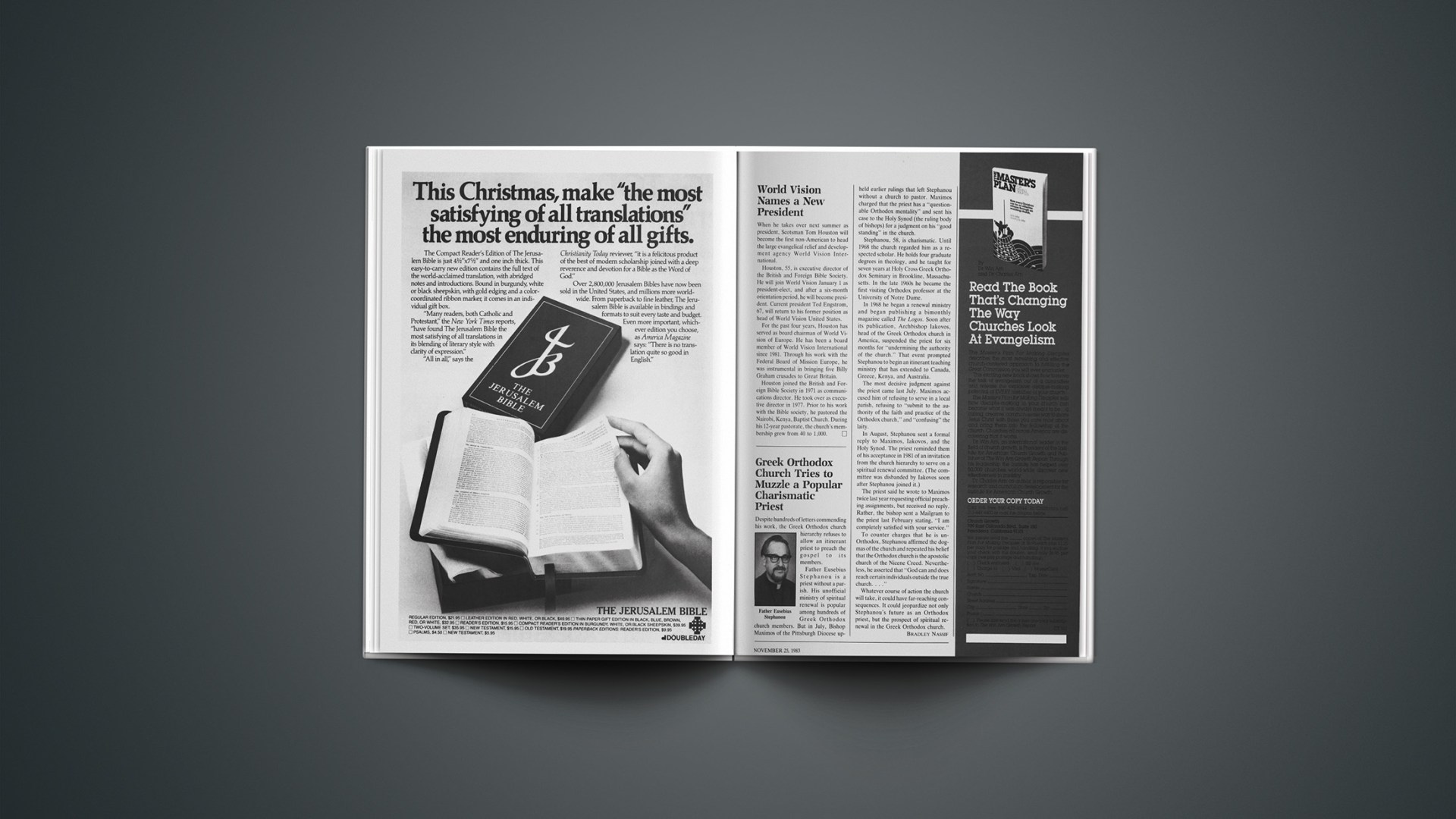

Despite hundreds of letters commending his work, the Greek Orthodox church hierarchy refuses to allow an itinerant priest to preach the gospel to its members.
Father Eusebius Stephanou is a priest without a parish. His unofficial ministry of spiritual renewal is popular among hundreds of Greek Orthodox church members. But in July, Bishop Maximos of the Pittsburgh Diocese upheld earlier rulings that left Stephanou without a church to pastor. Maximos charged that the priest has a “questionable Orthodox mentality” and sent his case to the Holy Synod (the ruling body of bishops) for a judgment on his “good standing” in the church.
Stephanou, 58, is charismatic. Until 1968 the church regarded him as a respected scholar. He holds four graduate degrees in theology, and he taught for seven years at Holy Cross Greek Orthodox Seminary in Brookline, Massachusetts. In the late 1960s he became the first visiting Orthodox professor at the University of Notre Dame.
In 1968 he began a renewal ministry and began publishing a bimonthly magazine called The Logos. Soon after its publication. Archbishop Iakovos, head of the Greek Orthodox church in America, suspended the priest for six months for “undermining the authority of the church.” That event prompted Stephanou to begin an itinerant teaching ministry that has extended to Canada, Greece, Kenya, and Australia.
The most decisive judgment against the priest came last July. Maximos accused him of refusing to serve in a local parish, refusing to “submit to the authority of the faith and practice of the Orthodox church,” and “confusing” the laity.
In August, Stephanou sent a formal reply to Maximos, Iakovos, and the Holy Synod. The priest reminded them of his acceptance in 1981 of an invitation from the church hierarchy to serve on a spiritual renewal committee. (The committee was disbanded by Iakovos soon after Stephanou joined it.)
The priest said he wrote to Maximos twice last year requesting official preaching assignments, but received no reply. Rather, the bishop sent a Mailgram to the priest last February stating, “I am completely satisfied with your service.”
To counter charges that he is unorthodox, Stephanou affirmed the dogmas of the church and repeated his belief that the Orthodox church is the apostolic church of the Nicene Creed. Nevertheless, he asserted that “God can and does reach certain individuals outside the true church.…”
Whatever course of action the church will take, it could have far-reaching consequences. It could jeopardize not only Stephanou’s future as an Orthodox priest, but the prospect of spiritual renewal in the Greek Orthodox church.