

Hispanics Meet to Examine How U.S. Churches Respond to Them

Spanish-speaking Christians from 20 denominations will meet next month in Los Angeles to examine how U.S. churches are responding to a rapidly growing Hispanic presence.

Churches have made ministry to, and competition for, Hispanics a major priority. The nation’s fastest-growing minority group numbers from 17 million to 20 million, many of them unchurched. Most estimates list only 15 to 30 percent of Hispanics as “active” Catholics, with 5 to 10 percent identifying with Protestant churches.

“For many years, Hispanics have been an invisible people within society and the church,” says Herbert Arrunategui, coordinator of national Hispanic ministries for the Episcopal Church. “But they can’t be ignored any longer. This is a mission of opportunity.”

The church’s response takes many forms. At next month’s meeting, sponsored by the Hispanic task force of the ecumenical Joint Strategy and Action Committee, speakers will describe ways to develop Spanish-speaking congregations. Hispanics keep their culture and language for generations. As a result, several denominations stress the creation of separate congregations rather than integrating Hispanics into English-speaking churches.

Ministries to Hispanics often emphasize leadership training. The South Bronx Pastoral Center in New York City last year trained 650 Hispanics to administer sacraments in Catholic parishes and to work in other areas of liturgy, parish governance, religious education, and social action. In Boynton Beach, Florida, Saint Vincent De Paul Seminary has instituted the first Spanish-language master of divinity degree program. Students in a number of Protestant seminaries are encouraged to start Hispanic churches while studying for their degrees.

“There is a self-interest here,” says Eli Rivera of the United Methodist Board of Global Ministries. “Most of the major denominations have lost many members in large cities. And that is where Hispanic communities are growing.”

United Methodists in July elected their first Hispanic bishop, Elias Galvan, of Pasadena, California. The 14-million-member Southern Baptist Convention estimates that it offers 4,000 programs for Hispanics.

In the Roman Catholic church, 108 of 175 dioceses have offices concerned exclusively with Hispanic ministries. Eight regional agencies serve the same purpose. However, many Spanish-speaking Americans are joining Protestant churches. In a pastoral letter, U.S. Catholic bishops have denounced “anti-ecumenical” and “anti-Catholic” proselytizing of Hispanics by evangelical Christians and fundamentalists.

The two-million-member Assemblies of God attributes its recent explosive growth largely to new Hispanic members. Some 1,100 Spanish-speaking congregations make up 10 percent of the denomination’s membership. The Southern Baptist Convention boasts 1,800 Hispanic congregations. That figure grows by more than 150 a year. The American Baptist Churches list 209 Hispanic congregations; the Church of the Nazarene, 147; the Presbyterian Church (USA), 120; and the Christian Church (Disciples of Christ), 30.

The influx of Spanish-speaking Christians into American denominations promises to influence religious life in the United States. James W. Carty, Jr., a professor at Bethany College in West Virginia, describes the worship style of Hispanics as usually “charismatic with simultaneous praying aloud; musical combos of percussion instruments, electronic organs, and guitars; and singing of hymns with theological concepts set to indigenous music.” The Hispanic exposure to grassroots Christian communities in their native countries could accelerate the push for lay decision making in their adopted churches.

RELIGIOUS NEWS SERVICE

Also in this issue

The CT archives are a rich treasure of biblical wisdom and insight from our past. Some things we would say differently today, and some stances we've changed. But overall, we're amazed at how relevant so much of this content is. We trust that you'll find it a helpful resource.

Intervarsity Withdraws a Book Opposed by Prolifers

Randy Frame

Eutychus and His Kin: September 21, 1984

Editorial

Our November Call to Conscience

Narrow Victories—Or Defeats

Frank Gaebelein: Character before Career: From My Earliest Years I Simply Knew that Dad Rang True

Gretchen Gaebelein Hull

Can Any Good Thing Come out of Hollywood?: An Interview with Producer Ken Wales

A Misunderstood Reformer: Sören Kierkegaard Has Burst on the Consciousness of the Twentieth Century like a Time Bomb with a Long-Delayed Fuse

C. Stephen Evans

Two Brothers … Who Changed the Course of Church Singing: For 57 Years, John and Charles Wesley Wrote an Average of Three Hymns per Week

Richard D. Dinwiddie

The Jesus ‘Technique’

Virginia Stem Owens

These Christians Are Helping Gays Escape from Homosexual Lifestyles

Beth Spring

A Woman Who Cares about Gays in Washington, D.C.

Dragons in the Church

Do Jehovah’s Witnesses Still Hold to Their 1984 Doomsday Deadline?

Born-Again Minnesotans Play Political Hardball

Beth Spring

Canadian Better Business Bureaus Warn against Humbard’s Fund-Raising Letters

A Self-Styled Evangelist Stretches God’s Truth

Ronald Enroth

Hatfield Is Bruised by the ‘Appearance of Impropriety’

Christians in Nepal Share Their Faith despite the Threat of Imprisonment

Sharon Mumper

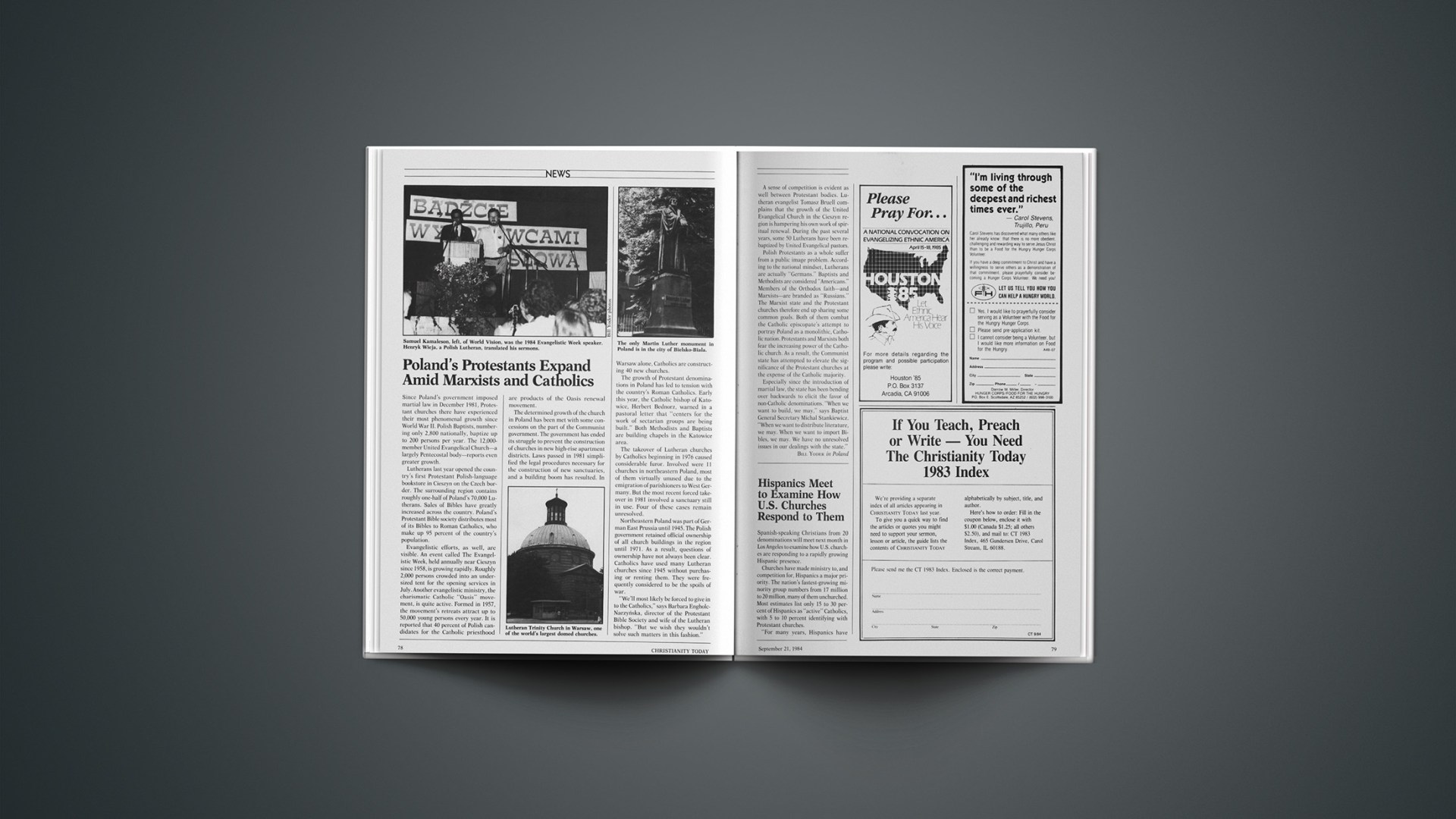
Poland’s Protestants Expand amid Marxists and Catholics

Speaking out: Where Have All the Heroes Gone?

Alice Poynor

Refiner’s Fire: A 350-Year-Old Passion

Carol R. Thiessen

View issue

Our Latest

From Our Community

A Commitment to the Gospel Is A Commitment to Diversity

Caitlin Edwards

Rev. Dr. Gabriel Salguero shares how the Gospel teaches us to love our neighbors and build bridges.

A Memoir of Exvangelical Anger—but Not for the People in the Pews

Journalist Josiah Hesse discusses his new book on poverty, Pentecostalism, and the politics of the Christian right.

News

Nigerian Christian Schools Fill Gaps for Students with Disabilities

Emiene Erameh

Many public schools can’t offer special education, so churches offer needed resources and community.

The Russell Moore Show

Moore to the Point: Why Christians Ignore What the Bible Says About Immigrants

Believers can disagree on migration policies—but the Word of God should shape how we minister to vulnerable people.

Studying Pain ‘Causes Me to Pine for Eternity’

Interview by Yi Ning Chiu

A clinical psychologist explains her research on the brain, suffering, and culture—and what she’s learned about God’s beautiful design.

Being Human

Adam Young on Trauma and Theology: Why Your Certainty Might Be Just a Fancy Disguise

Can exploring the impact of trauma on our lives lead wounds to wisdom?


The Bulletin

Venezuelan Oil, LA Fires Aftermath, and Revival In America

Mike Cosper, Clarissa Moll, Russell Moore

The global aftershock of military action in Venezuela, California churches rebuild one year after LA fires, and the possibility of revival in America.

What Christian Parents Should Know About Roblox

Isaac Wood

The gaming platform poses both content concerns and safety risks that put minors in “the Devil’s crosshairs.” The company says tighter restrictions are coming.

Apple PodcastsDown ArrowDown ArrowDown Arrowarrow_left_altLeft ArrowLeft ArrowRight ArrowRight ArrowRight Arrowarrow_up_altUp ArrowUp ArrowAvailable at Amazoncaret-downCloseCloseEmailEmailExpandExpandExternalExternalFacebookfacebook-squareGiftGiftGooglegoogleGoogle KeephamburgerInstagraminstagram-squareLinkLinklinkedin-squareListenListenListenChristianity TodayCT Creative Studio Logologo_orgMegaphoneMenuMenupausePinterestPlayPlayPocketPodcastRSSRSSSaveSaveSaveSearchSearchsearchSpotifyStitcherTelegramTable of ContentsTable of Contentstwitter-squareWhatsAppXYouTubeYouTube






