
During an election year, prolifers intensify picketing efforts, venture into civil disobedience.
The National Abortion Federation (NAF) recorded 19 acts of bombing or arson against abortion clinics during the first nine months of this year. One of the bombings took place at the NAF’s Washington, D.C., office. Only four such incidents occurred during all of 1983. NAF blames “anti-choice” demonstrators for the increased violence.
The National Organization for Women (NOW) has launched a “campaign to end clinic violence.” In a letter to members, NOW president Judy Goldsmith alleged that President Reagan’s “irresponsible and inflammatory anti-abortion, anti-women rhetoric … incites and encourages the right-wing terrorists.” At the insistence of NAF and NOW, the United States Department of Alcohol, Tobacco and Firearms is investigating the violence. So far there have been no convictions.
Prolife spokesmen countercharge that abortion providers set fire to abortion clinics to collect insurance money, to hurt competitors, or to char the image of the prolife movement. Abortionists and antiabortionists, however, agree on one thing: prolife activism has escalated in this election year, and it shows no signs of abating.
In May, prolife activists met in Fort Lauderdale, Florida, for their first national conference. Among other things they discussed a strategy for picketing Democratic presidential candidate Walter Mondale and his running mate, Geraldine Ferraro. Prolife demonstrators regularly greeted Ferraro at her campaign stops.
In addition, demonstrations at abortion clinics have become more frequent and intense. “We have four abortion mills in Cincinnati,” says Jack Willke, president of the National Right to Life Committee (NRLC), the country’s largest antiabortion organization. “We’ve been picketing them for 12 years. But it used to be only on Saturdays. Now it’s three or four times a week.”
Steven Baer, until recently director of education for Americans United for Life, says prolifers are getting impatient. “A lot of frustration has been building up over the last 10 years,” he says. “[Reagan] is the most outspoken prolife President in history. And Congress is definitely moving in a prolife direction. But with 4,000 babies being killed every day, for some of us things aren’t moving fast enough.”
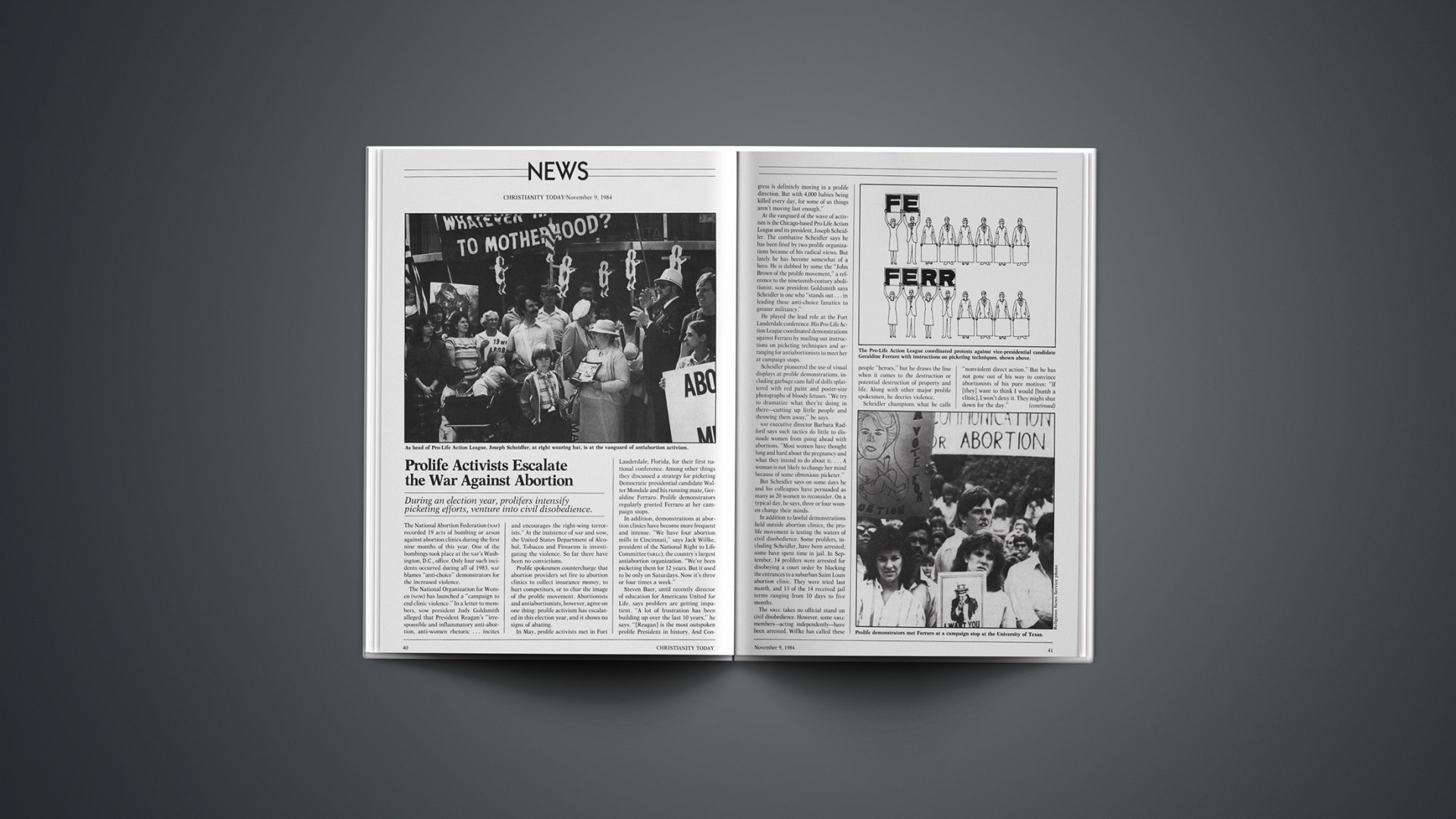
At the vanguard of the wave of activism is the Chicago-based Pro-Life Action League and its president, Joseph Scheidler. The combative Scheidler says he has been fired by two prolife organizations because of his radical views. But lately he has become somewhat of a hero. He is dubbed by some the “John Brown of the prolife movement,” a reference to the nineteenth-century abolitionist. NOW president Goldsmith says Scheidler is one who “stands out … in leading these anti-choice fanatics to greater militancy.”
He played the lead role at the Fort Lauderdale conference. His Pro-Life Action League coordinated demonstrations against Ferraro by mailing out instructions on picketing techniques and arranging for antiabortionists to meet her at campaign stops.
Scheidler pioneered the use of visual displays at prolife demonstrations, including garbage cans full of dolls splattered with red paint and poster-size photographs of bloody fetuses. “We try to dramatize what they’re doing in there—cutting up little people and throwing them away,” he says.
NAF executive director Barbara Radford says such tactics do little to dissuade women from going ahead with abortions. “Most women have thought long and hard about the pregnancy and what they intend to do about it.… A woman is not likely to change her mind because of some obnoxious picketer.”
But Scheidler says on some days he and his colleagues have persuaded as many as 20 women to reconsider. On a typical day, he says, three or four women change their minds.
In addition to lawful demonstrations held outside abortion clinics, the prolife movement is testing the waters of civil disobedience. Some prolifers, including Scheidler, have been arrested; some have spent time in jail. In September, 14 prolifers were arrested for disobeying a court order by blocking the entrances to a suburban Saint Louis abortion clinic. They were tried last month, and 13 of the 14 received jail terms ranging from 10 days to five months.
The NRLC takes no official stand on civil disobedience. However, some NRLC members—acting independently—have been arrested. Willke has called these people “heroes,” but he draws the line when it comes to the destruction or potential destruction of property and life. Along with other major prolife spokesmen, he decries violence.
Scheidler champions what he calls “nonviolent direct action.” But he has not gone out of his way to convince abortionists of his pure motives: “If [they] want to think I would [bomb a clinic], I won’t deny it. They might shut down for the day.”
Scheidler says that “to admonish prolifers not to bomb clinics would be an insult to the prolife movement. I don’t know of anyone who would do this.” He believes that enraged families of young women who have been “victimized by the abortion industry” are in part responsible for clinic violence.
However, Willke and other prolife leaders acknowledge that a fringe element in the prolife movement holds the view that anything—including violence—that succeeds in shutting down abortion clinics is acceptable. Rumors abound that some compare the slaying of an abortionist to killing an enemy soldier during a war in order to protect the innocent.
Christian attorney and prolife spokesman John Whitehead says this “fringe element is very, very small.… Some people out there are tremendously frustrated. I understand this frustration. But frustration does not override biblical principles. The Bible does not establish vigilantes.”
The NRLC’s Willke agrees that the mainstream prolife movement is nonviolent. But he emphasizes that “for every two living human beings who go into an abortion clinic, one is killed. That’s the ultimate violence. And I’ll predict that the only way to stop the violence outside the doors is to first stop the violence inside the doors.”