


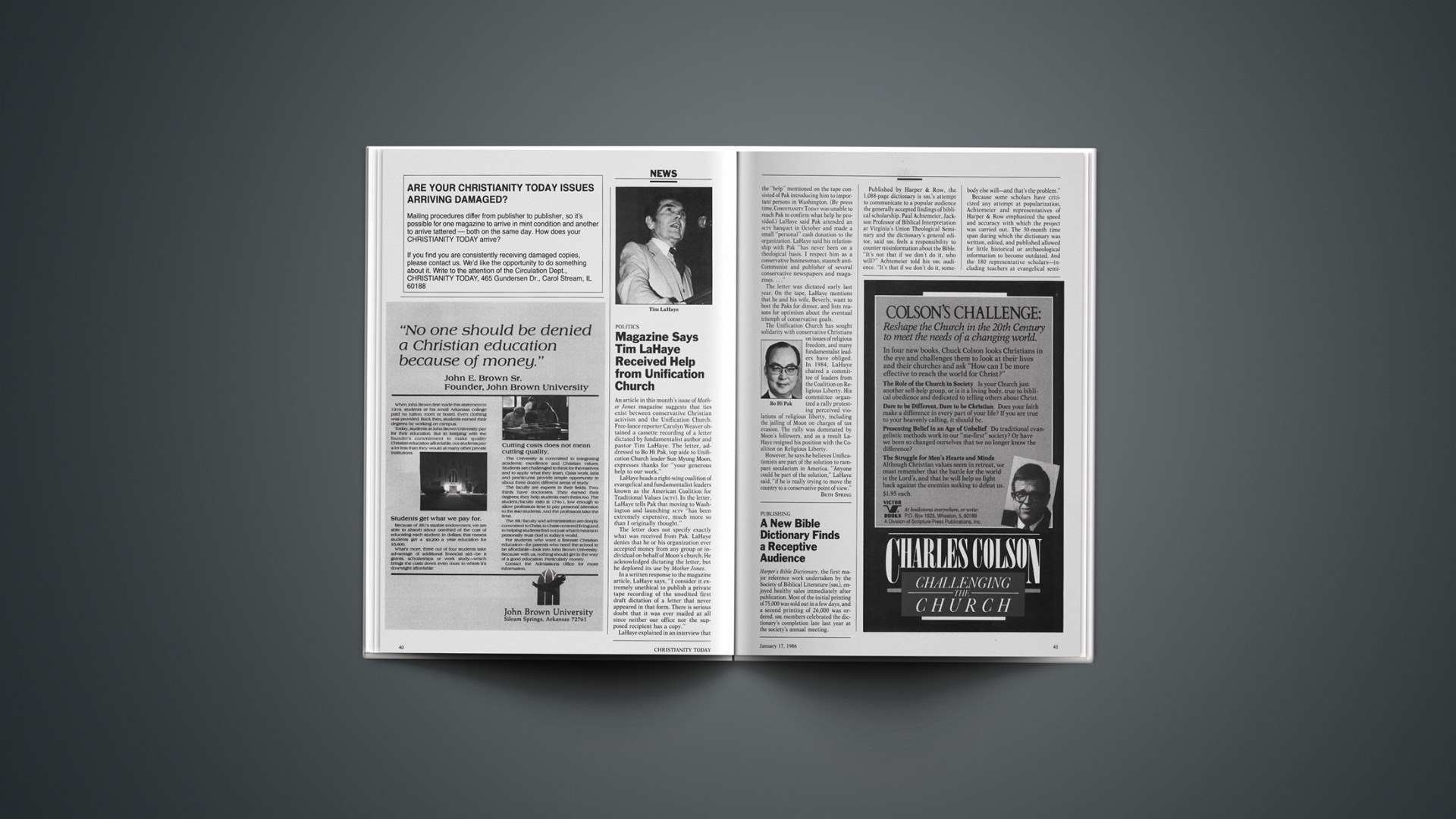

Harper’s Bible Dictionary, the first major reference work undertaken by the Society of Biblical Literature (SBL), enjoyed healthy sales immediately after publication. Most of the initial printing of 75,000 was sold out in a few days, and a second printing of 26,000 was ordered. SBL members celebrated the dictionary’s completion late last year at the society’s annual meeting.
Published by Harper & Row, the 1,088-page dictionary is SBL’s attempt to communicate to a popular audience the generally accepted findings of biblical scholarship. Paul Achtemeier, Jackson Professor of Biblical Interpretation at Virginia’s Union Theological Seminary and the dictionary’s general editor, said SBL feels a responsibility to counter misinformation about the Bible. “It’s not that if we don’t do it, who will?” Achtemeier told his SBL audience. “It’s that if we don’t do it, somebody else will—and that’s the problem.”
Because some scholars have criticized any attempt at popularization, Achtemeier and representatives of Harper & Row emphasized the speed and accuracy with which the project was carried out. The 30-month time span during which the dictionary was written, edited, and published allowed for little historical or archaeological information to become outdated. And the 180 representative scholars—including teachers at evangelical seminaries and colleges—were selected to insure that only majority viewpoints among biblical scholars were presented.
Although the editors attempted to present only “consensus scholarship,” most evangelical readers will disagree with some of the information presented. The dictionary’s article on inspiration contains nothing objectionable to those who believe in the inerrancy of Scripture. However, the article on biblical criticism asserts without support that chapters 40 through 66 of Isaiah were not written by Isaiah, and that the letters to Timothy and Titus were not written by Paul—a position not generally held by evangelical and fundamentalist scholars.
Harper & Row has brought SBL’s scholarship to the general public by gaining the attention of major secular book marketing channels—chain stores such as Waldenbooks and B. Dalton Bookseller, and major book clubs such as Book-of-the-Month Club and Literary Guild. Cheered by the success of its first venture into popularizing its expert knowledge, SBL is working on a follow-up project, the one-volume Harper’s Bible Commentary, to be released in the fall of 1987.