In this series

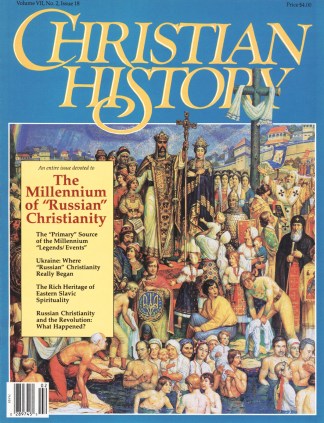
That Prince Vladimir, the Slavic ruler credited with the Christianization of Rus’ (not Russia), allegedly ordered all the inhabitants of Kiev, his capital city, to appear at the river for baptism on a particular day in 988 or they would be considered enemies of the kingdom?
That one reason Vladimir allegedly decided to accept Christianity was because, after hearing defenses of several major religions, he was healed from an eye disease after his grandmother Olga prayed to her god, the God of the Orthodox?
That another alleged reason for Vladimir’s conversion was his emissaries’ report that when they saw the grandeur of the Eastern Orthodox services in Constantinople, they were so awed that “We knew not whether we were in heaven or on earth, for on earth there is no such splendor or such beauty!”?
That believers from the Ukrainian portion of the Soviet Union have for centuries embraced St. Andrew the Apostle as their patron saint, citing several early sources that say that he, the “first-called” apostle, conducted mission work in their homeland c.50–60 A.D.?
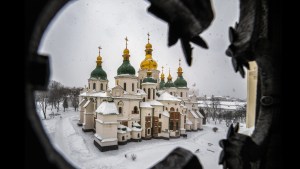
That despite the millennium events primarily conducted in Moscow in 1988, the baptism that the millennium celebrates actually took place in the region that is today known as Ukraine, in the ancient city of Kiev (hundreds of miles from Moscow, which hardly even existed in 988)?
That the Ukrainian Catholic Church, which claims direct lineage to the 988 baptism, is today banned in the Ukrainian Soviet Socialist Republic, and its four million adherents are either worshipping “underground” in Ukraine or have scattered across the globe, primarily to the U.S. and Canada?
That the Constitution of the Soviet Union says its citizens are “guaranteed … the right to profess … any religion, and to conduct religious worship”?
That, while statistics from the Soviet Union are very questionable, it seems certain that today some 50 million Soviet citizens are members of the Russian Orthodox church, some 10 million are members of the Roman Catholic Church, and at least another 12 million are members of the Georgian and Armenian Orthodox Churches, and of various Protestant churches?
That adding to the 72 million above the Muslims, Jews, and others, at least 40 percent of the Soviets retain a religious identity, while only 19 million are members of the Communist Party?
That as recently as the late 1950s and early ’60s, during Nikita Kruschev’s policy of “de-Stalinization,” from 7,000 to 10,000 Russian Orthodox Churches—about half of those then open—were closed down and dissolved by government action?
That in some republics of the Union of Soviet Socialist Republics, believers can, with little resistance, evangelize, carry out religious instruction, and publish religious literature?
That clergymen of the Russian Orthodox Church set foot on what is today known as the State of Alaska in 1794, and established Orthodox churches all the way down to San Francisco, Calif., before Alaska was even purchased from Russia by the United States government?
Copyright © 1988 by the author or Christianity Today/Christian History magazine. Click here for reprint information on Christian History.