





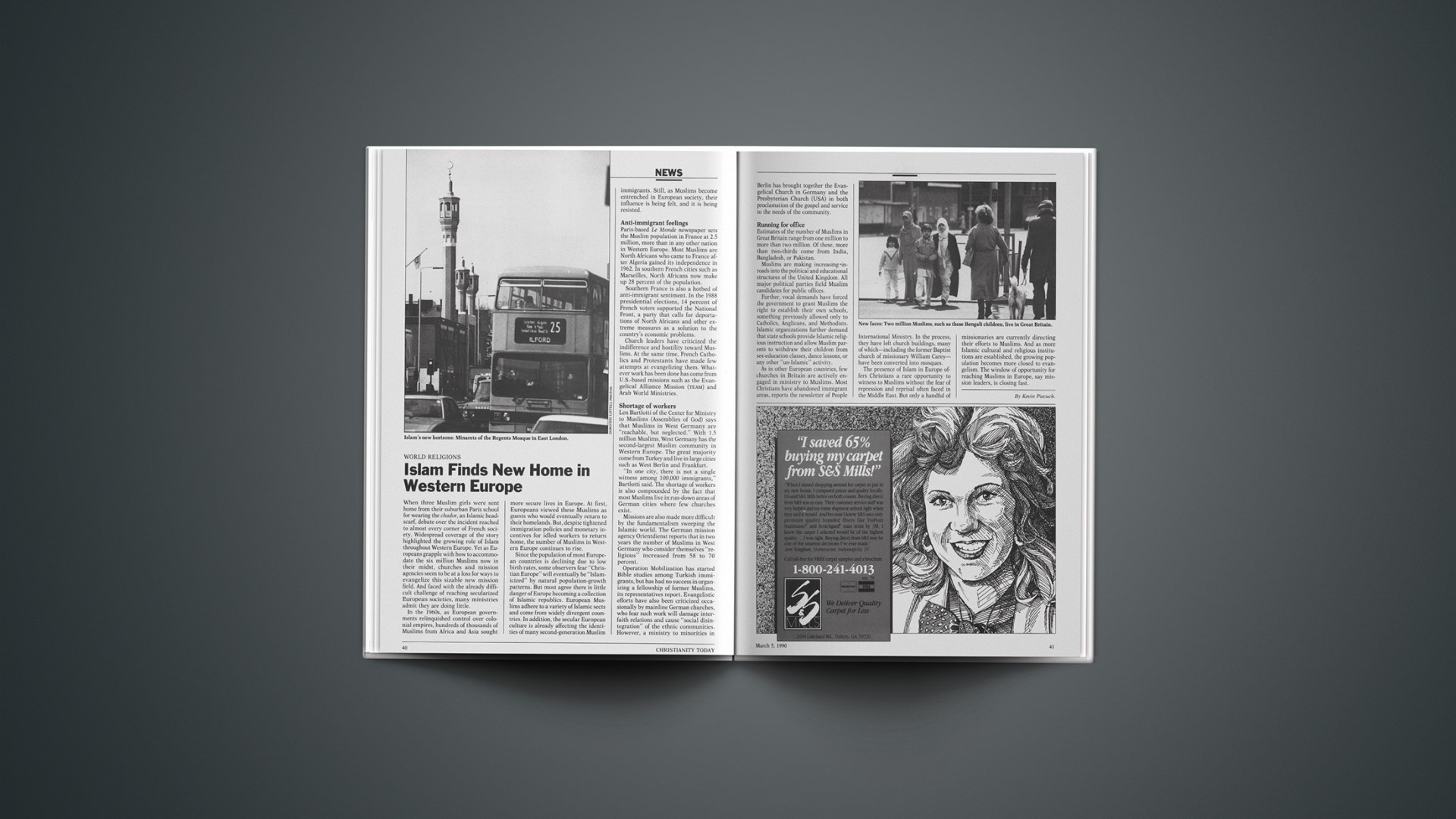

When three Muslim girls were sent home from their suburban Paris school for wearing the chador, an Islamic headscarf, debate over the incident reached to almost every comer of French society. Widespread coverage of the story highlighted the growing role of Islam throughout Western Europe. Yet as Europeans grapple with how to accommodate the six million Muslims now in their midst, churches and mission agencies seem to be at a loss for ways to evangelize this sizable new mission field. And faced with the already difficult challenge of reaching secularized European societies, many ministries admit they are doing little.
In the 1960s, as European governments relinquished control over colonial empires, hundreds of thousands of Muslims from Africa and Asia sought more secure lives in Europe. At first, Europeans viewed these Muslims as guests who would eventually return to their homelands. But, despite tightened immigration policies and monetary incentives for idled workers to return home, the number of Muslims in Western Europe continues to rise.
Since the population of most European countries is declining due to low birth rates, some observers fear “Christian Europe” will eventually be “Islamicized” by natural population-growth patterns. But most agree there is little danger of Europe becoming a collection of Islamic republics. European Muslims adhere to a variety of Islamic sects and come from widely divergent countries. In addition, the secular European culture is already affecting the identities of many second-generation Muslim immigrants. Still, as Muslims become entrenched in European society, their influence is being felt, and it is being resisted.
Anti-Immigrant Feelings
Paris-based Le Monde newspaper sets the Muslim population in France at 2.5 million, more than in any other nation in Western Europe. Most Muslims are North Africans who came to France after Algeria gained its independence in 1962. In southern French cities such as Marseilles, North Africans now make up 28 percent of the population.
Southern France is also a hotbed of anti-immigrant sentiment. In the 1988 presidential elections, 14 percent of French voters supported the National Front, a party that calls for deportations of North Africans and other extreme measures as a solution to the country’s economic problems.
Church leaders have criticized the indifference and hostility toward Muslims. At the same time, French Catholics and Protestants have made few attempts at evangelizing them. Whatever work has been done has come from U.S.-based missions such as the Evangelical Alliance Mission (TEAM) and Arab World Ministries.
Shortage Of Workers
Len Bartlotti of the Center for Ministry to Muslims (Assemblies of God) says that Muslims in West Germany are “reachable, but neglected.” With 1.5 million Muslims, West Germany has the second-largest Muslim community in Western Europe. The great majority come from Turkey and live in large cities such as West Berlin and Frankfurt.
“In one city, there is not a single witness among 100,000 immigrants,” Bartlotti said. The shortage of workers is also compounded by the fact that most Muslims live in run-down areas of German cities where few churches exist.
Missions are also made more difficult by the fundamentalism sweeping the Islamic world. The German mission agency Orientdienst reports that in two years the number of Muslims in West Germany who consider themselves “religious” increased from 58 to 70 percent.
Operation Mobilization has started Bible studies among Turkish immigrants, but has had no success in organizing a fellowship of former Muslims, its representatives report. Evangelistic efforts have also been criticized occasionally by mainline German churches, who fear such work will damage interfaith relations and cause “social disintegration” of the ethnic communities. However, a ministry to minorities in Berlin has brought together the Evangelical Church in Germany and the Presbyterian Church (USA) in both proclamation of the gospel and service to the needs of the community.
Running For Office
Estimates of the number of Muslims in Great Britain range from one million to more than two million. Of these, more than two-thirds come from India, Bangladesh, or Pakistan.
Muslims are making increasing inroads into the political and educational structures of the United Kingdom. All major political parties field Muslim candidates for public offices.
Further, vocal demands have forced the government to grant Muslims the right to establish their own schools, something previously allowed only to Catholics, Anglicans, and Methodists. Islamic organizations further demand that state schools provide Islamic religious instruction and allow Muslim parents to withdraw their children from sex-education classes, dance lessons, or any other “un-Islamic” activity.
As in other European countries, few churches in Britain are actively engaged in ministry to Muslims. Most Christians have abandoned immigrant areas, reports the newsletter of People International Ministry. In the process, they have left church buildings, many of which—including the former Baptist church of missionary William Carey—have been converted into mosques.
The presence of Islam in Europe offers Christians a rare opportunity to witness to Muslims without the fear of repression and reprisal often faced in the Middle East. But only a handful of missionaries are currently directing their efforts to Muslims. And as more Islamic cultural and religious institutions are established, the growing population becomes more closed to evangelism. The window of opportunity for reaching Muslims in Europe, say mission leaders, is closing fast.
By Kevin Piecuch.







