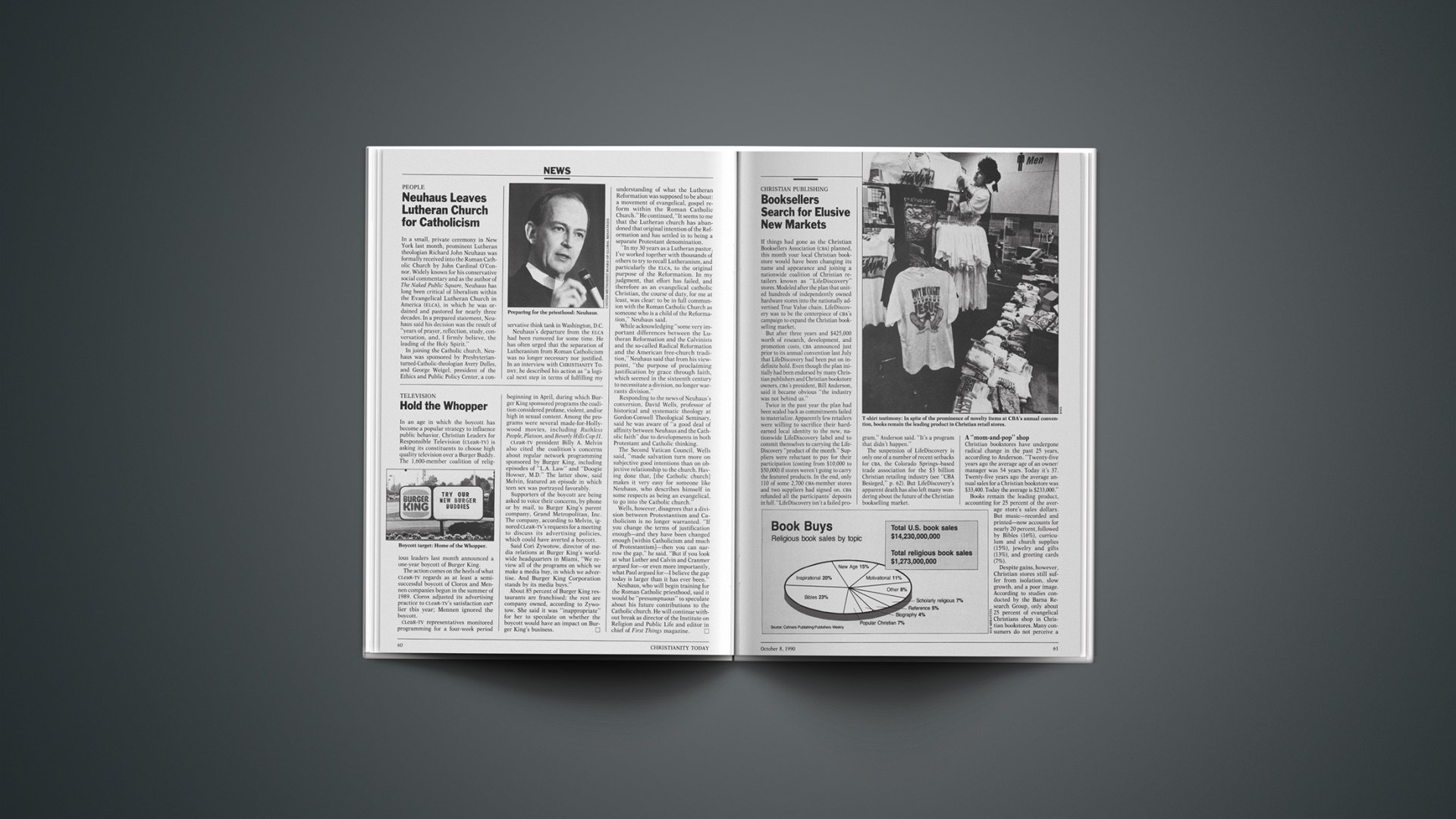

In a small, private ceremony in New York last month, prominent Lutheran theologian Richard John Neuhaus was formally received into the Roman Catholic Church by John Cardinal O’Connor. Widely known for his conservative social commentary and as the author of The Naked Public Square, Neuhaus has long been critical of liberalism within the Evangelical Lutheran Church in America (ELCA), in which he was ordained and pastored for nearly three decades. In a prepared statement, Neuhaus said his decision was the result of “years of prayer, reflection, study, conversation, and, I firmly believe, the leading of the Holy Spirit.”
In joining the Catholic church, Neuhaus was sponsored by Presbyterian-turned-Catholic-theologian Avery Dulles, and George Weigel, president of the Ethics and Public Policy Center, a conservative think tank in Washington, D.C.
Neuhaus’s departure from the ELCA had been rumored for some time. He has often urged that the separation of Lutheranism from Roman Catholicism was no longer necessary nor justified. In an interview with CHRISTIANITY TODAY, he described his action as “a logical next step in terms of fulfilling my understanding of what the Lutheran Reformation was supposed to be about: a movement of evangelical, gospel reform within the Roman Catholic Church.” He continued, “It seems to me that the Lutheran church has abandoned that original intention of the Reformation and has settled in to being a separate Protestant denomination.
“In my 30 years as a Lutheran pastor, I’ve worked together with thousands of others to try to recall Lutheranism, and particularly the ELCA, to the original purpose of the Reformation. In my judgment, that effort has failed, and therefore as an evangelical catholic Christian, the course of duty, for me at least, was clear: to be in full communion with the Roman Catholic Church as someone who is a child of the Reformation,” Neuhaus said.
While acknowledging “some very important differences between the Lutheran Reformation and the Calvinists and the so-called Radical Reformation and the American free-church tradition,” Neuhaus said that from his viewpoint, “the purpose of proclaiming justification by grace through faith, which seemed in the sixteenth century to necessitate a division, no longer warrants division.”
Responding to the news of Neuhaus’s conversion, David Wells, professor of historical and systematic theology at Gordon-Conwell Theological Seminary, said he was aware of “a good deal of affinity between Neuhaus and the Catholic faith” due to developments in both Protestant and Catholic thinking.
The Second Vatican Council, Wells said, “made salvation turn more on subjective good intentions than on objective relationship to the church. Having done that, [the Catholic church] makes it very easy for someone like Neuhaus, who describes himself in some respects as being an evangelical, to go into the Catholic church.”
Wells, however, disagrees that a division between Protestantism and Catholicism is no longer warranted. “If you change the terms of justification enough—and they have been changed enough [within Catholicism and much of Protestantism]—then you can narrow the gap,” he said. “But if you look at what Luther and Calvin and Cranmer argued for—or even more importantly, what Paul argued for—I believe the gap today is larger than it has ever been.”
Neuhaus, who will begin training for the Roman Catholic priesthood, said it would be “presumptuous” to speculate about his future contributions to the Catholic church. He will continue without break as director of the Institute on Religion and Public Life and editor in chief of First Things magazine.