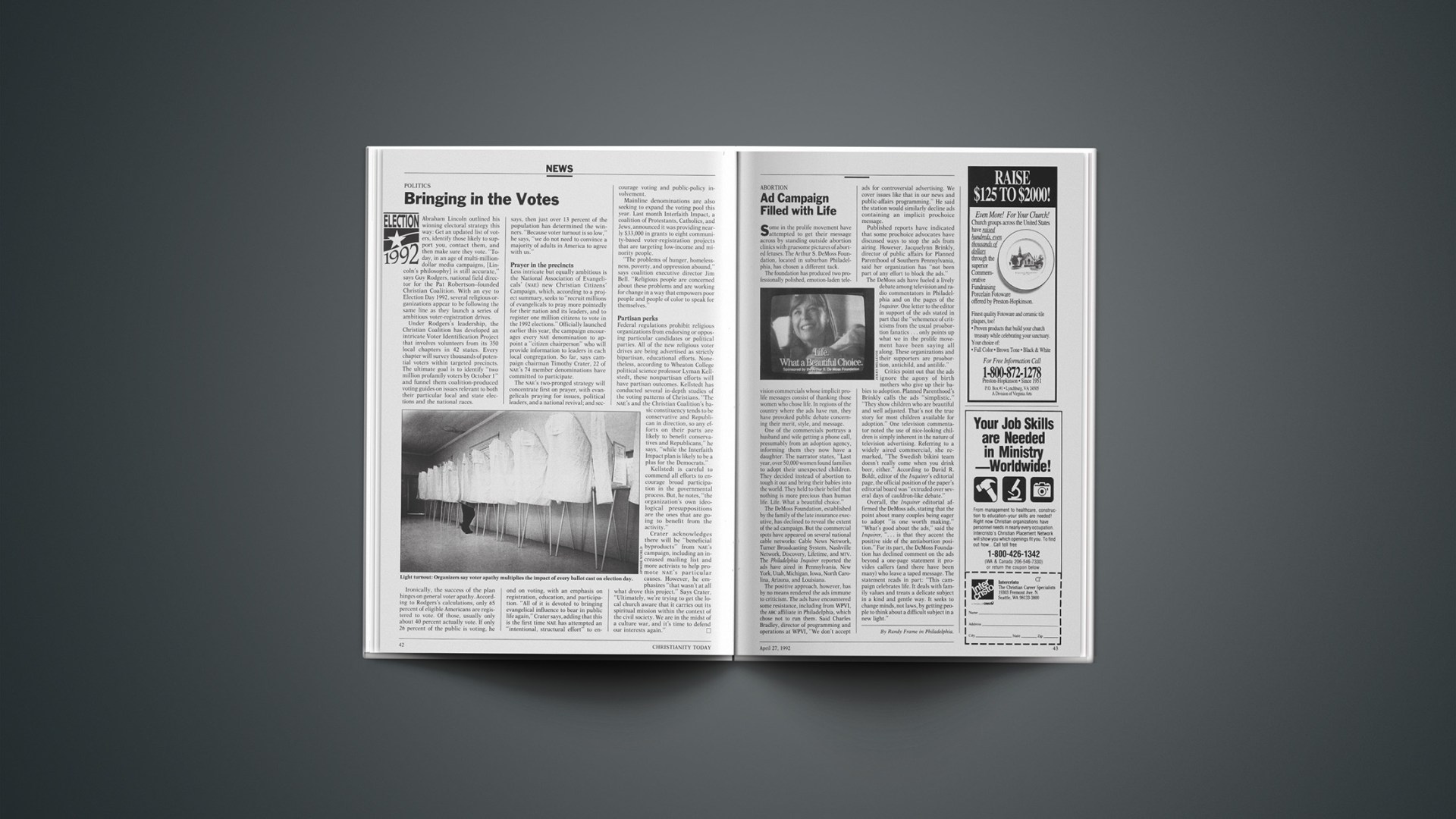

Abraham Lincoln outlined his winning electoral strategy this way: Get an updated list of voters, identify those likely to support you, contact them, and then make sure they vote. “Today, in an age of multi-million-dollar media campaigns, [Lincoln’s philosophy] is still accurate,” says Guy Rodgers, national field director for the Pat Robertson-founded Christian Coalition. With an eye to Election Day 1992, several religious organizations appear to be following the same line as they launch a series of ambitious voter-registration drives.
Under Rodgers’s leadership, the Christian Coalition has developed an intricate Voter Identification Project that involves volunteers from its 350 local chapters in 42 states. Every chapter will survey thousands of potential voters within targeted precincts. The ultimate goal is to identify “two million profamily voters by October 1” and funnel them coalition-produced voting guides on issues relevant to both their particular local and state elections and the national races.
Ironically, the success of the plan hinges on general voter apathy. According to Rodgers’s calculations, only 65 percent of eligible Americans are registered to vote. Of those, usually only about 40 percent actually vote. If only 26 percent of the public is voting, he says, then just over 13 percent of the population has determined the winners. “Because voter turnout is so low,” he says, “we do not need to convince a majority of adults in America to agree with us.”
Prayer In The Precincts
Less intricate but equally ambitious is the National Association of Evangelicals’ (NAE) new Christian Citizens’ Campaign, which, according to a project summary, seeks to “recruit millions of evangelicals to pray more pointedly for their nation and its leaders, and to register one million citizens to vote in the 1992 elections.” Officially launched earlier this year, the campaign encourages every NAE denomination to appoint a “citizen chairperson” who will provide information to leaders in each local congregation. So far, says campaign chairman Timothy Crater, 22 of NAE’s 74 member denominations have committed to participate.
The NAE’s two-pronged strategy will concentrate first on prayer, with evangelicals praying for issues, political leaders, and a national revival; and second on voting, with an emphasis on registration, education, and participation. “All of it is devoted to bringing evangelical influence to bear in public life again,” Crater says, adding that this is the first time NAE has attempted an “intentional, structural effort” to encourage voting and public policy involvement.
Mainline denominations are also seeking to expand the voting pool this year. Last month Interfaith Impact, a coalition of Protestants, Catholics, and Jews, announced it was providing nearly $33,000 in grants to eight community-based voter-registration projects that are targeting low-income and minority people.
“The problems of hunger, homelessness, poverty, and oppression abound, “says coalition executive director Jim Bell. “Religious people are concerned about these problems and are working for change in a way that empowers poor people and people of color to speak for themselves.”
Partisan Perks
Federal regulations prohibit religious organizations from endorsing or opposing particular candidates or political parties. All of the new religious voter drives are being advertised as strictly bipartisan, educational efforts. Nonetheless, according to Wheaton College political science professor Lyman Kellstedt, these nonpartisan efforts will have partisan outcomes. Kellstedt has conducted several in-depth studies of the voting patterns of Christians. “The NAE’s and the Christian Coalition’s basic constituency tends to be conservative and Republican in direction, so any efforts on their parts are likely to benefit conservatives and Republicans,” he says, “while the Interfaith Impact plan is likely to be a plus for the Democrats.” Kellstedt is careful to commend all efforts to encourage broad participation in the governmental process. But, he notes, “the organization’s own ideological presuppositions are the ones that are going to benefit from the activity.”
Crater acknowledges there will be “beneficial byproducts” from NAE’s campaign, including an increased mailing list and more activists to help promote NAE’s particular causes. However, he emphasizes “that wasn’t at all what drove this project.” Says Crater, “Ultimately, we’re trying to get the local church aware that it carries out its spiritual mission within the context of the civil society. We are in the midst of a culture war, and it’s time to defend our interests again.”