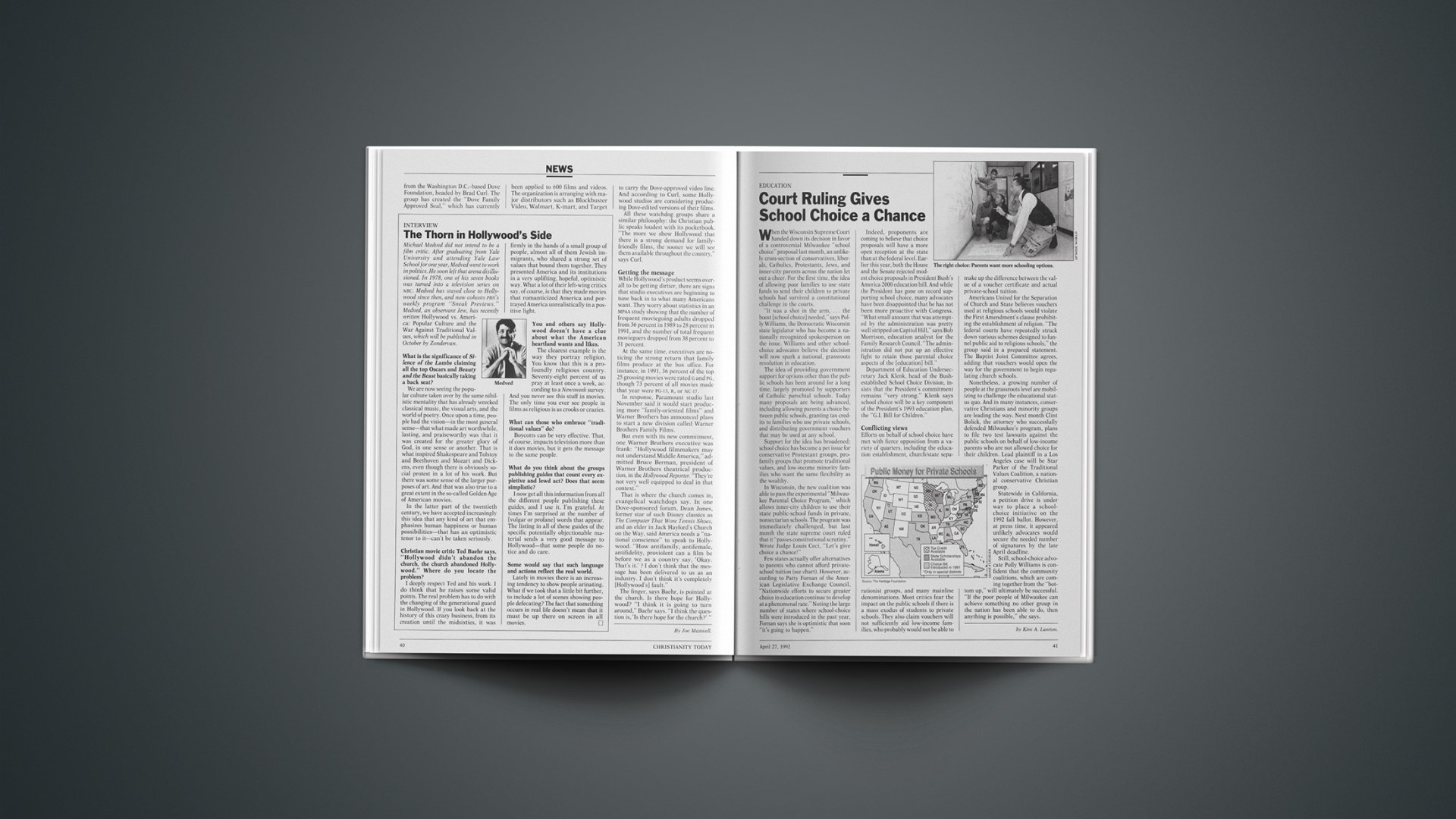

Michael Medved did not intend to be a film critic. After graduating from Yale University and attending Yale Law School for one year, Medved went to work in politics. He soon left that arena disillusioned. In 1978, one of his seven books was turned into a television series on NBC. Medved has stayed close to Hollywood since then, and now cohosts PBS’s weekly program “Sneak Previews.” Medved, an observant Jew, has recently written Hollywood vs. America: Popular Culture and the War Against Traditional Values, which will be published in October by Zondervan.
What is the significance of Silence of the Lambs claiming all the top Oscars and Beauty and the Beast basically taking a back seat?
We are now seeing the popular culture taken over by the same nihilistic mentality that has already wrecked classical music, the visual arts, and the world of poetry. Once upon a time, people had the vision—in the most general sense—that what made art worthwhile, lasting, and praiseworthy was that it was created for the greater glory of God, in one sense or another. That is what inspired Shakespeare and Tolstoy and Beethoven and Mozart and Dickens, even though there is obviously social protest in a lot of his work. But there was some sense of the larger purposes of art. And that was also true to a great extent in the so-called Golden Age of American movies.
In the latter part of the twentieth century, we have accepted increasingly this idea that any kind of art that emphasizes human happiness or human possibilities—that has an optimistic tenor to it—can’t be taken seriously.
Christian movie critic Ted Baehr says, “Hollywood didn’t abandon the church, the church abandoned Hollywood.” Where do you locate the problem?
I deeply respect Ted and his work. I do think that he raises some valid points. The real problem has to do with the changing of the generational guard in Hollywood. If you look back at the history of this crazy business, from its creation until the midsixties, it was firmly in the hands of a small group of people, almost all of them Jewish immigrants, who shared a strong set of values that bound them together. They presented America and its institutions in a very uplifting, hopeful, optimistic way. What a lot of their left-wing critics say, of course, is that they made movies that romanticized America and portrayed America unrealistically in a positive light.
You and others say Hollywood doesn’t have a clue about what the American heartland wants and likes.
The clearest example is the way they portray religion. You know that this is a profoundly religious country. Seventy-eight percent of us pray at least once a week, according to a Newsweek survey. And you never see this stuff in movies. The only time you ever see people in films as religious is as crooks or crazies.
What can those who embrace “traditional values” do?
Boycotts can be very effective. That, of course, impacts television more than it does movies, but it gets the message to the same people.
What do you think about the groups publishing guides that count every expletive and lewd act? Does that seem simplistic?
I now get all this information from all the different people publishing these guides, and I use it. I’m grateful. At times I’m surprised at the number of [vulgar or profane] words that appear. The listing in all of these guides of the specific potentially objectionable material sends a very good message to Hollywood—that some people do notice and do care.
Some would say that such language and actions reflect the real world.
Lately in movies there is an increasing tendency to show people urinating. What if we took that a little bit further, to include a lot of scenes showing people defecating? The fact that something occurs in real life doesn’t mean that it must be up there on screen in all movies.