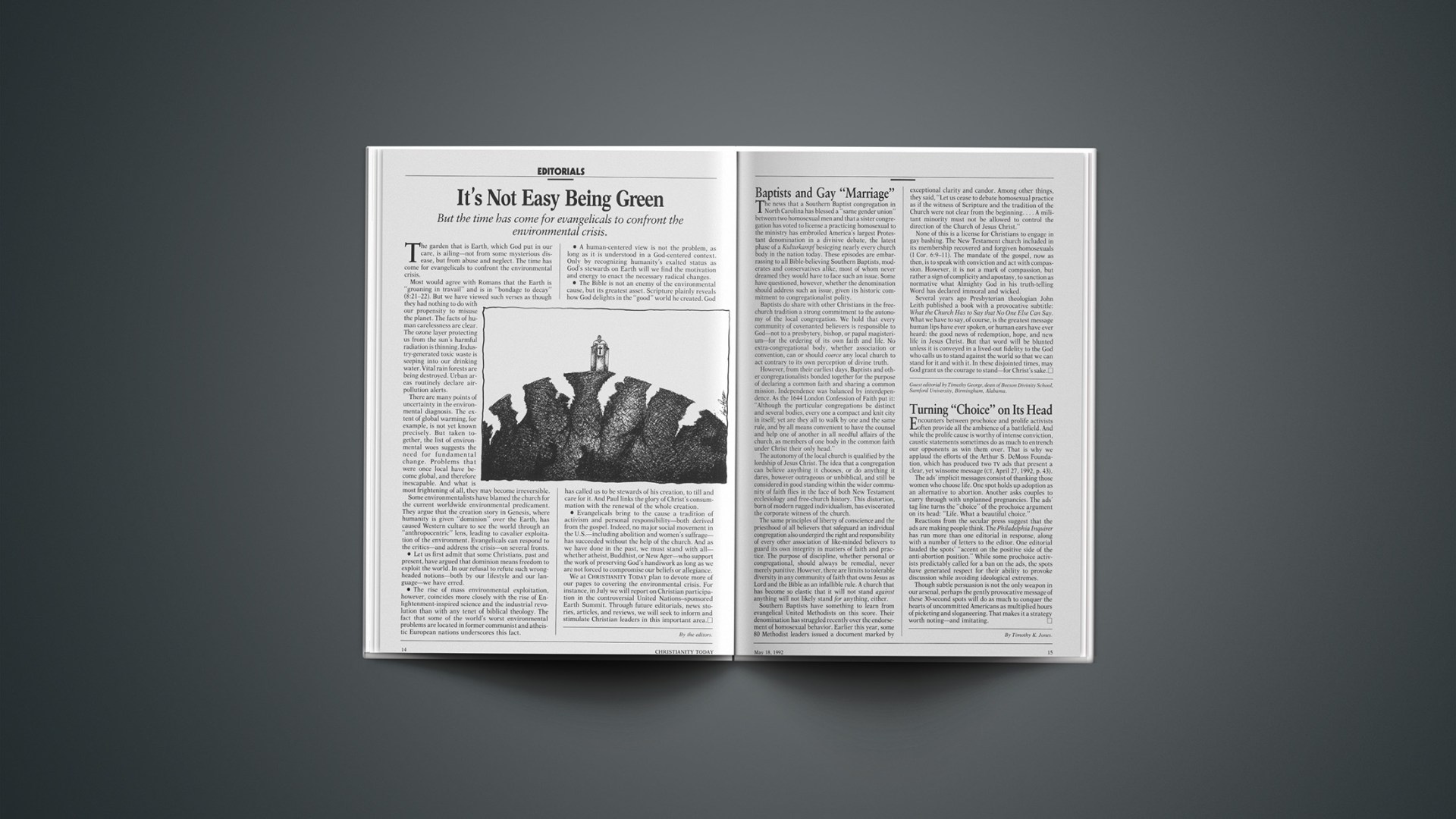

The garden that is Earth, which God put in our care, is ailing—not from some mysterious disease, but from abuse and neglect. The time has come for evangelicals to confront the environmental crisis.
Most would agree with Romans that the Earth is “groaning in travail” and is in “bondage to decay” (8:21–22). But we have viewed such verses as though they had nothing to do with our propensity to misuse the planet. The facts of human carelessness are clear. The ozone layer protecting us from the sun’s harmful radiation is thinning. Industry-generated toxic waste is seeping into our drinking water. Vital rain forests are being destroyed. Urban areas routinely declare air-pollution alerts.
There are many points of uncertainty in the environmental diagnosis. The extent of global warming, for example, is not yet known precisely. But taken together, the list of environmental woes suggests the need for fundamental change. Problems that were once local have become global, and therefore inescapable. And what is most frightening of all, they may become irreversible.
Some environmentalists have blamed the church for the current worldwide environmental predicament. They argue that the creation story in Genesis, where humanity is given “dominion” over the Earth, has caused Western culture to see the world through an “anthropocentric” lens, leading to cavalier exploitation of the environment. Evangelicals can respond to the critics—and address the crisis—on several fronts.
• Let us first admit that some Christians, past and present, have argued that dominion means freedom to exploit the world. In our refusal to refute such wrongheaded notions—both by our lifestyle and our language—we have erred.
• The rise of mass environmental exploitation, however, coincides more closely with the rise of Enlightenment-inspired science and the industrial revolution than with any tenet of biblical theology. The fact that some of the world’s worst environmental problems are located in former communist and atheistic European nations underscores this fact.
• A human-centered view is not the problem, as long as it is understood in a God-centered context. Only by recognizing humanity’s exalted status as God’s stewards on Earth will we find the motivation and energy to enact the necessary radical changes.
• The Bible is not an enemy of the environmental cause, but its greatest asset. Scripture plainly reveals how God delights in the “good” world he created. God has called us to be stewards of his creation, to till and care for it. And Paul links the glory of Christ’s consummation with the renewal of the whole creation.
• Evangelicals bring to the cause a tradition of activism and personal responsibility—both derived from the gospel. Indeed, no major social movement in the U.S.—including abolition and women’s suffrage—has succeeded without the help of the church. And as we have done in the past, we must stand with all—whether atheist, Buddhist, or New Ager—who support the work of preserving God’s handiwork as long as we are not forced to compromise our beliefs or allegiance.
We at CHRISTIANITY TODAY plan to devote more of our pages to covering the environmental crisis. For instance, in July we will report on Christian participation in the controversial United Nations-sponsored Earth Summit. Through future editorials, news stories, articles, and reviews, we will seek to inform and stimulate Christian leaders in this important area.
By the editors.