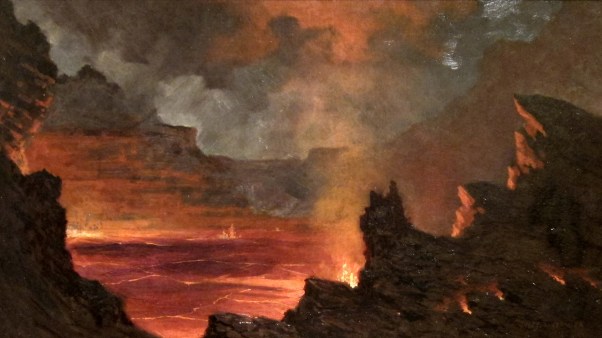
The sky glowed orange and smoky through the floor-to-ceiling library windows at Pepperdine University, where students spent two nights in a row as flames licked over the hilltops along the Malibu campus.
During the final days before winter break, a 2,800-acre wildfire forced the Christian university to issue shelter-in-place orders Monday night and again Tuesday.
Around 3,000 people—undergrads in backpacks, hoodies, and N-95 masks, along with other members of the university community—waited out the blaze in fireproofed campus buildings, including Payson Library, the Tyler Campus Center, and the dining facility, Waves Café.
Student reporter Gabrielle Salgado told The New York Times that it was hard to sleep in the library on Monday. Some students played games or studied. By morning, the rest of the week’s exams had been canceled.
Before they were ordered to take shelter Monday night, some students with cars and faculty members had rushed to evacuate on their own, and some were able to navigate road closures to make their way out on Tuesday morning.
But by Tuesday afternoon, the university reported that the fire had returned. It burned down a ridge to the road along campus’s perimeter, though officials hadn’t seen any significant damage to buildings.
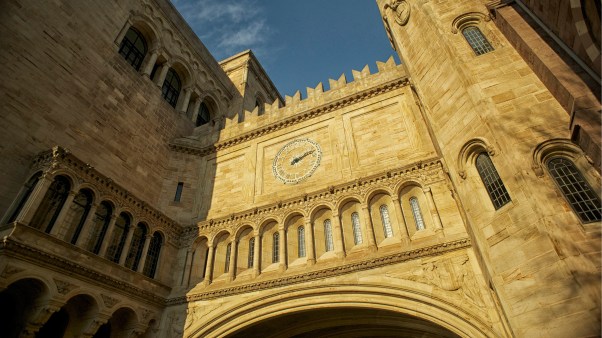
The iconic tower displaying a cross at the school’s entrance also glowed as the land around it burned.
University president Jim Gash moved between emergency operations meetings and the shelter areas, where he said students were “supporting each other and lifting one another up in prayer.” He praised the “calm resilience” of the Pepperdine community.
“When we are tested, we lean on our faith, rely upon our planning, and rally alongside one another,” Gash said in a statement.
Due to the frequency of wildfires in the region and the congestion along the nearby Pacific Coast Highway, Pepperdine’s campus was built to withstand such blazes. The school developed an extensive emergency plan, including stocking meals and supplies, to allow the Malibu campus to shelter in place.
The chief of the Los Angeles County Fire Department said that 1,500 firefighters were battling the Franklin fire, which remained 0 percent contained as of Tuesday night. He estimated that 15 structures in the area had been damaged or destroyed, but there were no reports of fatalities.
“Fire activity around Pepperdine’s Malibu campus has greatly diminished as the Franklin Fire has burned through most of the fuel immediately surrounding campus, but some flames are still visible in small pockets of campus,” the university wrote late Tuesday, as the shelter-in-place order remained overnight. “Firefighters continue to respond to and put out lingering hot spots and protect structures.”


Onlookers following the spread—seeing pictures of the blaze approaching Pepperdine and the students inside buildings on the news—have wondered why the university community is allowed to stay while thousands of neighbors evacuate.
Curbed Los Angeles reported on the school’s fire preparedness in 2018, during the last major wildfire to threaten the area, writing that “Fire is such a way of life at Pepperdine that students and faculty can measure their time at the school in the number of times they’ve participated in the shelter-in-place exercise.” The school’s emergency plans were developed alongside the fire department and are audited by officials.
The plan went into action once again this week. According to the Associated Press, resident assistants heard word of the shelter-in-place orders on Monday and began knocking on dorm room doors in the middle of the night, with no power, to usher students to refuge.
Pepperdine’s executive vice president, Phil Phillips, said in the Curbed piece that “many of our employees are alumni who actually sheltered in place during a fire.” He’s now been through seven.
“What you don’t want is to be stuck,” he told the AP on Tuesday. “Protecting our students, providing for their safety is a moral obligation for us, so we take it really, really seriously.”
As the university posted updates on its Facebook page Tuesday night, commenters offered prayers and recalled the school’s record with wildfires.
“You have always handled these fires with the utmost care. I can attest to that from my experience in the 1985 fire as a new student,” one alumna wrote. Another said that the pictures looked exactly like what he saw while sheltering in place a decade ago.
Curbed pointed out the building design and placement on the 830-acre campus, which was built in the early ’70s: Pepperdine relied on fireproof materials like steel, concrete, stucco, glass, and tile—no exposed wood. The architect’s “Mediterranean modern” style was inspired by the Greek island of Patmos.
The school also clears away dry brush that can accelerate wildfires and collects runoff waste water in a pond, which helicopters used to fight the Franklin fire.
Faculty who evacuated on-campus housing, including humanities professor Jessica Hooten Wilson and law professor Joel Johnson, shared dispatches and asked for prayers.
Jeff Baker, an associate dean at Pepperdine’s law school, offered an update on Tuesday night.
“Long day in Malibu. We remain safely off campus. #FranklinFire returned to Pepperdine tonight from a different angle & burned through the part of campus where our neighborhood is,” he wrote on the social media platform Bluesky. “Pepp reports no structures suffered significant damage. Heroic firefighters have saved our homes again.”
Baker told followers, “We’ve walked this road before,” and that the law clinic was planning to set up pro bono disaster response “right away.”