In this series

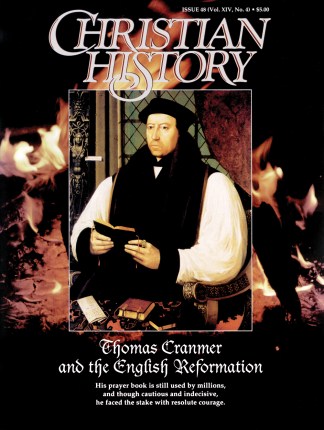
Thomas Cranmer
SCHOLAR AND TEACHER 1489–1526
1489 July 2. Born at Aslockton, Nottinghamshire, second son of small landholder
1503–11 Undergraduate studies at Jesus College, Cambridge
1515 Marries; wife dies in childbirth
1515–26 Fellow of Jesus College; ordained; university preacher; completes doctorate
DIPLOMAT AND ARCHBISHOP 1527–1547
1527 Henry VIII seeks to annul his marriage to Catherine of Aragon
1529 Cranmer suggests Henry seek university opinion on the divorce question
1530-32 Serves as an ambassador to the Continent; marries Margaret, niece of Lutheran reformer Osiander
1533 Becomes Archbishop of Canterbury; declares Henry’s marriage invalid; Anne Boleyn becomes queen
1534 Act of Supremacy recognizes king as “supreme head” of church in England
1536 Ten Articles outline early Protestant theology; Parliament dissolves smaller monasteries
1537 Bishop’s Book, a commentary on the Ten Articles; Pilgrimage of Grace, a popular Catholic uprising against reforms
1538 Henry VIII orders English Bible to be put in every parish church
1539 Remaining monasteries dissolved; Henry’s Six Articles enforce a more Catholic theology, including priestly celibacy; Cranmer sends his wife to Germany
1543 Henry’s King’s Book prohibits Scripture reading; Cranmer accused of heresy, but Henry protects him
1547 Henry dies holding Cranmer’s hand
REFORMER AND LITURGIST 1547–1553
1547 Nine-year-old Edward VI becomes king; Somerset becomes Lord Protector; priests required to preach from Cranmer’s Homilies
1549 Act of Uniformity orders use of Cranmer’s Book of Common Prayer; Northumberland becomes Lord Protector
1552 Cranmer revises Book of Common Prayer; Cranmer’s Forty-Two Articles outline a Calvinist doctrine for Church of England
1553 Cranmer supports Lady Jane Grey to succeed Edward; July 6, Edward dies
MARTYR 1553–1556
1553 Aug. Mary enters London in triumph and becomes queen; Nov. Cranmer convicted of high treason and imprisoned
1555 Sept. Cranmer tried and convicted of heresy; Oct. Ridley and Latimer executed
1556 Jan. Cranmer signs first submission; Mar. 21, renounces recantations and burned at stake
1558 Mary dies; Elizabeth I becomes queen and begins promoting Protestantism
Other Reformation Events
SCHOLAR AND TEACHER 1489–1526
1516 Erasmus publishes Greek New Testament
1517 Luther’s 95 Theses attacks sale of indulgences
1519 Charles V elected Holy Roman Emperor; Zwingli’s preaching sparks Swiss Reformation
1524 Peasants’ Revolt in Germany
DIPLOMAT AND ARCHBISHOP 1527–1547
1529 Luther and Zwingli fail to resolve differences over Communion at Marburg Colloquy
1530 Augsburg Confession outlines Lutheran beliefs
1535 Anabaptists take over Münster and are defeated
1536 First edition of Calvin’s Institutes
1540 Society of Jesus (“Jesuits”) founded
1545 Council of Trent begins
1546 Luther dies; Emperor seeks to suppress Lutheranism in German Schmaldkaldic war
REFORMER AND LITURGIST 1547–1553
1548 Augsburg Interim seeks to reimpose Roman Catholicism on Germany; Martin Bucer and other reformers flee to England
MARTYR 1553–1556
1555 Peace of Augsburg allows German states to choose between Lutheranism and Catholicism
1559 Persecution of French Protestants intensifies
Rudolph Heinze is vice-principal and tutor of church history at Oak Hill College, London. He is author of The Proclamations of Tudor Kings (Cambridge, 1976).
Copyright © 1995 by the author or Christianity Today/Christian History magazine.Click here for reprint information on Christian History.