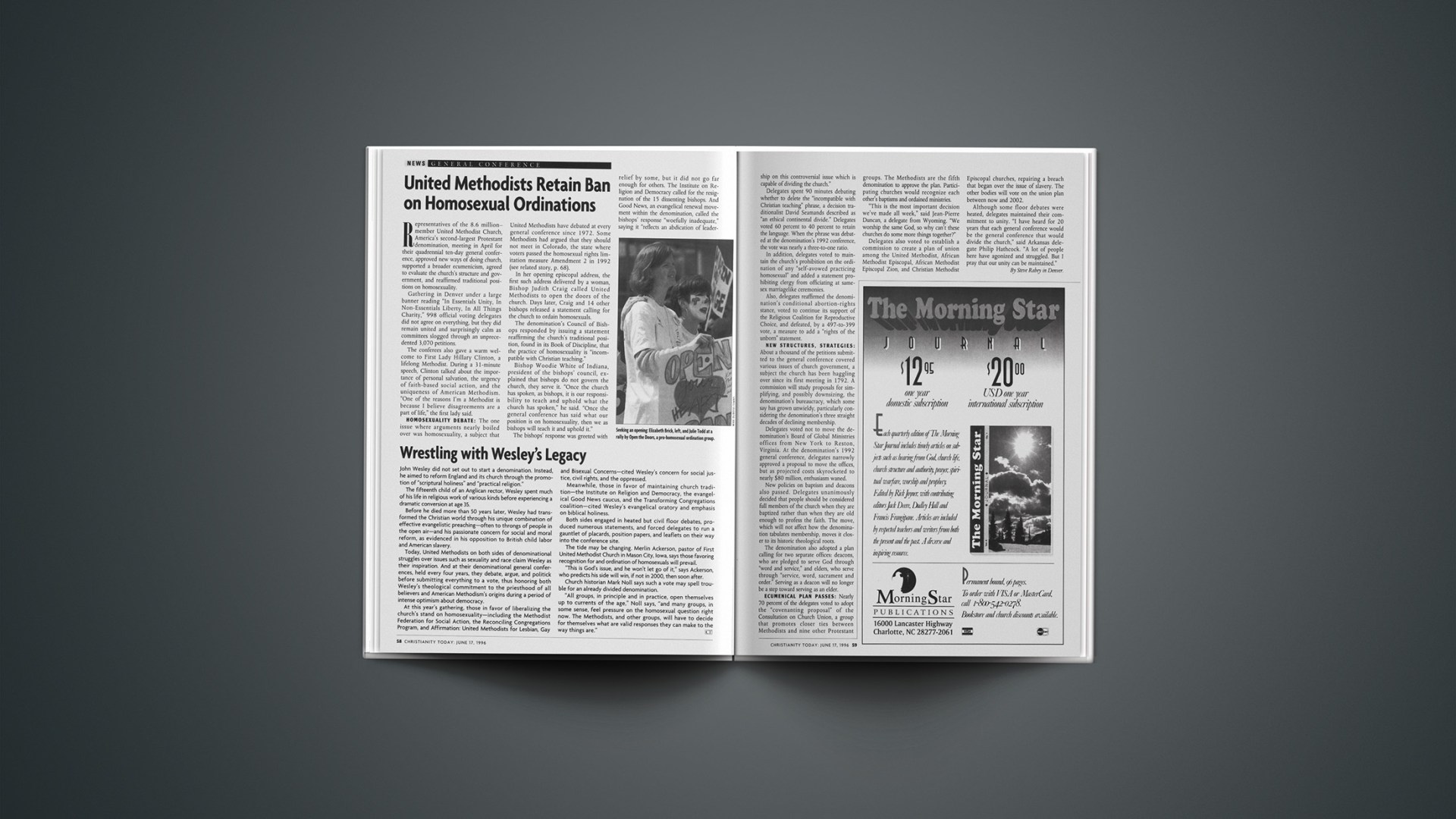

John Wesley did not set out to start a denomination. Instead, he aimed to reform England and its church through the promotion of “scriptural holiness” and “practical religion.”
The fifteenth child of an Anglican rector, Wesley spent much of his life in religious work of various kinds before experiencing a dramatic conversion at age 35.
Before he died more than 50 years later, Wesley had transformed the Christian world through his unique combination of effective evangelistic preaching–often to throngs of people in the open air–and his passionate concern for social and moral reform, as evidenced in his opposition to British child labor and American slavery.
Today, United Methodists on both sides of denominational struggles over issues such as sexuality and race claim Wesley as their inspiration. And at their denominational general conferences, held every four years, they debate, argue, and politick before submitting everything to a vote, thus honoring both Wesley’s theological commitment to the priesthood of all believers and American Methodism’s origins during a period of intense optimism about democracy.
At this year’s gathering, those in favor of liberalizing the church’s stand on homosexuality–including the Methodist Federation for Social Action, the Reconciling Congregations Program, and Affirmation: United Methodists for Lesbian, Gay and Bisexual Concerns–cited Wesley’s concern for social justice, civil rights, and the oppressed.
Meanwhile, those in favor of maintaining church tradition–the Institute on Religion and Democracy, the evangelical Good News caucus, and the Transforming Congregations coalition–cited Wesley’s evangelical oratory and emphasis on biblical holiness.
Both sides engaged in heated but civil floor debates, produced numerous statements, and forced delegates to run a gauntlet of placards, position papers, and leaflets on their way into the conference site.
The tide may be changing. Merlin Ackerson, pastor of First United Methodist Church in Mason City, Iowa, says those favoring recognition for and ordination of homosexuals will prevail.
“This is God’s issue, and he won’t let go of it,” says Ackerson, who predicts his side will win, if not in 2000, then soon after.
Church historian Mark Noll says such a vote may spell trouble for an already divided denomination.
“All groups, in principle and in practice, open themselves up to currents of the age,” Noll says, “and many groups, in some sense, feel pressure on the homosexual question right now. The Methodists, and other groups, will have to decide for themselves what are valid responses they can make to the way things are.”
Copyright © 1996 Christianity Today. Click for reprint information.