History is repeating itself in West Africa’s Liberia. Six years after the start of a costly civil war, reckless ethnic killing and looting have again overrun the capital, Monrovia. Refugees are moving over the borders into neighboring West African countries, and a second major evacuation of foreign nationals has been carried out by the U.S. military. Caught up in the mayhem, churches have been hard hit, although relief and reconstruction activities are set to continue, with local pastors cautiously taking the lead.
An estimated 150,000 people have been killed since the 1989 attack by Charles Taylor’s National Patriotic Front of Liberia (NPFL) rebels from neighboring Ivory Coast. A long line of peace initiatives concluding with an agreement last August have failed to bring an end to the war.
The latest violence began April 6, when Liberia’s shaky transitional state council tried to arrest “General” Roosevelt Johnson, leader of the United Liberation Movement in Liberia faction, on murder charges. Many American missionaries and relief-and-development workers have fled Monrovia unharmed (CT, May 20, 1996, p. 78).
As in other African countries plagued by civil strife, such as Rwanda, Burundi, and Somalia, the toll of the fighting has been devastating on the general population, including Christians. Food and clean water are in short supply in many areas of the capital, and there has been widespread concern about the spread of disease, namely cholera.
“The Christian community is totally disillusioned and quite angry with everything,” Brian Johnson, World Relief’s Liberia director, told CT from Sierra Leone, where he is working after being evacuated.
According to Johnson, the leadership for the Association of Evangelicals in Liberia is “drastically scattered.” Some have left the country while others remain in safe areas of the capital.
Church pastors, he says, are responsible for the relief-and-development commission whose task it will be to help distribute food to the poor, since they cannot afford to buy it at current inflated prices. Plans are in place to have food shipped to Monrovia.
“Many people want to leave,” Johnson says. “They feel that the fighting is going to continue. In the meantime, they need to eat. They desperately would like to have food, water, and medical care.”
PLEA FOR HELP: The local clergy, Johnson says, are pleading for U.S. military personnel to intervene. “They feel that if they’d come on land and show a little force, it would stop the whole situation.” United Methodist Bishop Arthur Kulah, whose conference headquarters have moved to Conakry, Guinea, has urged the United States to use military might to disarm all warring factions.
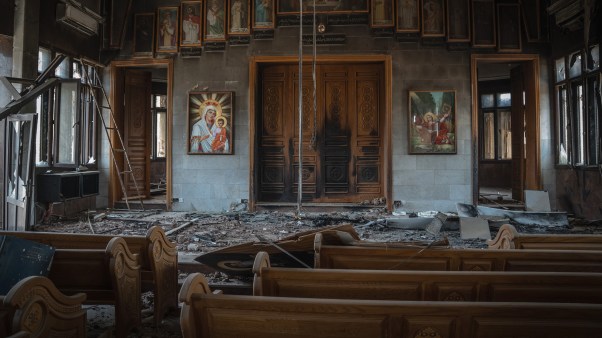
In the anarchy in Monrovia, churches and missions have systematically been ransacked by soldiers from all factions.
Three SIM International missionaries who tried to save the ELWA radio and medical complex in Liberia had to abandon their efforts May 2 when fighters overran it. Armed men repeatedly stripped and searched the missionaries, entered every home on the compound, and robbed the ELWA hospital and pharmacy of its supplies.
SIGNS OF HOPE: “There is no fear of the evangelical Christian church collapsing during this time,” says an evacuated missionary in West Africa. “During the heat of intense fighting, you will find a gathering of people in their homes worshiping and praising God.”
Denominational agencies and relief organizations are not giving up, because they believe abandoning the country will only cause greater problems later. Many missionaries have moved to Ivory Coast and Sierra Leone to try to help with refugees–and to be nearby to return to their missions once fighting subsides in Liberia.
World Vision International (WVI) issued an urgent appeal May 7 for $500,000 for blankets, soap, cooking sets, water cans, and salt for displaced persons in Liberia. WVI, whose vehicles have been stolen by NPFL commanders, is operating its Liberia relief efforts from Freetown, Sierra Leone.
Part of the task of the church will be to reach the rebels, some of whom are as young as five. An estimated 15,000 child soldiers have been recruited by different fighting factions and taught that shooting and looting is conventional.
“The hatred that is being lived out only sows the seeds of more hate and violence within the children,” says WVI president Dean Hirsch. “The risks are high for our staff to try to work in Liberia, but the need is so great we must respond.”
Sumoward Harris, bishop of the Lutheran Church in Liberia, agrees. “It is not enough to offer them rice to get their weapons,” says Harris, whose headquarters are in exile in Abidjan, Ivory Coast. “They need to get education. We need psychologists, pastors, social workers who can help them work through their terrible experiences.”
Copyright © 1996 Christianity Today. Click for reprint information.