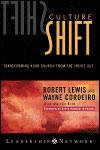
Every church holds the key that will unlock the door to a rich spiritual inheritance. That key is the church’s unique internal culture, the characteristics that make it unique, according to Robert Lewis and Wayne Cordeiro, authors of Culture Shift. The key to understanding and changing a congregation is found in its attitudes, customs, and beliefs.
Sounds simple enough. Look for a key. Some of us in church leadership have assumed it requires a club.
As a leader in a church attempting such a cultural shift, I was immediately hooked by the book’s thesis. Our church, only 11 years old, already has a deeply entrenched culture and power structure. I’ve discovered that change, even in a relatively new church, requires time and strong leadership. I eagerly read Culture Shift looking for a road map for our church’s journey.
No plug-and-play solutions
Culture, they contend, must be discovered not imported. The authors are clearly against what they call the “plug-and-play” approach that attempts to solve problems by implementing another church’s programs.
“Programs build a presence, not a future,” they write, and are merely Band-Aids for an ailing internal culture.
Instead, Lewis and Cordeiro encourage us to see our church’s culture as unique and full of possibilities, a combination of God’s kingdom agenda, the leader’s individual gifts and personality, and the church’s unique setting.
“Regardless of how your church looks now, it has billion-dollar potential.”
In the opening chapters, Culture Shift seems full of potential as well. Unfortunately, the authors never fully deliver on the book’s subtitle: Transforming Your Church from the Inside Out. The remaining chapters focus more on culture creation than on actual culture change. The road map I had hoped for never seemed to unfold.
 |
In part two, “Birthing the Culture,” they offer broad ideas when greater detail would have been helpful. For example, the authors simply state, “Shifting culture takes time.” I was hoping for more.
In parts three and four, Lewis and Cordeiro focus on their own church experiences. Again, they seem to mistake culture creation with a culture shift. Both men had the advantage of shaping their churches’ cultures in the early stages of development, and they have benefited from long tenure. Cordeiro planted New Life Christian Fellowship in Honolulu ten years ago, and Lewis has led Fellowship Bible Church in Little Rock for 25 years, and began when the church was only three years old.
Their experience may not translate to those pastors who enter established churches with preexisting cultures—my husband and myself included.
Still, Culture Shift is chock-full of principles and valuable observations and worth highlighting for future review. I was pleased by the authors’ belief that the goal of any church is spiritual transformation, not size.
“Sometimes we’re more interested in marketing than in modeling kingdom values,” they note. They also encourage leaders to be patient and persistent. “Every day, make a move toward your destination,” Lewis urges. “Have a meeting, recruit a leader, do a teaching, write an article, make a phone call; somehow, act on it.”
And rather than praying for God to bring the “right people” to your church, recognize that God has already put the right people in the right place.
Overall, Culture Shift is an excellent introduction to the nature and importance of church culture, and the leader’s role in shaping it. But leaders disoriented in the middle of an actual change journey may long for a road map with more detail.
Angie Ward, Durham, North Carolina
Copyright © 2005 by the author or Christianity Today/Leadership Journal.Click here for reprint information on Leadership Journal.