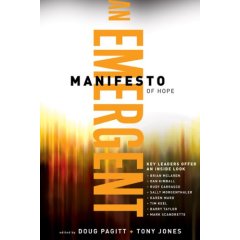
Barry Taylor is back with another excerpt from An Emergent Manifesto of Hope (Baker, 2007), edited by Doug Pagitt and Tony Jones. As our culture abandons any sense of certainty, how should Christians respond? Taylor invites us to consider a less dogmatic and “muscular” view of our faith in favor of one that is comfortable in the ever-shifting currents of our world.
The times in which we live are intense on any number of levels. The threat of terror haunts the world like a specter; issues of global poverty and disease are constant reminders of economic disparity
and human despair. Our world has also recently been rocked by a series of natural disasters, the sheer force of which has raised renewed concerns about environmental issues and the ramifications
of our commitment to fossil fuels, chemicals, and other resources on the planet. The impact of globalization and its many discontents on various parts of the world is a continuing part of our daily lives. Along with this, we in the West find ourselves drowning in choices, trying to balance our rampant materialism with a renewed desire for meaning and purpose.
These are certainly not the times to be seeking self-preservation, but that seems to be the general focus of the church today. Everywhere we turn we see books, conferences, workshops, and a host of other
resources that focus on what can be done to preserve the church, and we are willing, it seems, to employ any marketing device to make it happen. Trend watchers and marketing strategists offer ways in which churches can connect with the culture. We brand and market Christianity in attempts to make it viable again.
But what if we let go of our need for a branded and marketable entity and turn instead toward a new way of living and being in the world? This is not an entirely new idea. Dietrich Bonhoeffer posited a “religionless Christianity” in the 1940s, but what if it is an idea whose time has finally come? What if “religion,” and by this I mean the institutional and organizational form around faith, is no longer necessary for the future of faith?
Religions exist in certainty and sanctity; faith lives in inquiry and fluidity. The reason traditional faiths are having a hard time of things is that the present situation is one in which certainty is suspect and sanctity is being redefined.
We should consider letting go of our obsession with certainty; we do, after all, “see through a glass darkly,” as the apostle Paul reminds us. It is hard to claim clarity when shadows linger over what is revealed. The future of faith does not lie in the declaration of certainties but in the living out of uncertainty. “Believing that one believes” is how philosopher Gianni Vattimo puts it: “To believe means having faith, conviction, or certainty in something, but also to opine – that is, to think with a certain degree of uncertainty.” Our declarations about matters of faith are always fragmentary and provisional.
This idea challenges religion’s commitment to sanctity. Sanctity implies security and inviolability – the territory is delineated, the lines clearly drawn. Contemporary society is reluctant to draw such lines of division; sometimes it is difficult to tell where one idea ends and another begins.
One of the most interesting dynamics of the present time is the collapse of distinction between the sacred and the profane. Contemporary society allows for the “holy” to be found in the most unexpected places. As Christopher Partridge writes, “The new spiritual awakening makes use of thought-forms, ideas and practices, which are not at all alien to the majority of Westerners. They emerge from an essentially non-Christian religio-cultural milieu, a milieu that both resources and is resourced by popular culture.” The future of Christian faith lies in its ability to inhabit this gray world, not attempting to “sort it out” as much as to be available to help others navigate and negotiate the complexities that such a dynamic raises. To “go with the flow” might seem a trite way of describing theological engagement, but a commitment to fluidity and a willingness to swim in the cultural waters rather than insisting on one’s own paddling pool is a necessary perspective.
All of these thoughts can be summarized as a commitment to weakness rather than strength. “Muscular Christianity” and “robust faith” are views that worked well in modernity’s concrete world, but the viability of Christian faith in the twenty-first century is not guaranteed by claims to power and declarations of strengths and doctrinal postures. This is not a slide into relativism but a commitment to nondogmatic specificity. We can tell the gospel story without resorting to competition, exclusivism, or elitism.
Barry Taylor teaches at Fuller Seminary in California, where he has developed a number of courses focusing on the intersections between theology and popular culture. He also teaches on advertising at the Art Center College of Design in Pasadena.
Used by permission of Baker Books, a division of Baker Publishing Group, copyright ? 2007. All rights to this material are reserved. Materials are not to be distributed to other web locations for retrieval, published in other media, or mirrored at other sites without written permission from Baker Publishing Group.