





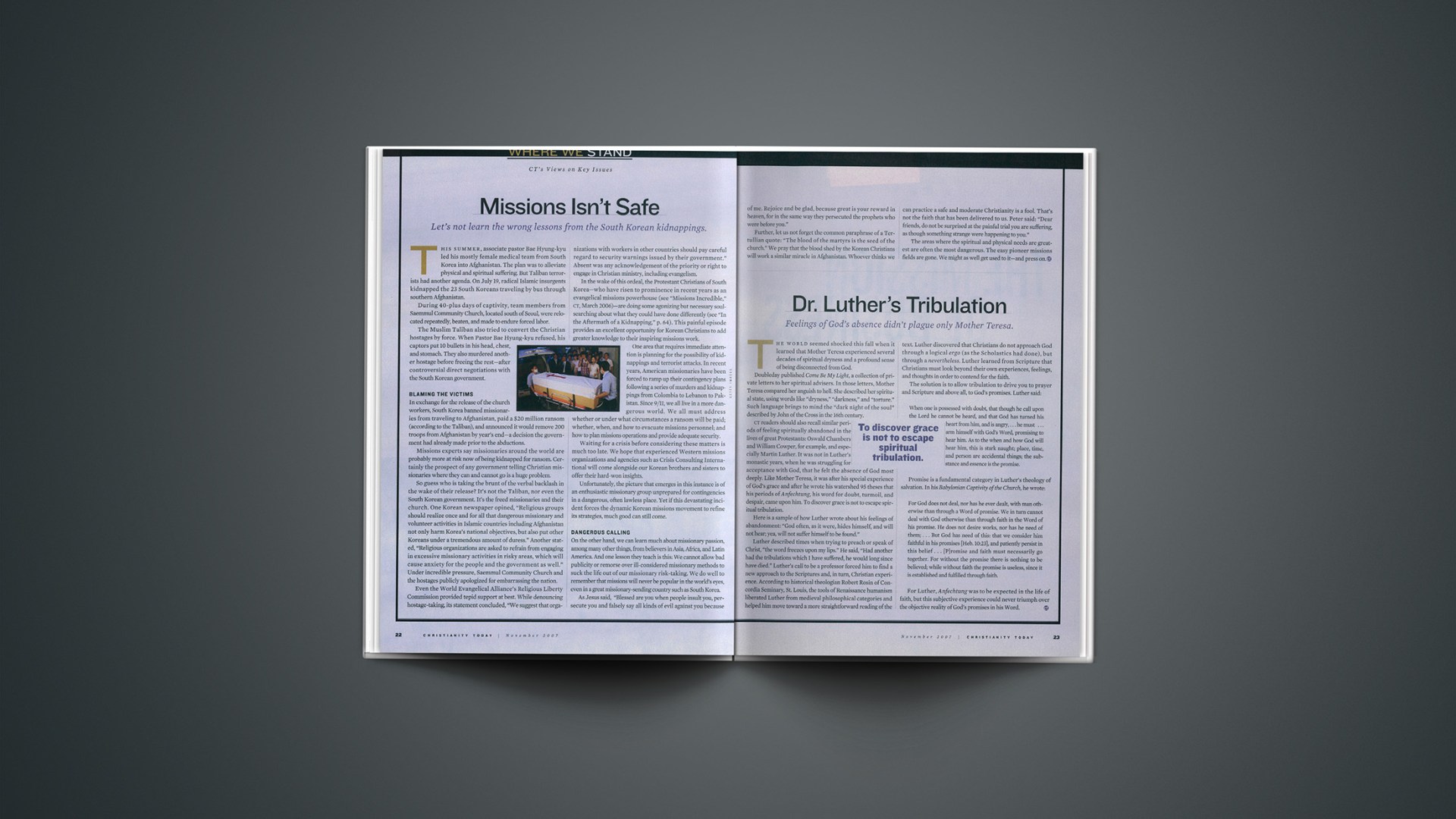
The world seemed shocked this fall when it learned that Mother Teresa experienced several decades of spiritual dryness and a profound sense of being disconnected from God.
Doubleday published Come Be My Light, a collection of private letters to her spiritual advisers. In those letters, Mother Teresa compared her anguish to hell. She described her spiritual state, using words like “dryness,” “darkness,” and “torture.” Such language brings to mind the “dark night of the soul” described by John of the Cross in the 16th century.
CT readers should also recall similar periods of feeling spiritually abandoned in the lives of great Protestants: Oswald Chambers and William Cowper, for example, and especially Martin Luther. It was not in Luther’s monastic years, when he was struggling for acceptance with God, that he felt the absence of God most deeply. Like Mother Teresa, it was after his special experience of God’s grace and after he wrote his watershed 95 theses that his periods of Anfechtung, his word for doubt, turmoil, and despair, came upon him. To discover grace is not to escape spiritual tribulation.
Here is a sample of how Luther wrote about his feelings of abandonment: “God often, as it were, hides himself, and will not hear; yea, will not suffer himself to be found.”
Luther described times when trying to preach or speak of Christ, “the word freezes upon my lips.” He said, “Had another had the tribulations which I have suffered, he would long since have died.” Luther’s call to be a professor forced him to find a new approach to the Scriptures and, in turn, Christian experience. According to historical theologian Robert Rosin of Concordia Seminary, St. Louis, the tools of Renaissance humanism liberated Luther from medieval philosophical categories and helped him move toward a more straightforward reading of the text. Luther discovered that Christians do not approach God through a logical ergo (as the Scholastics had done), but through a nevertheless. Luther learned from Scripture that Christians must look beyond their own experiences, feelings, and thoughts in order to contend for the faith.
The solution is to allow tribulation to drive you to prayer and Scripture and above all, to God’s promises. Luther said:
When one is possessed with doubt, that though he call upon the Lord he cannot be heard, and that God has turned his heart from him, and is angry, … he must … arm himself with God’s Word, promising to hear him. As to the when and how God will hear him, this is stark naught; place, time, and person are accidental things; the substance and essence is the promise.
Promise is a fundamental category in Luther’s theology of salvation. In his Babylonian Captivity of the Church, he wrote:
For God does not deal, nor has he ever dealt, with man otherwise than through a Word of promise. We in turn cannot deal with God otherwise than through faith in the Word of his promise. He does not desire works, nor has he need of them; … But God has need of this: that we consider him faithful in his promises [Heb. 10:23], and patiently persist in this belief … [P]romise and faith must necessarily go together. For without the promise there is nothing to be believed; while without faith the promise is useless, since it is established and fulfilled through faith.
For Luther, Anfechtung was to be expected in the life of faith, but this subjective experience could never triumph over the objective reality of God’s promises in his Word.
Copyright © 2007 Christianity Today. Click for reprint information.
Related Elsewhere:
Christian History magazine devoted two issues to Martin Luther, one on his early years (including his posting of the 95 Theses) and another on his later years (including his marriage and writing “A Mighty Fortress.”)
Other Christianity Today articles about Martin Luther’s influence and theology include:
Picture Christ | Martin Luther’s advice on preparing to die. (April 12, 2007)
Man of Contradictions | Martin Luther was a God-obsessed seeker of certainty and assurance. (May 1, 2004)
A Reformer’s Agony | A high-caliber film shows how messy it was when Luther helped change the course of history (September 1, 2003)
Christian History Corner: ‘Hier Stehe Ich!’ | When Martin Luther stood up for his ideas at the Diet of Worms, did he really say, Here I stand? (April 1, 2002)
Why We Still Need Luther | Four hundred fifty years after his death, Martin Luther can still inspire and guide us. (October 28, 1996)
Come Be My Light: The Private Writings of the ‘Saint of Calcutta‘ is available from ChristianBook.com and other retailers.
Christianity Today‘s previous coverage of Mother Teresa and her “dark night of the soul” includes:
‘I Thirst’ | What was going on with Mother Teresa? (September 17, 2007)
Book Uncovers a Lonely, Spiritually Desolate Mother Teresa | “There is no God in me,” she wrote. (August 30, 2007)
John Paul II’s Canonization Cannon | Why and how this pope has made over 470 saints (October 1, 2003)
Flash: Mother Teresa Was Human | Letters reveal the Catholic nun had doubts about God (February 1, 2003)







