
Should a blind person be permitted to carry a loaded weapon? That was the focus of a 2013 court battle in Iowa. Advocates for extending the state's "Conceal and Carry" law to include blind citizens said the visually impaired should not be discriminated against because it is the right of every American to own and carry a gun. Amazingly, the courts agreed with this argument.
Sometimes there is a gap between legal sense and common sense.
I feel the same way about anger. I've heard numerous theological and biblical arguments about Christians wielding "righteous anger." There are many examples of God becoming angry in Scripture, including the unpopular stories of wrath in the Old Testament and those of Jesus overturning tables in the Temple or pronouncing judgment upon his enemies in the New. If our Lord demonstrates righteous anger, shouldn't we follow his example?
I believe a theological case can be made for the righteous deployment of godly anger. In the right hands, with the right training, and from the right heart, anger can be wielded redemptively. However, I rarely see all things clearly, and a weapon as dangerous and destructive as anger is best deployed by someone with 20/20 vision. I trust Jesus to use anger righteously. I don't yet trust myself. I have misfired too many times, and I have hurt too many people with my anger, but that doesn't mean I am never tempted.
It seems like our entire culture, including the church, is addicted to outrage. Anger has become the acceptable, and even expected, sign of one's commitment to any cause. I have learned that if I fail to show sufficient outrage on my podcast or in a sermon, I will receive messages from fellow Christians who are angered by my lack of anger. They usually say, "Don't you care that …"
It feels like my credibility as a committed Christian depends on my willingness to at least brandish my anger arsenal if not unleash it. In some Christian communities, particularly online, anger is so ubiquitous one might think it is a fruit of the Spirit. Why has it found such acceptance among us?
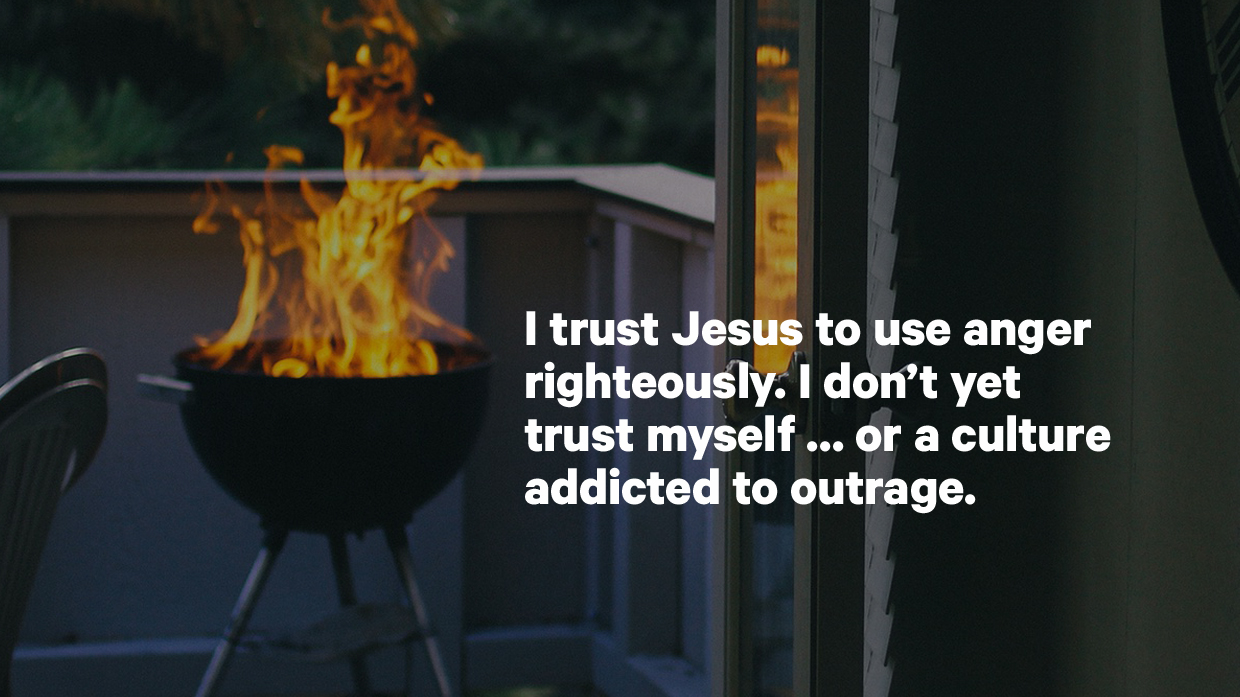
I trust Jesus to use anger righteously. I don't yet trust myself … or a culture addicted to outrage.
Perhaps our constant media consumption has deadened our ability to feel the more subtle human emotions. In this over-stimulated environment only the sledgehammer of anger is able to get our attention, and if we don't use it to convey every emotion, we are dismissed as not having any.
Or maybe we are collectively in the second stage of grieving our loss of cultural significance as the Church in North America. The first phase was denial (rejecting the evidence of declining church attendance and cultural marginalization). A few Pollyannas are still in this first phase of grief. Many of us have now moved to the second phase—anger.
As we sense the culture moving into a decidedly post-Christian posture, and as more evangelical institutions contract or close, there is a sadness that manifests as anger from those who once felt privileged and in control. If you do not share sufficiently in this evangelical outrage you may be suspected to "not really be one of us." I've heard that one too.
If our attraction to anger is part of a collective grieving process, then I suspect we will eventually move on to bargaining, depression, and finally acceptance that our time of cultural power has passed.
Until then, I'm looking for ways to resist the temptation to join the advocates of outrage. There are many injustices and evils in the world that provoke me to reach for my sidearm of anger. "I would only do it with the best of intentions," I tell myself. Bullies always justify their actions by extolling their good intentions. That's why the road to hell is paved with them.
Skye Jethani is senior editor of Leadership Journal.
Copyright © 2015 by the author or Christianity Today/Leadership Journal. Click here for reprint information on Leadership Journal.