 Marcel Hartmann / X Filme Creative Pool
About twenty minutes into Alone in Berlin, I began to worry for my health: I’ve been in Germany for three days, and I’m an experienced traveler, so I couldn’t figure out why the jetlag was still affecting me so badly. I blinked madly, willing myself to stay awake, chewing gum, rubbing a knot in my shoulder, annoying the guy sitting next to me.
Thirty minutes in, I realized it wasn’t me. (Partly because the woman beside me started snoring loudly.)
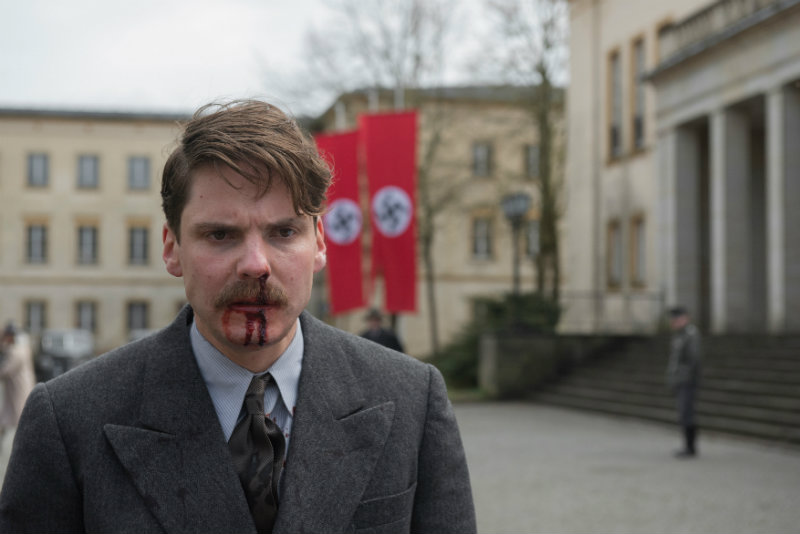
Alone in Berlin boasts a truly fascinating premise, based on the 1947 German novel Jeder stirbt für sich allein (which translates to something like “Every Man Dies Alone”). The story is based on a true one: a German husband and wife lose their son in World War II, then become part of the Resistance not by joining a cell but acting as their own small unit, writing cards with subversive messages about Hitler’s regime and leaving them all over town.
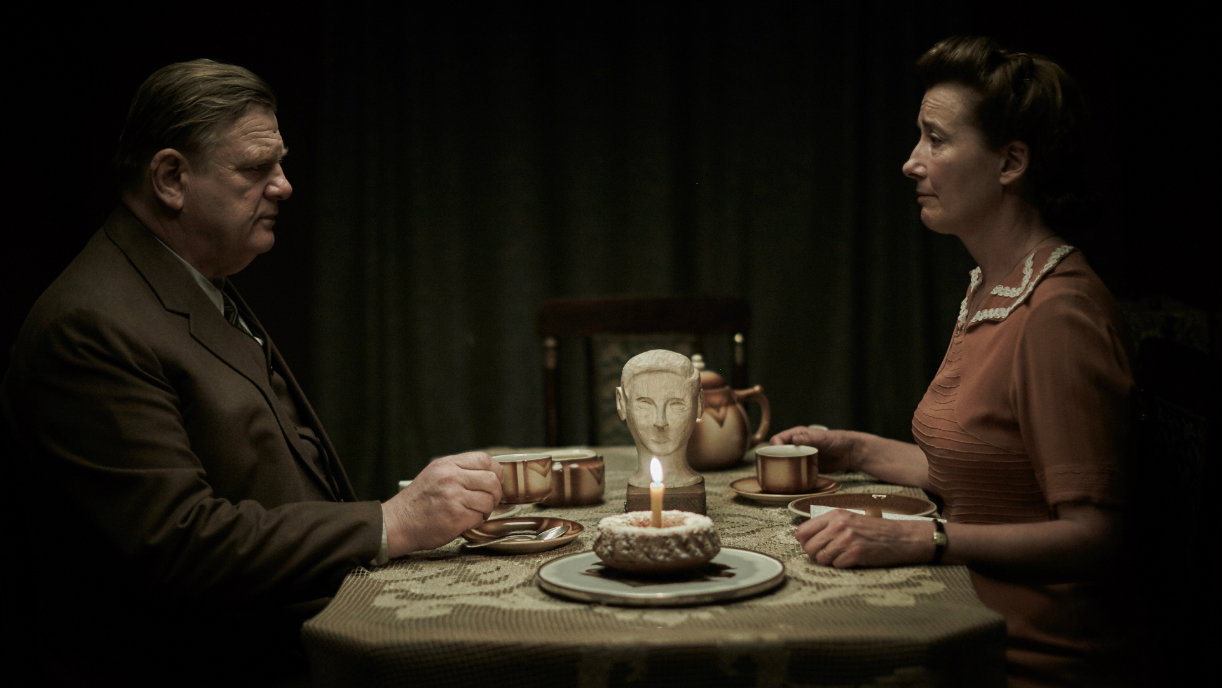
Theoretically, the fact that Brendan Gleeson and Emma Thompson play the couple should be in its favor as well—two terrific actors. But in this case it’s the exact opposite. There is something profoundly strange about sitting in a movie theater in Berlin watching a film about Berlin in which the leads (whom you know to be Irish and English, respectively) are speaking in English with German accents. In fact, everyone speaks English in this film, which is doubly strange because they write and read in German.
That’s not the film’s biggest flaw, either. There are side stories about other people in the building that probably work well in a novel as counterpoint—I haven’t read it—but are confusing and distracting. Additionally, our main characters are stoic, working-class Germans who show little emotion, even after their son has been killed, and while you can experience a rich interior life for such characters in a novel, that’s much harder to pull off in a film with so much plot.
Visually, the film shows some promise—the camerawork is very high-concept from the start, but doesn’t seem to know what it’s trying to evoke. It frequently pulls in tight to non-human objects; at the beginning we see shots of a quiet forest before a soldier runs through and is shot, and at one point we get not one but two close shots on Gleeson’s hand as he descends a staircase.
But . . . why? I kept trying to sort out the reasoning behind such self-consciously arty framing. In the end was left to conclude it was just that: arty.
 Christine Schröder / X Filme Creative Pool
This is all a massive shame, because the story is so naturally layered with storytelling possibilities. It tries, by turns, to be a quiet family drama, a political statement, a historical epic, and a detective thriller. And I promise, I stayed awake for the whole thing, enough to be emotionally affected at the end by the couple’s renewed relationship. The idea that responding to tragedy can bring a couple closer together rather than push them apart is also interesting, and could have some great parallels for a story about such a tragic period of shame in a country’s history.
I just wish it had figured that out before the credits rolled.
Alissa Wilkinson is Christianity Today’s chief film critic and an assistant professor of English and humanities at The King’s College in New York City. She is co-author, with Robert Joustra, of How to Survive the Apocalypse: Zombies, Cylons, Faith, and Politics at the End of the World (Eerdmans, April 2016). She tweets @alissamarie.