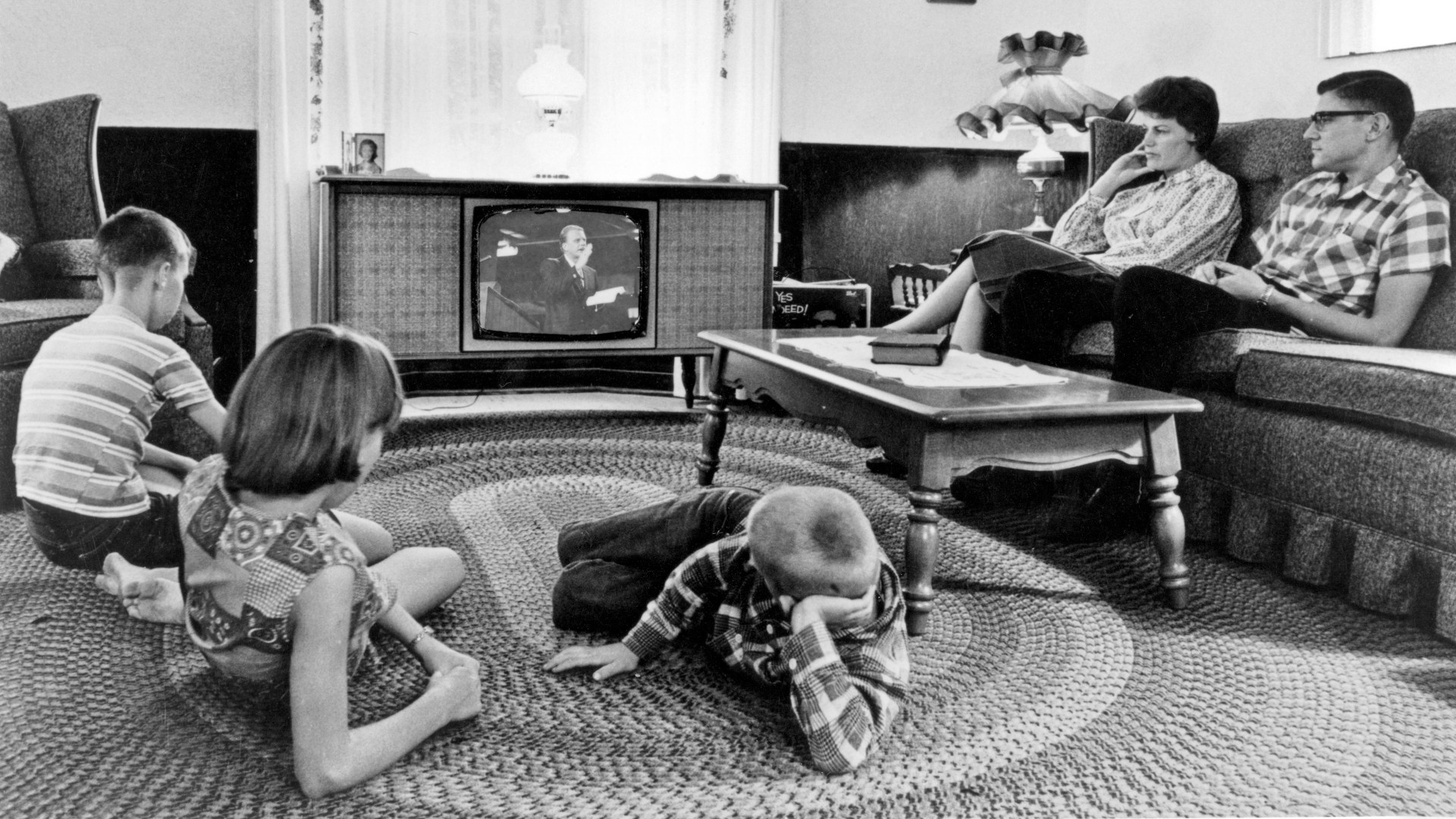

While researching a book on Billy Graham's life and legacy, we discovered a cache of answered but apparently long-forgotten letters that children had posted to him in the early 1970s. The letters reveal that these children saw Graham as a combination of friend, confidant, and trusted adviser in matters practical as well as spiritual. In their innocence, the children often said more than they knew.
Keeping a straight face wasn't always easy. Eight-year-old Russ informed Graham—they usually called him by his full name, Billy Graham—that his family was "going organic." Todd, 14, "still loved God," yet admitted, "the most reason I'm writing you is to get stickers." Predictably, pets played a large role. Ten-year-old Craig explained that after leaving two parakeets in the car on a hot day, they ended up "three-quarters dead," but prayer brought them back. Others had even better news. Scott happily reported that his dog had "just turned Christian."
For children, as for adults, money loomed large. Some showed early signs of an entrepreneurial spirit. Kathy asked Graham to help her sell a bunny for $1.50. Many sent their savings, or sums received for a lost tooth, a good report card, or raking leaves. Others wished they could give more. Darlene had hoped to do better than a quarter, but remembered, "after all I'm only ten." Twelve-year-old Julie lamented that she did not own a checking account, then assured Graham, "God will help you. . . . He is just testing your faith!"
Graham seemed to know that theology was too important to leave entirely in the hands of the theologians, and so did the children. Karen wondered: What do you do when you pray and your fish does not get well? "Write me back." Grades were a problem, especially in math and spelling, and children believed that Graham's prayers could help.
Questions of cosmology and creation also found their way into the letters. Linda, 10, cut right to the core. "I love God because if he didn't make the world we wouldn't be here." Nine-year-old Mark knew that some things were worth fighting for. "My school teacher and I got in to a little scrap," he admitted, "because he said the scientists thought that man was first one-celled and then gradually turned into man." The deeper truths of the gospel shone brightly. "God loves white and red and black and brown," young Sandra quietly insisted.
If Graham had a heart for evangelism, so did his youthful followers. Ten-year-old Randy explained that witnessing at school was hard work. "I plot and plan to try to win people to Christ," he added with jut-jawed determination. The world was stony ground. Twelve-year-old Doug had witnessed to two people, yet "one boy I am working on … is a real sinner." If individuals could prove resistant, so could entire cities. Young David invited Graham to hold a crusade at Veterans Stadium in Philadelphia—located at Broad Street and Pattison Avenue, he took care to note—because, "Who needs it better than Philadelphia?"
Children understood the power of the personal testimony. Many pinpointed the year of their conversion. Kelley, 8, remembered that she had come to Jesus when she was 3. Carol, saved when she was "about 5," liked Graham best "because you do not say a lot of big words . . ." More than a few found that the Christian life required vigilance. At school, 9-year-old Linda felt the devil telling her "to plug up the toilet, but I didn't. Something told me not to." Donald, 11, discovered God's love when he was 5 and learned the plan of salvation when he was 6. Nonetheless, in the next three years, he drifted. "I started to cuss and be very nasty," he allowed. Yet Donald now understood that it was not enough just to ask Jesus to come into your life. You "must live like him" too.
The young authors somehow sensed the inevitable passing of time. "I pray that God will keep you alive for a hundred years," wrote Danielle. "Don't die until there is someone to take your place," pleaded Tim. Little wonder. If Graham had helped transform children's lives, he also had helped transform their parents' lives. After your services, wrote Maurice, exactly 12 and 3/4 years old, "my dad has changed. He asked my sister and my brother and me all these things and at the end he said I love you all. So thank you Billy Graham."
In July 2009, we had the privilege of seeing Graham and telling him about these letters. "Oh, that touches my heart," he responded gently. They touched ours too.
Note: We have regularized the children's often-creative spelling, but otherwise quoted the letters as they wrote them.
Katherine and Grant Wacker live in Chapel Hill, North Carolina. Katherine, now retired, spent 30 years as a guidance counselor in Massachusetts and North Carolina public schools. Grant teaches at Duke Divinity School and is the author of America’s Pastor: Billy Graham and the Shaping of America (Harvard University Press, 2014).