Halfway through fifth grade, the school district issued a laptop to our son. Up to then, his “accelerated learning” classroom had been a pretty good fit. He had a great teacher, dynamic peers, and a pace that challenged and stimulated him.
But with the laptop, our son’s learning immediately went off-track. He browsed the internet in class, played online games, fiddled around with display settings, changed his desktop photo, and then changed the photo again. His grades, behavior, and organizational skills suffered. Even after his 504 educational plan for attention deficit hyperactivity disorder (ADHD) was adjusted, he had less and less success in school.
Our son is an insightful kid who’s in constant motion, as prone to getting locked into classic literature as arranging his toy cars. He joined our family through foster care and adoption and is, as his fourth-grade teacher informed us, “twice exceptional,” possessing both significant capabilities and significant impairments.
I’ve long observed that children like him, with backgrounds of early adversity, develop deep sensitivities to things that others do not particularly notice. In so many cases, their responses are the canary in the coal mine, alerting us to something important that will soon affect everyone.
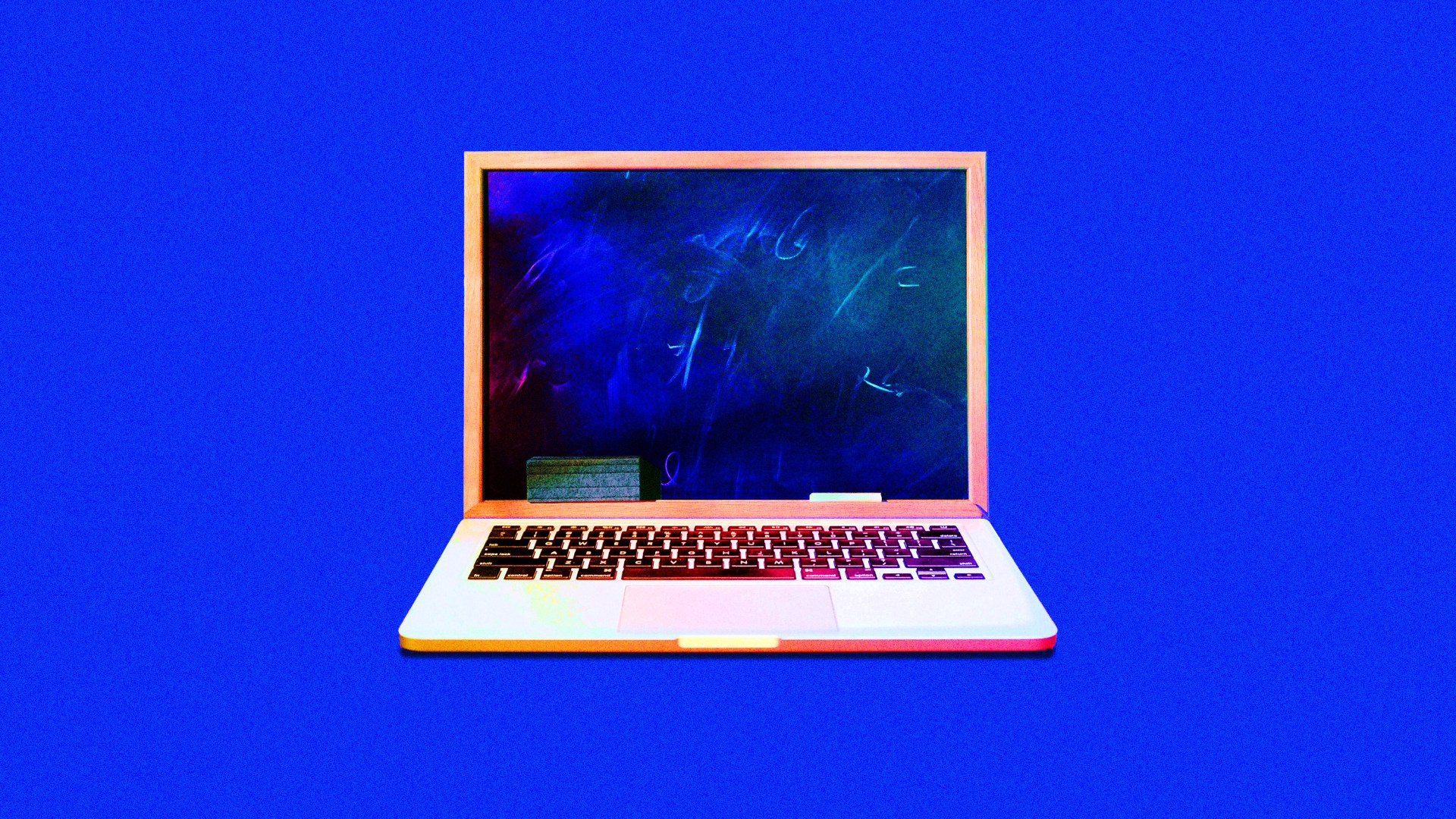
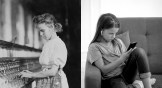
Classroom tech is something important—and as another school year begins, parents and pundits, organizations and educators are hearing the canary’s song on school-issued laptops and tablets. Screen-based learning, it turns out, has not proven particularly effective, negatively affecting students by interrupting their focus, decreasing their attention spans, and desensitizing their brains’ reward systems. One study found that about 13 percent of US teens have viewed pornography on a school-owned device during school. Even when conventional social media platforms are blocked by internet filters, laptops open up channels of cyberbullying through Microsoft Teams, YouTube, and Google Docs.
These realities impact all students. But for kids like my son—for the 11 percent of school-aged children with ADHD or for children suffering the lingering impacts of trauma—screens have even more severe effects. Their conditions make them more susceptible to developing the attention fragmentation, sleep deprivation, social deprivation, and addiction that psychologist Jonathan Haidt identifies as the major risks of a high-tech childhood.
Thus, screen-based learning creates an educational disparity for children who are especially vulnerable through no fault of their own. My son’s disability meant that he paid a higher price for the district’s laptop decision relative to his peers—and there seemed to be no remedy. His school was unwilling to accommodate off-screen learning for him, telling me, “It’s just not possible.”
Christians should want to address this. We’re called to cherish children, helping them avoid whatever causes them to stumble (Matt. 18:6). We also serve a God who prioritizes the needs of the most vulnerable community members (Ps. 68:5; Matt. 19:14; 25:40). By advocating for school-tech policies that accommodate disability interventions and establish loving guardrails, we take a stand against the “war on the weak.” We flourish as Christ followers, becoming his hands and feet in specific commitments to the least of these.
Our Christian advocacy on this issue also offers an opportunity to understand anew God’s enduring intention for human flourishing. Through the struggles that our son and other vulnerable children have with screens, we reaffirm something marvelous about our created human nature and the Lord’s delight over us (Zeph. 3:17).
In our son’s encounter with classroom tech, it became impossible to ignore how essentially creatural he was—how important it was for him to learn in an embodied, relational environment. Already his childhood trauma—connected to his ADHD—had led him to struggle with attachment, a word that’s always felt too sterile to describe the rich sense of mattering. Babies matter first to their parents, through eye contact and loving touch; children who experience disruption or pain during their formative years develop “disordered attachment.” That intrinsic sense of being unique, cherished, and secure within loving relationships, that inner conviction of worth and innate sense of personal security, is broken.
Screens can exacerbate this brokenness for kids who already experience it. And screens also seem to break something in all of us, exerting a pull out of our God-ordained personhood and into a nonpersoned, disembodied, and nonreal world of missing attachments.
Good learning takes not more solo time in front of a screen but rich relationships that span the spectrum of intimacy. Close family is important, but so are peer, teacher, and public relationships. Good learning means we stop scrolling and involve our full bodies, moving in space and time.
Our family had a very rare opportunity to enroll our son in a school where every tech tool is “ruthlessly evaluated” before being used in the classroom. Students have scheduled sessions in a computer lab for writing, attend classes like website development, and can use a graphing calculator for some math problems but have no access to an “under-regulated digital world.” The school makes participation in class and extracurriculars independent of individualized screens as much as possible. Our son has wrestled with his attention and organizational skills, found decent academic success, and further developed his gifts.
A retreat from high-tech learning might not be a retreat at all. It might be an opportunity to affirm that learning apart from personal interactions is bankrupt for everyone, not just students like my son. It might be a chance for God’s people to shape education that honors children’s need for attachment as they grow and flourish. In that shaping, we refer back to a God who exists in eternal relationship, a God who took on flesh in the person of Jesus Christ and who provides for all our embodied needs.
Wendy Kiyomi is an adoptive parent, scientist, and writer in Tacoma, Washington, whose work on faith, adoption, and friendship has also appeared in Plough Quarterly, Image, Mockingbird, and The Englewood Review of Books. She is a 2023 winner of the Zenger Prize.