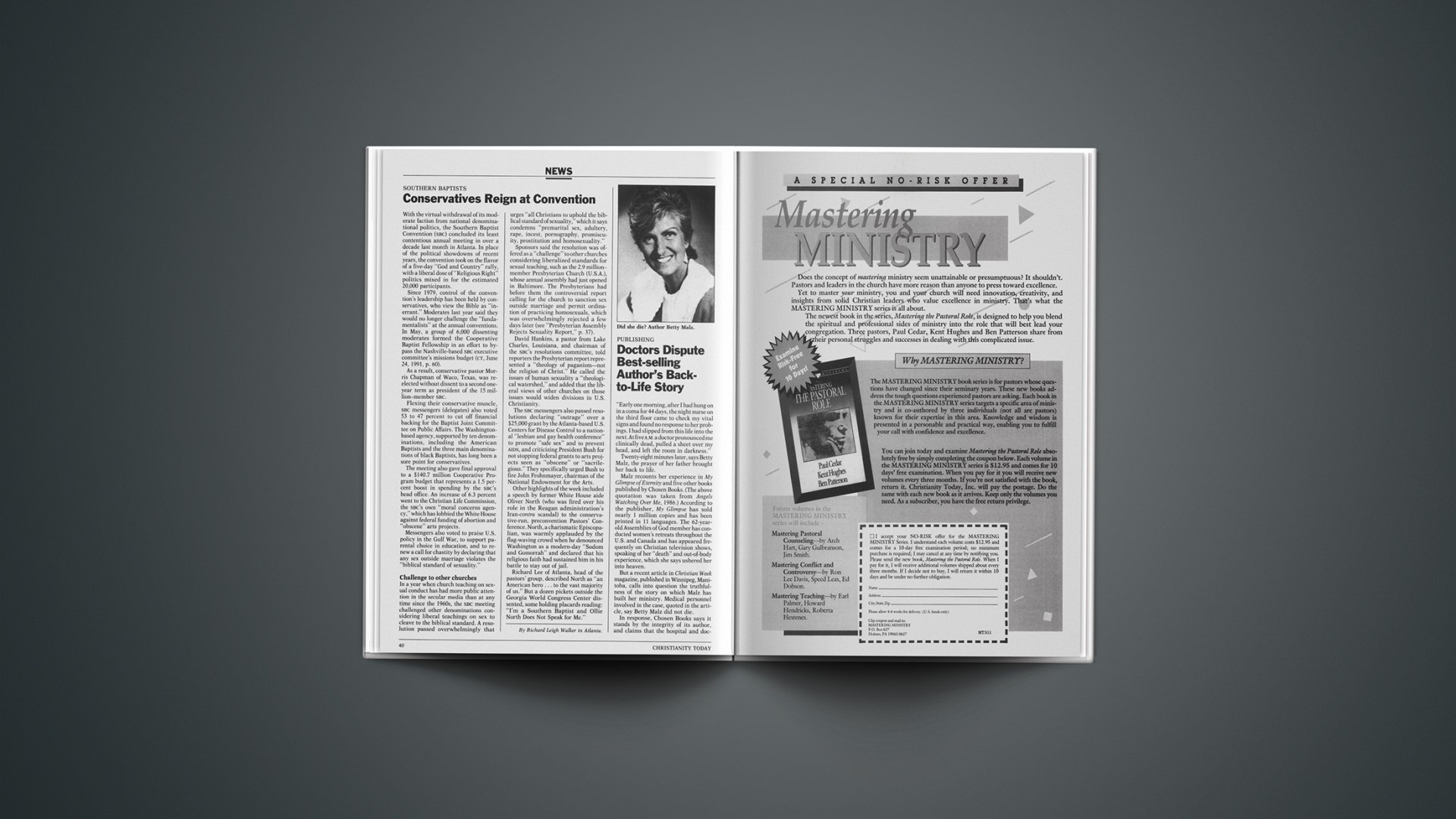

With the virtual withdrawal of its moderate faction from national denominational politics, the Southern Baptist Convention (SBC) concluded its least contentious annual meeting in over a decade last month in Atlanta. In place of the political showdowns of recent years, the convention took on the flavor of a five-day “God and Country” rally, with a liberal dose of “Religious Right” politics mixed in for the estimated 20,000 participants.
Since 1979, control of the convention’s leadership has been held by conservatives, who view the Bible as “inerrant.” Moderates last year said they would no longer challenge the “fundamentalists” at the annual conventions. In May, a group of 6,000 dissenting moderates formed the Cooperative Baptist Fellowship in an effort to bypass the Nashville-based SBC executive committee’s missions budget (CT, June 24, 1991, p. 60).
As a result, conservative pastor Morris Chapman of Waco, Texas, was re-elected without dissent to a second one-year term as president of the 15 million-member SBC.
Flexing their conservative muscle, SBC messengers (delegates) also voted 53 to 47 percent to cut off financial backing for the Baptist Joint Committee on Public Affairs. The Washington-based agency, supported by ten denominations, including the American Baptists and the three main denominations of black Baptists, has long been a sore point for conservatives.
The meeting also gave final approval to a $140.7 million Cooperative Program budget that represents a 1.5 percent boost in spending by the SBC’s head office. An increase of 6.3 percent went to the Christian Life Commission, the SBC’s own “moral concerns agency,” which has lobbied the White House against federal funding of abortion and “obscene” arts projects.
Messengers also voted to praise U.S. policy in the Gulf War, to support parental choice in education, and to renew a call for chastity by declaring that any sex outside marriage violates the “biblical standard of sexuality.”
Challenge To Other Churches
In a year when church teaching on sexual conduct has had more public attention in the secular media than at any time since the 1960s, the SBC meeting challenged other denominations considering liberal teachings on sex to cleave to the biblical standard. A resolution passed overwhelmingly that urges “all Christians to uphold the biblical standard of sexuality,” which it says condemns “premarital sex, adultery, rape, incest, pornography, promiscuity, prostitution and homosexuality.”
Sponsors said the resolution was offered as a “challenge” to other churches considering liberalized standards for sexual teaching, such as the 2.9 million-member Presbyterian Church (U.S.A.), whose annual assembly had just opened in Baltimore. The Presbyterians had before them the controversial report calling for the church to sanction sex outside marriage and permit ordination of practicing homosexuals, which was overwhelmingly rejected a few days later (see “Presbyterian Assembly Rejects Sexuality Report,” p. 37).
David Hankins, a pastor from Lake Charles, Louisiana, and chairman of the SBC’s resolutions committee, told reporters the Presbyterian report represented a “theology of paganism—not the religion of Christ.” He called the issues of human sexuality a “theological watershed,” and added that the liberal views of other churches on those issues would widen divisions in U.S. Christianity.
The SBC messengers also passed resolutions declaring “outrage” over a $25,000 grant by the Atlanta-based U.S. Centers for Disease Control to a national “lesbian and gay health conference” to promote “safe sex” and to prevent AIDS, and criticizing President Bush for not stopping federal grants to arts projects seen as “obscene” or “sacrilegious.” They specifically urged Bush to fire John Frohnmayer, chairman of the National Endowment for the Arts.
Other highlights of the week included a speech by former White House aide Oliver North (who was fired over his role in the Reagan administration’s Iran-contra scandal) to the conservative-run, preconvention Pastors’ Conference. North, a charismatic Episcopalian, was warmly applauded by the flag-waving crowd when he denounced Washington as a modern-day “Sodom and Gomorrah” and declared that his religious faith had sustained him in his battle to stay out of jail.
Richard Lee of Atlanta, head of the pastors’ group, described North as “an American hero … to the vast majority of us.” But a dozen pickets outside the Georgia World Congress Center dissented, some holding placards reading: “I’m a Southern Baptist and Ollie North Does Not Speak for Me.”
By Richard Leigh Walker in Atlanta.