The New Therapeutic Invasion

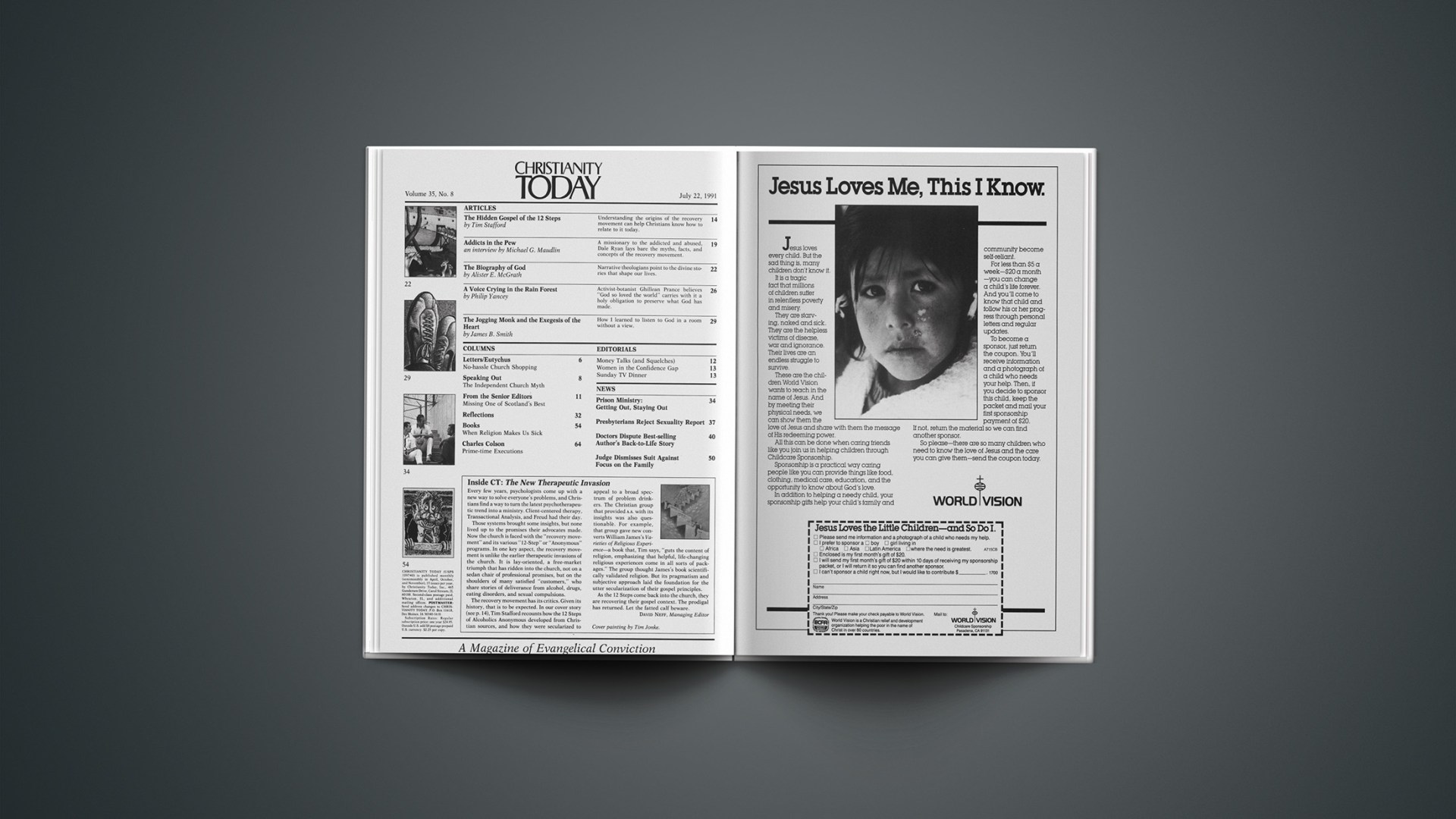
Every few years, psychologists come up with a new way to solve everyone’s problems, and Christians find a way to turn the latest psychotherapeutic trend into a ministry. Client-centered therapy, Transactional Analysis, and Freud had their day.

Those systems brought some insights, but none lived up to the promises their advocates made. Now the church is faced with the “recovery movement” and its various “12-Step” or “Anonymous” programs. In one key aspect, the recovery movement is unlike the earlier therapeutic invasions of the church. It is lay-oriented, a free-market triumph that has ridden into the church, not on a sedan chair of professional promises, but on the shoulders of many satisfied “customers,” who share stories of deliverance from alcohol, drugs, eating disorders, and sexual compulsions.

The recovery movement has its critics. Given its history, that is to be expected. In our cover story (see p. 14), Tim Stafford recounts how the 12 Steps of Alcoholics Anonymous developed from Christian sources, and how they were secularized to appeal to a broad spectrum of problem drinkers. The Christian group that provided A.A. with its insights was also questionable. For example, that group gave new converts William James’s Varieties of Religious Experience—a book that, Tim says, “guts the content of religion, emphasizing that helpful, life-changing religious experiences come in all sorts of packages.” The group thought James’s book scientifically validated religion. But its pragmatism and subjective approach laid the foundation for the utter secularization of their gospel principles.

As the 12 Steps come back into the church, they are recovering their gospel context. The prodigal has returned. Let the fatted calf beware.

DAVID NEFF, Managing Editor
Also in this issue

The CT archives are a rich treasure of biblical wisdom and insight from our past. Some things we would say differently today, and some stances we've changed. But overall, we're amazed at how relevant so much of this content is. We trust that you'll find it a helpful resource.

Our Latest

What $18 Would Get You

In 1979, CT investigated deceptive Christians, made the case for psychology, and watched Islam with concern.

News

Palestinian Christians Prepare for Easter amid War and Settler Violence

Heather M. Surls

Many in the community have moved abroad. Those who stay are barred from visiting holy sites.

The Eternal Meaning of the Cup

John Anthony Dunne

Across the church, our Communion practices reveal a broken world and anticipate the one to come.

The Russell Moore Show

Everything Depends on an Empty Tomb

 A reflection on how the resurrection reshapes science, suffering, joy, and the future of the world.

A Case for In-Person Voting

As a volunteer at a polling station, I saw what we lose when we choose convenience over communal participation.

Review

We Need More Than Generalities About Beauty and Justice

Makoto and Haejin Fujimura’s new book aims to help Christians think deeply about how we live but falls short on details.

Excerpt

American Presbyterianism Was Born Amid Chaos

D.G. Hart

An excerpt from Protestants and Patriots: Presbyterians in the Age of Revolution.

The Bulletin

Classroom Tech, Anti-Trump Protests, Troops in Iran, and Crisis in Cuba

Schools question tech for students, No Kings protests continue, US sends troops to Iran, and a repressive situation in Cuba.

Apple PodcastsDown ArrowDown ArrowDown Arrowarrow_left_altLeft ArrowLeft ArrowRight ArrowRight ArrowRight Arrowarrow_up_altUp ArrowUp ArrowAvailable at Amazoncaret-downCloseCloseEmailEmailExpandExpandExternalExternalFacebookfacebook-squareGiftGiftGooglegoogleGoogle KeephamburgerInstagraminstagram-squareLinkLinklinkedin-squareListenListenListenChristianity TodayCT Creative Studio Logologo_orgMegaphoneMenuMenupausePinterestPlayPlayPocketPodcastprintRSSRSSSaveSaveSaveSearchSearchsearchSpotifyStitcherTelegramTable of ContentsTable of Contentstwitter-squareWhatsAppXYouTubeYouTube