News

Long Sermons Seem Longer in the Pews, Study Finds

But it’s not a new problem. Just ask Martin Luther.

Edits by Christianity Today. Source: Sean824 / Karl Fletcher / Getty

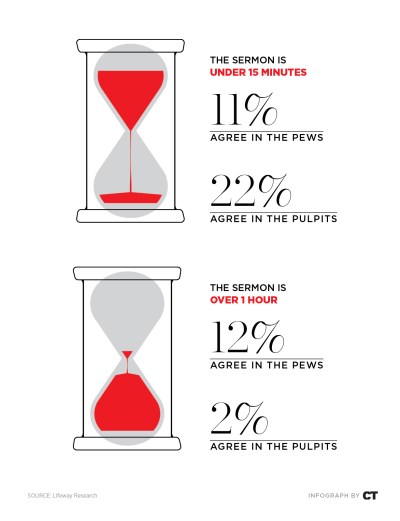
Churchgoers are six times more likely than preachers to say that their church’s typical sermon goes over an hour. Preachers, on the other hand, are twice as likely to say their sermons last less than 15 minutes.

Time, it seems, moves differently in pulpit and pew.

Modern preachers may decry the shortened attention spans of contemporary congregants, but conflict over sermon length isn’t new. It was a frequent point of contention during the Reformation, as preachers discovered the great depths of the Word—and went on and on about it.

Some sermons clocked in at three hours. Even the leading Reformers soon suggested restraints. Thomas Cranmer thought an hour and a half really ought to be plenty of time. John Calvin said a preacher needed to stop when he got tedious. Martin Luther offered young ministers this indelible advice: When people say, “He was prattling on and could no longer stop,” that’s a bad sign.

British churches eventually started installing hourglasses by the pulpits, according to church historian Owen Chadwick. The craftsmen who made them were more sympathetic to the experience in the pews than in the pulpits, though, and more than a few of the timepieces did not keep an honest hour. One surviving hourglass reliably runs out of sand at 48 minutes.

Though the preacher probably said it was half an hour.
Source: Lifeway ResearchInfograph by Christianity Today
Source: Lifeway Research

For more on sermon length and the perception of sermon length, visit: Lifeway Research.

Also in this issue

Our cover story this month follows a handful of Ukrainians who left their country on the eve of war—or in some cases, years earlier—and who sensed they were in exile “for such a time as this.” Plus: laundromat ministries, sermon lengths, fighting compassion fatigue, Jesus and jazz, and more.

Cover Story

They Fled Ukraine, and Ukraine Followed

Reply All

News

Counting the Cost of Paying Ransoms for Missionaries

Can We Resurrect Expertise?

Why We Preach for Proper Names

Learning to Love Our Neighbor’s Fears

Bronwyn Lea

Testimony

God Wanted Me When the Foster-Care System Didn’t

Tori Hope Petersen

Taking the Lord’s Name in Vain Without Swearing

News

Germany’s Nuclear Power Plants Are Closing. But Their Moral Questions Have a Long Half-Life.

News

Anglicans Lose 14 Properties in South Carolina Court Battle

Editorial

How to Greet the End of ‘Roe’

News

Preach the Gospel Everywhere. When Necessary, Use Laundromats.

5 Books for Getting to Know the Desert Fathers and Mothers

Andrew Arndt

Who Will Pay Africa’s Medical Bills?

Emily Belz in Nkhoma, Malawi

Our July/August Issue: War Stories

Andy Olsen

Cultural Diversity Isn’t a Problem to Be Solved

Elliot Clark

The Gospel and All That Jazz

Joy Marie Clarkson

What Should We Do If Our Compassion Runs Out?

Eric McLaughlin

Disasters Often Bring Revelation Rather than Punishment

The Unexpected Parenting Comfort of Ecclesiastes

The Christian Case for Reading Black Classics

Interview by Patricia Raybon

New & Noteworthy Fiction

Amanda Dykes

View issue

Our Latest

Being Human

Christine Caine Shares Her Adoption Story, Abuse Recovery, and ‘The Faith to Flourish’

Emotional healing through identity in Christ not identity in crisis

The Russell Moore Show

Should I Report Abuse in Church to the Police?

Spoiler alert: yes, you should.

Fertility Treatment Beyond the Quick Fix

Restorative reproductive medicine is a great idea and can honor traditional Christian teachings on marriage, children, and sex. Just don’t oversell it.

News

10 Journalistic Reading and Listening Recommendations

Ten prize winners who acknowledge sin but report redemptive twists.

Threatening Profound Evil Trivializes That Evil

Justin R. Hawkins

President Donald Trump and Pete Hegseth speak often of Christianity—but they seem to have no interest in its vision for just warfare.

The Iranian Church Persists

David Yeghnazar

Amid war, some Christians are evangelizing, preparing food for neighbors, and displaying other acts of generosity.

The Bulletin

Trump Threatens Iran, Artemis II Returns, and Anthropic’s AI Triggers Fear

Clarissa Moll, Russell Moore

Trump kills conservatism, astronauts head home, and Claude Mythos Preview deemed too dangerous for public consumption.

Review

Are Christians Rude Dinner Guests?

Three books on politics and public life about the common good, ISIS brides, and Ronald Reagan.

addApple PodcastsDown ArrowDown ArrowDown Arrowarrow_left_altLeft ArrowLeft ArrowRight ArrowRight ArrowRight Arrowarrow_up_altUp ArrowUp ArrowAvailable at Amazoncaret-downCloseCloseellipseEmailEmailExpandExpandExternalExternalFacebookfacebook-squarefolderGiftGiftGooglegoogleGoogle KeephamburgerInstagraminstagram-squareLinkLinklinkedin-squareListenListenListenChristianity TodayCT Creative Studio Logologo_orgMegaphoneMenuMenupausePinterestPlayPlayPocketPodcastprintremoveRSSRSSSaveSavesaveSearchSearchsearchSpotifyStitcherTelegramTable of ContentsTable of Contentstwitter-squareWhatsAppXYouTubeYouTube