Culture

Talking Turkey

The wild bird has brought people together for centuries.

A vintage illustration of a wild turkey.
Christianity Today November 26, 2025
Edits by CT / Source Image: Library of Congress, WikiMedia Commons

Norman Rockwell’s 1943 oil painting, Freedom from Want, features a tableau of personalities around a dinner table. Their shoulders lean in, faces lit with anticipation, drawn in by what the matriarch of the family presents: the Thanksgiving turkey, the true main character of the scene. Who knows what conversation preceded the idyllic vignette—all the differing opinions on the hot button topics of the era—or which family members had conflicts with each other. In that moment, it mattered not. For the turkey had brought them together.

The turkey as a symbol of unity may sound familiar for those of us who eat forkfuls with mashed potatoes, dressing, and cranberry sauce. We may even have assigned to the bird a unifying, albeit somewhat fictitious narrative taught in elementary school, which paints friendly pilgrims and Native Americans gathering around the magnificent fowl. 

The only species native to North America, wild turkeys can live in just about any habitat as long as there’s water and shelter. It’s truly an all-American bird, in a category with other great American unifiers like Lady Liberty and Uncle Sam. While it’s a myth that Benjamin Franklin lobbied to make the turkey the national bird, he did tell his daughter in a letter that he wished the turkey would have been chosen instead because it was “a much more respectable bird.”

Today, researchers estimate there’s around 6 million wild turkeys across the United States. But despite its glowing reputation as a community centerpiece, this objectively weird-looking bird was once close to extinction. The survival of the wild turkey tells a powerful story of community and cooperation across differences. Every wild turkey that crosses the road—or arrives at the holiday table—represents the unified efforts of conservatives and liberals, biologists and hunters, and Christians and those outside the faith, reminding us that even in polarization, this great bird still creates unlikely friendships and brings people together. 

“By the 1900s, subsistence and commercial market hunting had caused decline in the species,” says Roger Shields, wild turkey program coordinator for the Tennessee Wildlife Resources Agency. Hunters noticed first. In response, a motley crew banded together, including hunters, biologists, conservationists, and lawmakers. 

The result was the 1937 Pittman-Robertson Act, legislation that aimed to restore populations and conserve endangered species through an 11 percent tax on firearms, ammunition, and archery equipment. The act symbolized the beginning of the wild turkey’s advancement to mend cultural divides, says historian Brent Rogers, inviting stakeholders “outside of political norms because there’s blood, sweat, and tears invested into it, for hunters and biologists alike.” 

While conservation efforts like President Roosevelt’s national parks initiative attempted to stave off threats to species like the wild turkey, at the turn of the century, habitat destruction caused by the industrial revolution prompted Aldo Leopold, a forest ranger in Arizona and New Mexico, to do more. He would one day inspire the likes of Wendell Berry and define a new conservation movement in the United States. 

Jessica Moerman, chief executive of the Evangelical Environmental Network, says that Christians bring a unique understanding to conversations about conservation. By “stopping and preventing activities that are harmful,” says Moerman, we contribute to furthering “Christ’s reconciliation of all of creation to God.”

Moerman is a scientist but also the daughter of a turkey hunter, and she remembers the turkey calls in her father’s office when hunting season opened. “My dad always said hunters are the greatest conservationists,” she said. 

Through the efforts of hunters, biologists, and conservationists, turkey populations increased by the mid-1900s. But the species remained at risk because of increased urbanization and decreased wild areas. Here, again, the wild turkey brought folks together. It turns out what’s good for the wild turkey is actually good for a host of other species too. 

Efforts began countrywide to restore turkey habitats, and in 1973, the National Wild Turkey Federation was formally established. The work of the NWTF brought initiatives from each state into one coordinated, national effort inclusive of hunters, biologists, conservationists, and environmentalists to transplant healthy populations and preserve their environments. And it worked. By 1974, the wild turkeys numbered 1.4 million.

Michael Chamberlain, the National Wild Turkey Federation Distinguished Professor at the University of Georgia’s school of forestry, works in research and advocacy for turkey conservation efforts. “Those vegetative communities are largely beneficial for a number of critters, whether it be birds, pollinators, insects,” said Chamberlain. “Those species are going to thrive in the same plant communities that turkeys thrive in.” 

Rogers, the historian, who is also a hunter, remembers seeing his first wild turkey in the 1980s, flying up out of the forested land his family had owned for decades. “Just watching it fly off, [I remember] thinking, That is a thing of grace and beauty.”

Today, Rogers uses all of the birds he hunts, even down to the feathers, which he sticks into his weathered Bible as bookmarks. (He even mailed me some, which now sit in the pages of my own Bible, marking my current reading spot in Acts.) He sees it as a reflection of God’s economy, where nothing is wasted. Raised Quaker in Iowa, Rogers has a feather resting on Psalm 8: “You put us in charge of everything you made, giving us authority over all things.”

“That is a privilege,” said Rogers after reading the passage over our Zoom call. “It’s also a burden. And as a hunter, you feel both.” For him, hunting carries a deep theological weight and responsibility that contributes to his particular hunting tradition. “I lay my hand on every turkey—even with people I’ve taken that are not spiritual people—and I say a prayer of thanks. Because to me, that’s a sacred act.”

Rogers and others like him believe that real hunters are also conservationists, because they know the cost firsthand. “A real hunter wants the animal to live more than you want it to die. And if you’re going to take, you have to give back.” 

This is the paradoxical thesis of the hunter-conservationists who are at the core of this movement. The work of Rogers, Shields, and at one time, Leopold, has inspired what modern conservationists call a “land ethic.” Leopold articulated this ethic throughout his teaching career at the University of Wisconsin and in the 1949 seminal work published after his death, A Sand County Almanac. Almanac influenced people like Wendell Berry and leaders of the second wave environmental movement in the 1960s and 1970s, including those who noticed the wild turkeys were still in need of attention.

For all its triumphs, the wild turkey’s population restoration is also a cautionary tale. By the year 2000 there were turkeys everywhere, says Chamberlain. But it’s not that simple, because even while restoration was finding success, populations were already declining. It was Chamberlain’s Wild Turkey Lab that sounded the alarm in 2015. “We got lulled to sleep, which is just human nature,” he said.

Today, new environmental factors play a large role in the ever-evolving needs of the species. There are fewer wild areas, more threats with cars and chemical presence, and fewer large predators, which leads to more nesting predators who eat eggs. Rogers emphasized the urgency to continue conservation efforts from all who care about creation: “Unless we’re investing in research to teach us about new threats, we’re not doing our full job as stewards.” Restoration this side of paradise requires constant diligence. 

When I asked Chamberlain what wild turkeys have taught him about community, he replied without hesitation, “Resiliency. You’ve got this bird that is so resilient but is yet vulnerable. The same goes for community. … Don’t take it for granted.” 

Wild turkey conservation teaches us that there are corners of our American landscape where the sharing of literal common ground is the antidote to an anti-“us” era. Like the turkey itself, we are resilient yet vulnerable, interdependent in ways that need care to flourish. Our relationships with one another are susceptible to atrophy through complacency. 

So while this Thanksgiving we may feel a unity around our own tables as fictional as a Rockwell painting, may we take heed of the very real call in Hebrews to show hospitality despite the many things that may put us at odds with one another. Maybe our eyes can fall on the centerpiece of the table—to the turkey itself—for a gentle and physical reminder of where the invitation in Romans to live at peace with others (12:18) has taken root and is still at work, shaping the very land on which we gather.


Culture
Review

Knives Out’s Benoit Blanc Says He Hates the Church

But there’s more to “Wake Up, Dead Man” than his condemnatory monologue.

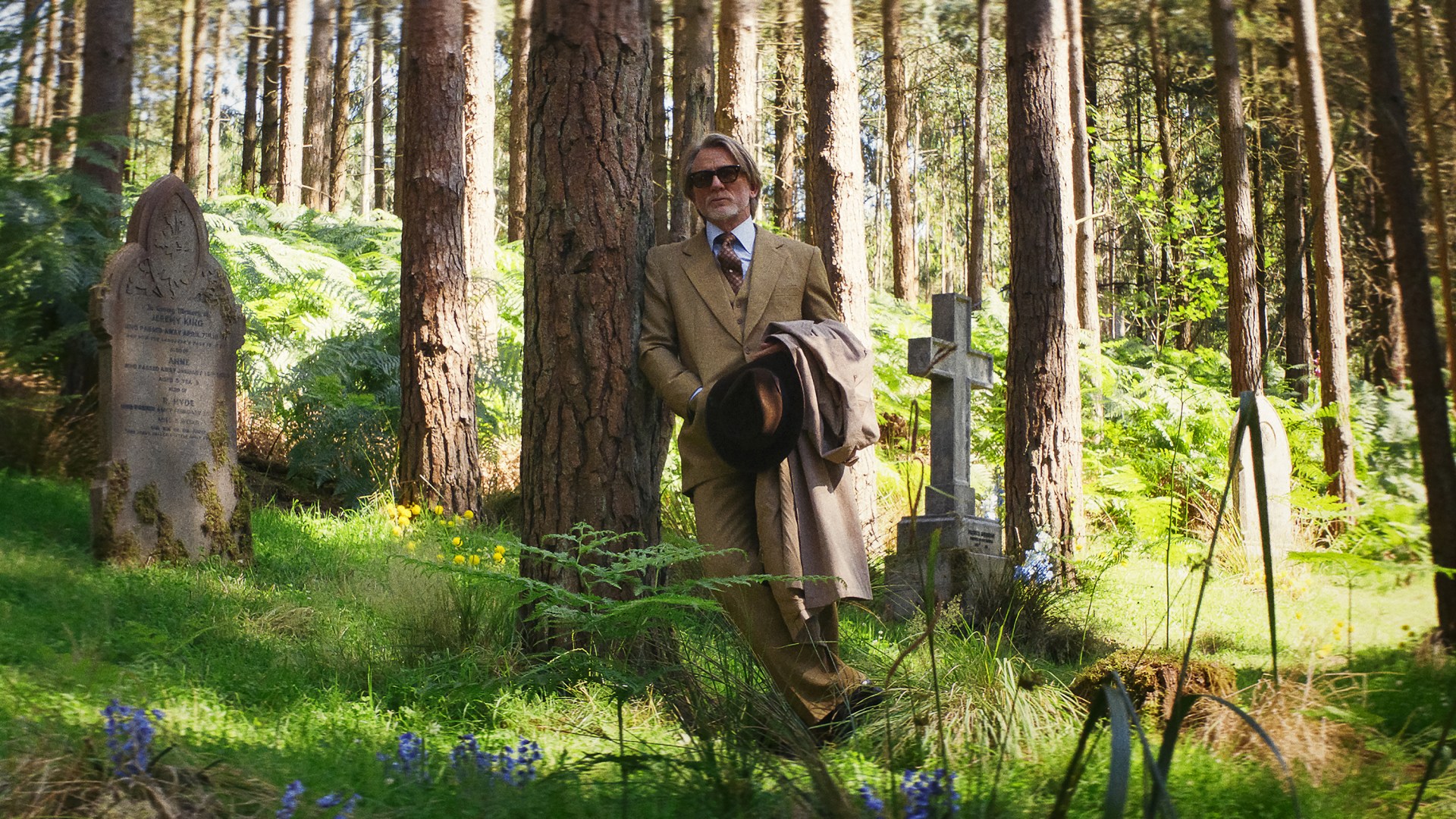
Daniel Craig in Wake Up Dead Man: A Knives Out Mystery.

Daniel Craig in Wake Up Dead Man: A Knives Out Mystery.

Christianity Today November 26, 2025
Courtesy of Netflix © 2025

Wake Up Dead Man, the third installment in the murder-mystery movie series Knives Out, shows the church at its worst.

In his latest adventure, detective Benoit Blanc (Daniel Craig) encounters a congregation centered on its pastor’s authoritarian personality, rooted in reactiveness instead of restoration. Get ready for plenty of tropes about fire-and-brimstone fury.

And yet there are glimmers of the gospel. For the Christian, Wake Up Dead Man ends up being as hopeful as it is heartbreaking.

The film takes place at Our Lady of Perpetual Fortitude, a small Catholic church in a small fictional town. Right away, we meet Father Jud Duplenticy (Josh O’Connor), a young priest, former boxer, and somewhat-recent convert. After an anger-fueled accident in the ring, he hung up his boxing gloves and dedicated his life to the Lord. Now he’s learning what it is to be a believer, eager to share God’s mercy and love. He’s reminiscent of some of the pastors I grew up around—leaders who came to faith as adults and began guiding others down the same path.

Father Duplenticy is sent as an extra set of hands to a flock whose current priest, Monsignor Jefferson Wicks (Josh Brolin), is more about fear than forgiveness. Something is wrong; the cross that once hung in the front of the sanctuary is missing. (Monsignor Wicks’s mother, in a demon-possessed, greed-motivated rampage, tore it down when she learned she would not inherit her father’s fortune.) Now Wicks references the missing cross in every sermon, using it as a symbol to remind the congregation of their sins, the evils of the world, and their perpetual dependence on him as their access to the divine.

After a crass confession, it’s apparent (if it wasn’t already) that Monsignor Wicks is narcissistic, egotistical, and manipulative. He’s focused more on seeking attention from an up-and-coming conspiracy theorist and influencer than on being a shepherd, and he advises a wealthy woman that she can be healed via his prayers. He’s replaced Christ in his church both figuratively and literally.

At its core, Wake Up Dead Man is an entertaining murder mystery. It’s also rife with religious imagery and allegory. Christian viewers might enjoy a richer watching experience because they’ll get all the symbolism—a murder weapon in the shape of a wolf, a tomb opened after three days.

The writing is wonderful. Comedic timing brings levity. I genuinely enjoyed the film.

But it was also hard to watch as someone who loves the church.

Turns out, Benoit Blanc has baggage. He walks into Our Lady’s sanctuary, is asked whether he’s religious, and launches into a barely-pausing-for-air rant about hatred and hurt. Blanc says the church is homophobic, misogynistic, manipulative, abusive, and hypocritical.

A few of his criticisms are fair. The congregation he’s just arrived at is a veritable case in point when it comes to abuse and hypocrisy.

But much of his monologue is more reflective of how secular culture stereotypes the church than of how it actually operates or what it really preaches. Blanc’s speech is full of the same kinds of accusations that stop me from sharing the gospel with nonbelieving friends. Who wants to be called an ignorant bigot?

I saw Wake Up Dead Mean at a film festival this fall, surrounded by a largely secular audience. Blanc could barely finish his speech before the crowd erupted in cheers. The theater of over a thousand people was suddenly deafeningly loud, jeering at my religious community as I sat silent.

I’ll remember that uncomfortable moment for the rest of my life. I sat in a crowd of people who—whether personally affronted by the church or assuming the worst of what they’d heard secondhand—clapped for a damning speech about the bride of Christ.

This kind of condemnation is not new to me. I live in Los Angeles; I grew up here too. I love my city, but it’s not the easiest place to be a believer. It’s built on an industry defined by vanity, wealth, and idolatry. Just the other day, an Uber driver asked me if I was happy I was Christian, because, in his opinion, Christians hated everyone else. I went to a public school where believers were few and far between. We didn’t really talk about our faith out of fear of disapprobation. The assumption was we were exactly what Benoit Blanc claimed us to be—homophobic, misogynistic, hateful, hypocritical.

The cheers in the theater weren’t surprising. But still, they broke my heart.

As I sat in my velvet seat, I found my brow furrowing and my eyes narrowing. I was getting angry and defensive—not Monsignor Wicks–level mad but way too close, itching to jump from my seat and point at the specks in others’ eyes (Matt. 7:3–5). I wanted to go off on a diatribe of my own, to spout off about my local church—the donations we collected to aid in fire-relief efforts across LA, the hundreds of meals we serve to the unhoused on a weekly basis, and the camp we put on for kids in the foster-care system. I wanted to plead with them to see past the sins of individual Christians and look to the person of Jesus Christ instead.

Also, I wanted to argue, the Bible never promises a perfect people of God. Far from it. Josiah cries out against Israel’s iniquities (2 Chron. 34:21). John says anyone who claims to be without sin is a liar (1 John 1:8–10). Again and again, Scripture highlights the hypocrisy of religious leaders. Jesus flips the tables at the temple, saying the church has become “a den of robbers” (Matt. 21:13). “Woe to you, teachers of the law and Pharisees, you hypocrites! You give a tenth of your spices—mint, dill and cumin. But you have neglected the more important matters of the law—justice, mercy and faithfulness,” he declares. “You should have practiced the latter, without neglecting the former. You blind guides! You strain out a gnat but swallow a camel” (23:23–24).

All this corruption, of course, causes pain. That’s why I was also holding back tears as the crowd clapped, remembering the times I’ve had to convince myself to stay in the pews after sisters and brothers in Christ have been wounded by the church.

It is easy to point fingers at bad pastors. But sitting in that theater showed me how easy it is to get fearful, angry, and prideful myself.

In my experience living in Los Angeles, sometimes malice toward the church covers up serious questions, raw curiosity, genuine misunderstandings that can be addressed, and stinging injury God can heal. Scripture also says social condemnation will come to Christians—and we are to turn the other cheek. “If the world hates you, keep in mind that it hated me first. … They will treat you this way because of my name, for they do not know the one who sent me,” Jesus says (John 15:18, 21). Instead of getting angry, I must try to bless those who curse the church (Luke 6:28).

Father Duplenticy is the breath of air Wake Up Dead Man needs—modeling integrity, putting others above himself. If the Monsignor is the church at its worst, this priest is the church at its best.

Thanks to Duplenticy’s example, Benoit Blanc witnesses a life in imitation of Christ. That witnessing is integral to his ability (or inability) to solve the latest case. Whether his eventual Damascus road leads to contemplation or confession, I’ll leave for you to find out.

By the end of the movie, I sensed a shift in the audience’s posture. I’d calmed down too. There were even some mumbles and gasps when true mercy was extended. I left the theater hopeful.

Wake Up Dead Man isn’t out to reject Christ. It’s out to decry the human sin found among his people. That’s something all of us, believers or not, can get behind. But Christians have additional context: Sin is not the end of the story. Grace gets the final word in the mystery of faith.

Mia Staub is editorial project manager at Christianity Today.

Culture

I Wanted to Serve Both God and Mammon

A friend’s request for a rent check called my dual loyalties into question.

A golden stroller.
Christianity Today November 26, 2025
Edits by CT / Source Image: Unsplash

A good friend once asked me for help with the rent. They were going through a hard time, they explained. Would my husband and I be willing to cover this one expense until they got through it?

I didn’t know how to answer. We had just given birth to our second child, and I had recently quit my job. Before that, we had been living on nonprofit and education salaries that were considered low even within our industries, and were spending as frugally as possible so that our paychecks wouldn’t be swallowed whole by the cost of living in the San Francisco Bay Area. I interjected before the conversation could go any further and said we needed time to think about it.


“Open thine hand wide,” says the Book of Deuteronomy, in one of many verses that indicate how adamantly God expects his people to follow his generous example (15:8, KJV).

Comprehensive Old Testament instructions encompass both individual giving and systemic movements toward land redistribution, debt forgiveness, and almsgiving. The New Testament is similarly insistent that we honor God through showing material care to others. “For I was hungry and you gave me something to eat,” says Christ; “I was thirsty and you gave me something to drink.” In Christ’s own telling, whatever we do for the dispossessed, we do for him (Matt. 25:35, 40).

As the early church establishes itself, similar commands are given to the people of God, even as they struggle to survive under foreign occupation. Paul, commending the Corinthian church for its spiritual depth and maturity, concludes by reminding its members to practice radical generosity in order to “prove … that your love also is genuine” (2 Cor. 8:8, ESV).

He accompanies his command with a pithy little closing, astonishing to anyone used to the acquisitiveness of contemporary life. If the Corinthians give to one another, he says, they will be assured that “the one who gathered much did not have too much, and the one who gathered little did not have too little” (v. 15)

The assumption here is that having too much is a problem to be solved and that the people of God can help those who struggle with this particular problem by rerouting their resources. Anyone with too little—even, provocatively, with too little as a result of insufficient “gathering,” or planning and saving on their own behalf—can be cared for and protected by their more affluent neighbors.

This is a revolutionary way to think about our belongings and how they ought to be managed. The scriptural narrative, which identifies all of us as bearers of the image of God and therefore as possessors of inalienable value, gives us the corollary identification as each other’s keepers. What we do with our possessions must be constellated around our shared, inherent belovedness.

I find the Bible’s view of money beautiful but unpersuasive. I approach its teachings with the admiration and unease of a visitor to a foreign land: appreciative of what I am witnessing, sharply aware that my home is elsewhere.

Once my husband and I finished the conversation with our friend, I began thinking about all the verses about money that I’ve memorized without fully internalizing them. I reside within another narrative about wealth, and that narrative comes from the market economy.

The market and its teachings are so compelling that they have, on multiple occasions, moved me to tears. When we had our first child, I realized that there were gorgeous strollers to be had, models affixed with four-figure price tags that could roll my baby forth on sleek metallic frames that looked like ergonomic Scandinavian thrones. All the ads I scrolled through suggested that affording such a stroller was the next step in our progression as parents, in proving we were capable of providing for our offspring.

Our child’s low-slung plastic contraption seemed like an affront to her beauty and a testament to the insufficiency of my love. What had all these other parents done, I wondered, to afford their strollers? Why had I not figured out a way to do the same? I wanted the same thing that the ads wanted for me, which was to grow into the kind of person who could provide our child with the best of everything. This longing was potent enough to make me cry.

Once my child began expressing a greater interest in her surroundings, different questions arose. Why could I not provide her with Waldorf-approved toys in natural colors and textures? Why did regular admission to the baby gym seem so exorbitant? Was there any real benefit to mother-baby Pilates classes? Why was I failing to afford these things? The story that exists in my imagination, the narrative line I want to follow, features a woman whose purchasing power is commensurate with her love.

These ideas don’t seem objectionable: I want money so that I can grow into my God-given responsibilities as an adult woman. Yet they also don’t explain the protectiveness I feel toward my possessions or my reluctance to grant a friend’s request. As I considered the prospect of covering someone else’s rent, I tried to identify the reasons why we couldn’t help and realized that my logic didn’t make sense.

Was I withholding money due to fear of lack? Truthfully, my husband and I were making enough to cover our basic needs. Was I afraid that giving would compromise my child’s prospects? Our ministry and education salaries already qualified us for free preschool programming. Besides, my child had already been outfitted for the first five years of life with a raft of hand-me-down clothing and gifts from doting family and friends.

Making decisions based on financial prudence has a semblance of wisdom. Yet my reasons for wanting to protect my wealth are surprisingly ill-defined, suggestive of beliefs I can rarely bring myself to articulate. My relationship to money has the clarity of a pointillist image—coherent from a distance but disintegrating upon close inspection.


In her book The Age of Choice: A History of Freedom in Modern Life, historian Sophia Rosenfeld suggests that most of our moral questions are clarified when understood as outgrowths of an obsession. To a historically unprecedented degree, we are fixated on personal freedom. Whenever we weigh contemporary debates about money, abortion, vaccinations, or schooling, Rosenfeld says that we are really weighing arguments about individual autonomy and how to best maximize its expression.

As an example, Rosenfeld points to the way “My body, my choice” has become a rallying cry for both pro-abortion and anti-vaccination activists. That two groups associated with opposing political camps will frame their work so similarly—as advocacy on behalf of personal decision-making—illustrates our collective state of mind. We may disagree about how to wield our liberties, but we rarely have meaningful disagreements about whether more liberty itself is good.

Rosenfeld sees evidence of this not only in our political language but in our religious and romantic practices as well. She points to the relatively recent emphasis on individual conversion experiences as evidence of spiritual authenticity and to the shift away from arranged marriages toward companionate partnerships.

The goodness of unfettered personal decision-making has become what sociologist Pierre Bourdieu termed a doxa—an idea that defines a culture. Undergirding this particular doxa is the continued expansion of market capitalism. “The business of selecting and the logic of the menu of options,” Rosenfeld writes, “have become both a way of life and, it is widely assumed, a means to build a life.”

My attachment to money takes on a troubling shape against the backdrop of these arguments. Rosenfeld views democracy, capitalism, and liberal societies as equally oriented toward maximizing choice. But as democratic governments and liberal societies become captured by special interests, the market appears to be the only realm in which my choices are still guaranteed to mean something.

I’m not convinced that my government will be responsive to me. My neighborhood institutions, ranging from local storefronts to schools and churches, have struggled to regain their pre-COVID vigor. Money, if I am honest, extends the most credible promise of a good life. It offers one of the few remaining mechanisms through which I can exert my will and expect to see a result.

Rosenfeld would point out that the control I wield as a consumer is already far more limited than I think. Although we experience ourselves as independent decision-makers, she says, “we rarely make up the rules of the game or craft the banquet of possibilities.” Modern adults have comparatively greater freedom to date and marry as they like but no control over the proliferation of dating apps and diminishing in-person opportunities to meet a potential romantic partner. They have choices, yet those choices are shaped by the companies that code their algorithms.

We may perceive ourselves as free—Rosenfeld observes that much of contemporary discourse around marriage still centers on our right to choose our partner—while living in a network of conditions that heavily constrain our will. Personal liberty becomes a subjective experience at best and an illusion at worst.

So who, exactly, is facilitating our convoluted relationship with money? The most glaring culprits are tech companies.

For decades, Harvard Business School’s Shoshana Zuboff has produced landmark research examining the effects of technological advancement and corporate dominance on selfhood. Her masterwork, The Age of Surveillance Capitalism, coins the term “surveillance economy” to describe the system we currently inhabit, and gives it the credit, or culpability, for both the comfort and dissonance of contemporary life.

Zuboff proposes that capitalism, having played out the competition for land, natural resources, labor, and attention, has evolved yet again. The most aggressive corporations are no longer focused on these comparatively traditional realms of activity, but on using consumer data to generate “prediction products that anticipate what you will do now, soon, and later.”

Big Tech’s era-defining innovation, says Zuboff, is its understanding that we are disclosing information about ourselves every time we interact with a device, and that this information can be used to manipulate our relationship to our future. Clients pay tech firms to create “behavioral futures”—to aggravate emotionally vulnerable teenagers before the release of a new wellness product, perhaps, or to induce the correct forms of outrage in swing-state voters in advance of an election year.

“We are not surveillance capitalism’s customers,” Zuboff says.

We are the sources of surveillance capitalism’s crucial surplus: the objects of a technologically advanced and increasingly inescapable raw-material extraction operation. Surveillance capitalism’s actual customers are the enterprises that trade in its markets for future behavior.

Her claims would sound hyperbolic if they were not accompanied by nearly 700 pages of documentation laying out the patents, interviews, correspondence, and litigations that tech firms have generated in their attempts to monetize our behavior. She offers Meta’s infamous “61-Million-Person Experiment in Social Influence and Political Mobilization” as an early demonstration of how precisely companies can move users towards a desired outcome and Gonzalez v. Google as a more recent, and much darker, example of what is possible.

In Zuboff’s view, life under surveillance capitalism promises to be convenient and fun, a utopia of two-day deliveries and astonishingly well-curated “For You” pages. But this life requires a long obedience in a direction that we have no way of fully comprehending. In order to receive surveillance capitalism’s comforts, we have to surrender our ability to imagine a life independent of its incursions. Zuboff believes that we are battling for the “right to a future tense”—for our capacity to conceive of our existence outside the priorities of the market.

I understand this intuitively. On all my devices, my future as an adult woman has clearly been mapped out in the exact way Zuboff describes. I receive ads about the vacations my family can take as my children grow older. I come across videos about buying insurance packages for house and car, and about depositing money in college savings accounts. I am regularly served content about home decor, meal-prep subscriptions, anti-aging beauty products, and boutique health care services, all of which, if I am honest, I find appealing.

To me, the closed loop Zuboff describes—in which companies plant and cultivate our desires, in which we can be trained to salivate for whatever the market has on offer, in which our money will obtain the exact items we have been conditioned to want—offers a comforting way to live.

Helping my friend in response to the scriptural call to generosity only endangers my place in this ecosystem, all but guaranteeing that there will be no lavish vacation in my future, no subscription boxes in the mail. Why would I relinquish these things?


Jesus famously declared that it is impossible to serve God and Mammon, casting money as a spiritual presence to which we cannot give partial devotion—only total fealty. The sharpness of his phrasing always makes me want to blunt his words a little, to interpret this teaching as a general warning against divided priorities instead of a direct rebuke of humanity’s lasting wealth obsession.

Yet even a brief consideration of what money promises, and why we come to rely on it, makes it impossible to ignore Jesus’ meaning. He calls money an idolatrous deity because it aims to satiate the appetites we would otherwise bring before the Lord.

All our interactions with money are freighted with spiritual consequence. Rosenfeld’s history of choice and individuality is a history of how thoroughly capitalism has reshaped our concept of self; Zuboff’s analysis of the surveillance economy also functions as a study in human insatiability and greed. If religious practice consists of regular behaviors that gradually reconfigure our affections, then our history with money is clearly a history of devotion.

Today, no one acculturated to consumerism will find Paul’s letters immediately comprehensible. To me, the idea that “the one who gathered much did not have too much, and the one who gathered little did not have too little” sounds deranged. So does the idea that Paul’s readers should seek to imitate the Macedonian church, who managed their circumstances of “deep poverty” by “overflow[ing] in the wealth of their liberality” (1 Cor. 8:2, NASB here and below). Why should anyone, as a practical matter, not retain “too much” of what they have earned or respond to their own “deep poverty” with acts of lavish giving?

Perhaps Paul is too flippant, praising people for giving “according to their ability, and beyond their ability (v. 3). His letter, breezily cheerful in its recommendations, indicates total ignorance regarding the terror and need that permeate the relationship between people and their money.

But to a mind conditioned by Scripture, Paul is not deluded but is deeply, appropriately critical. His writing bridges a vast tradition, which has long subjugated money to the task of honoring God and people. He addresses money not because it is his special concern but because it is the preoccupation of his audience. The goal of his argument is to rob money of its primacy and remind his readers of its best use—to be generously dispensed as an expression of love. “For you know the grace of our Lord Jesus Christ,” Paul writes, “that though He was rich, yet for your sake He became poor, so that you through His poverty might become rich.”

Echoing Christ’s God-and-Mammon juxtaposition, Paul draws a connection between money and worship, arguing that the choice to retain or surrender our resources is also the choice to limit or consummate our devotion to God. We can appraise one another through the eyes of the market, or through the eyes of the Lord.

Even across millennia, Paul’s critique holds true. Surveillance capitalism has yielded structures that respond to our desires with alacrity, but these structures prioritize only viable consumers. Those of us who become too sick, too old, or too impoverished to sustain our earning and spending quickly grow irrelevant. We have built a market system that imparts meaning and comfort to human life and gives us the tools to care for one another. But this system retracts its services the moment we enter a state of actual vulnerability.

Conversely, Paul describes Christ’s generosity as a phenomenon activated by the circumstances that cause human-made systems to falter. Christ, when faced with our helplessness, responds by voluntarily dispossessing himself, giving so extremely that there is no possibility he can ever be repaid.

Taking Christ’s example seriously, as Paul asks his readers to do, has a vertiginous effect, reminiscent of the moments in Scripture that have people presented with a shimmering new reality—Moses and the voice of God in a burning bush, Ezekiel sighting a heavenly figure in a storm. These men are so overcome at the prospect of a realm more potent and profound than our own that their only response is to prostrate their bodies on the ground.

Paul’s letter reads like these instances of divine encounter, in which the sheen of the familiar briefly melts away and exposes us to the startling immanence of the holy. Like the flame that is also a presence, like the storm that is a vision of eternity, Paul’s letter is also an invitation to communion with the Lord. He casts our confrontations with material need as opportunities to apprehend a Christlike generosity, as paradigm-shattering as a voice in the wilderness calling my name, as a vision unfurling before me in the sky.

Rosenfeld, at the close of her book, seems to anticipate my reaction to Paul. Every doxa comes in for a reckoning, she says, and the morality of personal liberty, as unimpeachable and self-evident as it has seemed in my lifetime, is revealing its limitations. American society is at an impasse, gridlocked by conflicts that treat every political contest as a zero-sum game for agency, indebted to surveillance capital for the uneven pleasures of optimized consumption. She suggests that we take this opportunity to “start wondering, without prejudgment, if choice as we know it is really what freedom should be all about.”

In other words, if we are seeing fissures in our moral universe, perhaps we should peer into them. If I am drawn to Paul’s letters, it is probably because they read like missives from someone who has already glimpsed what is on the other side.

Paul, whose orthodoxies led him to violently persecute the church, was on the road to Damascus when he was apprehended. Christ asked Paul, “Why do you persecute me? It is hard for you to kick against the goads” (Acts 26:14).

With a few phrases, Christ punctured Paul’s understanding of his own life, framing it as not a story of piety and certitude but of a struggle against a presence that Paul detects but cannot accept.

When I read the account of this conversion, I also want it to be an account of my life. I too am a person who has been obsessed and troubled by the gospel ethic of generosity. I too want to be standing on the precipice of a reality I have intuited and yet hesitated to enter. I want, like Paul, to surrender my right to kick against the goads.

Ultimately, I went to my husband, who was already prepared to give our friend the money. I told him that I had my answer.

Yi Ning Chiu writes the newsletter Please Don’t Go. Previously, she was the columnist for Inkwell, Christianity Today’s creative NextGen project. 

Ideas

No Longer Politically Ensnared

Contributor

Both parties are enmeshed in an ongoing identity crisis. The chaos can give us a chance to rediscover what we’ve lost.

A bald eagle with a red net and a blue net.
Christianity Today November 26, 2025
Illustration by Elizabeth Kaye / Source Images: Getty, WikiMedia Commons

I grew up in the front row of the church and on the frontlines of Chicago politics.

My view of public life was formed in church basements, union halls, and on the front porches of red-brick bungalows lined up on the west side of the city. As a kid, my great-aunt Irene worked as a precinct captain, mobilizing voters for Democrats, while my cousin brought neighborhoods together to address local issues.

On Saturday mornings, I often saw a generation of seasoned Black organizers gather at an advocacy organization to sing rapturous Gospel music, listen to a sermon, and then pour out to register, educate, and mobilize voters. The job wasn’t merely to win elections but also to protect the dignity of our people.

At the time, the distance between my parents’ pews and my community’s politics wasn’t far—similar people and values, just different platforms of expression. Even inside the world of partisan politics, which I pursued as a calling later in life, I saw myself as a part of something separate and distinct. Over the years, however, that distinctiveness seemed to fade.

We’re currently living through a strange and volatile political time that could be an invitation for rediscovery—not only for the Black church but also for evangelicals across the board. 

On one side, the Democratic Party is in the middle of a very public identity crisis. The same night that New York City’s Zohran Mamdani, a democratic socialist, was elected mayor—with a mandate to push left-wing policies from public grocery stores to rent control—Virginians delivered a decisive win to Abigail Spanberger, a moderate who represents a very different vision for the party.

Meanwhile, Democratic leaders like governors Gavin Newsom and J. B. Pritzker and former Chicago mayor Rahm Emanuel are all positioning themselves as presidential hopefuls, each offering distinct styles for the party’s future: technocratic management, progressive populism, or pragmatic machine-style politics.

Republicans, for their part, are in no less turmoil. Georgia congresswoman Marjorie Taylor Greene recently announced she was resigning from her position after a high-profile fallout with President Donald Trump on a host of issues, including the Epstein files.

Separately, Tucker Carlson’s friendly interview with a white nationalist and avowedly racist antisemite ignited bitter infighting among conservatives, which, as commentator Jonah Goldberg recently told Vox, is “previewing the bigger wars to come about what the right is about, who can be tolerated as part of the coalition, and who can’t be.”

In short, both parties are drifting, while the coalitions that once held them together appear to be fracturing in real time. Some of the attempted realignment is symptomatic of the moral rot in our politics. As the parties are trying to discover who they are, however, it can also offer the American church an opportunity to retrieve our own identity independent of the political chaos. 

Three years ago, I ran for Congress as a pro-life Democrat. When I look back on it now, that was the moment the need for political renewal felt undeniable to me. Friends—even those who were Christians—withdrew, and former colleagues insisted I should “just be a Republican” because of my pro-life views.

Perhaps most painfully, many Black churches—whose pews had taught me a moral vocabulary of responsibility, family formation, and the sacred worth of children—lined up to support candidates who had discarded those values entirely.

This took place in the aftermath of the Democratic Party’s shedding of pro-life voices across the board. In 2010, for example, the party had around 40 national legislators who held pro-life views, according to New York Times writer Ezra Klein. Today, there’s virtually none. The Republican party has also backed away from its strong pro-life stance while the Black church, a traditionally Democratic voting bloc, has all but lost its distinctive voice on the issue.  

That’s not the only thing that has been lost. Many have strayed from talking about economic justice with a healthy respect for personal responsibility or a high view of the traditional family structure, while still defending the dignity of those who don’t belong to one. We rightly agonize over how to make our criminal justice system fair and equitable. But we can’t seem to do that while still holding fast to the belief that those who commit crimes should be held responsible for the harms inflicted on communities.   

While all this is happening, the Black church has also been losing political power. Young people are leaving and are increasingly becoming discipled by the liturgies of secular progressivism or the moral intuitions of secular conservatives. They are also being drawn to other traditions or to alternative spiritual movements—places where belief feels less superficial and the bar for belonging and participation feels higher.

When churches become little more than cultural outposts for partisan ideology, rather than the kind of spiritual communities that shape political judgment through Scripture, tradition, and discipleship, they cease to offer a compelling reason for continued participation.

The problem is not that Black churches, or any churches, lack moral convictions. It’s that we often express those convictions in the language of the parties rather than the language of the faith. We trade our prophetic distance for proximity to power and forget that our social authority arose from our willingness to be different.

Whether they admit it or not, both parties need religious Americans to succeed. An identity crisis gives the church an opportunity to make a demand on them—not as beggars seeking concessions but as citizens with the right to negotiate the moral terms of this country’s political future. I’m not saying we can ultimately control what Democrats or Republicans become. We can’t. But when we remember who we are and act accordingly, our voice can carry further than we know. 

This is where the history of the Black church has something crucial to offer. I say this not because it is the only Christian tradition worth analyzing, but because its historical political witness avoided the great temptations of cultural assimilation and retreat. At its best, the Black church offered something our politics rarely produces: compassion with conviction, justice rooted in righteousness, hope grounded in sacrifice, and resistance joined to reconciliation.

If the church hopes to speak with moral clarity into this political vacuum, we must learn again what the Black church once embodied.

The first thing to remember is that distinctiveness matters. The Black church held moral authority because its theology shaped its politics, not the other way around. It critiqued exploitation from the right and overreach from the left. It refused to treat the individual as an autonomous unit unconstrained by community, just as it refused to treat the community as a collective that bears no responsibility for individual decisions and actions.

At a time when both parties are fostering a culture that undercuts the biblical view of the imago Dei—whether through identity idolatry or hyper-individualistic autonomy—the church must recover its own distinctive vision of human dignity.

Secondly, we can maintain proximity to people who face disadvantages without being captured by partisans. The Black church was able to stand close to victims of housing injustice, health disparities, and other types of disenfranchisements without merely mimicking those offering plausible policy solutions. We need that kind of posture today to correctly address challenges faced by African Americans, working-class white communities, and immigrant populations navigating an upheaval in policy and enforcement.

Thirdly, we must remember that the church’s most powerful political act is in shaping voters, not in mobilizing turnout. We are called to disciple people by helping them think biblically about life, weigh tradeoffs, seek the common good, and discern justice. Election decisions matter, but we can’t treat them as substitutes for good discipleship.

Lastly, courage can be exhibited without belligerence. The current political atmosphere rewards outrage, while tribes treat disagreement as betrayal. But believers who know their identity in Christ can model the courage to speak without cruelty, challenge without demeaning, and confront without dehumanizing.

We don’t do this for civility’s sake but because it’s what Jesus demands of us. After all, we have not been called to be witnesses to the aspirations and anxieties of the left or the right, but to the kingdom of God breaking into the world. If we fail to do that, our moral authority will continue to erode, slowly at first (as it already has), and then all at once.

Chris Butler is a pastor in Chicago and the director of Christian civic formation at the Center for Christianity & Public Life. He is also the co-author of  Compassion & Conviction: The And Campaign’s Guide to Faithful Civic Engagement.

Dr. Nicole Martin: CT’s New President & CEO

Learn more about CT’s new President & CEO.

Dr. Nicole Martin has been unanimously selected by the Christianity Today Board of Directors to serve as its next president and CEO, bringing more than 25 years of nonprofit, academic and ministry leadership experience to this role. 

Dr. Martin has committed to reaffirm Billy Graham’s vision for CT by serving the church through creative and redemptive storytelling, informative journalism from an Evangelical Christian worldview, and resources and convenings that foster flourishing.

Just as Billy Graham created CT for believers who did not “feel at home in progressive mainline congregations or reactionary fundamentalist settings,” Dr. Martin brings a collaborative and unifying ministry leadership approach to this role that will bring together all parts of the global evangelical Christian family. During a time in our culture that is filled with relativism and a perversion of truth, Christianity Today will stand strong on a biblical foundation and point people to the life-changing power of Jesus Christ.

Join in the mission and vision of CT. You can do so by subscribing or giving to CT.

Books

Is Protestantism Good?

Beth Felker Jones’s book charitably holds up its merits against other traditions.

The book cover on a red background.
Christianity Today November 25, 2025
Illustration by Christianity Today / Source Images: Getty, IVP

In an age which often seems characterized by vitriol, division, and polarization among Christians, books such as Beth Felker Jones’s Why I Am Protestant offer a welcome respite and compelling counterexample to online shouting matches.

Jones’s book is the second publication in InterVarsity Press’s Ecumenical Dialogue series, which is slated to include three books by different theologians reflecting on their own faiths and traditions with an ecumenical slant. Matthew Levering’s contribution, Why I Am Roman Catholic, was published in 2024. An Eastern Orthodox perspective is forthcoming. In Jones’s contribution to the series, she argues that being a Protestant is both intellectually credible and spiritually sustaining in a world of theological diversity and Christian division.

In Jones’s volume, the reader is treated to a refreshingly positive argument for the riches of the Protestant tradition.

First and most crucially, Jones begins by focusing on “why I am a Christian.” Her description of gradual and grace-filled growth in the life of faith alone makes the book worth reading. As another theologian whose testimony is also of the “I-grew-up-in-a-Christian-home” variety, as Jones puts it, I was touched by her experience of a continual call into deeper relationship with Jesus Christ, alongside her growing conviction of God’s beauty and the joy of living out Jesus’ good news in Christian community. Jones’s testimony is both theologically rich and full of deep, personal conviction—a rare combination.

Beyond telling her own story, Jones’s book serves as a useful guide for ecumenical dialogue in two ways. First, Jones is a charitable reader of her own and of others’ traditions. She never succumbs to polemics, and most of her own arguments focus on the graces she has received within the Protestant tradition. She demonstrates this charity especially clearly in her emphasis on the value of “unity in diversity” (following Paul’s call in 1 Corinthians 12 to celebrate different gifts) within Protestantism and Christianity more broadly.

Jones’s charitable approach to theological difference provides an important model. Her gratitude does not hinder her from articulating intellectual and experiential challenges to Protestantism. Jones approaches these challenges—such as conflicting interpretations of Scripture, the continuing Protestant schism, and historical divergence from the early church—honestly.

Without dismissing them, she presents arguments as to how they might be overcome. For example, in considering the Protestant tendency to divide, Jones argues for a spiritual rather than an institutional reading of the church’s unity. Although she does not support continuing church divisions, she seeks spiritual unity, which she believes lies deeper than institutional divisions. In a similar way, she argues that finding a cohesive, orthodox reading of Scripture is feasible even among divergent theological arguments.

While Jones demonstrates charity, she also writes with clarity and intellectual rigor. One problematic trend in some of the 20th century’s ecumenical movements was abandoning clarity in favor of unity, underplaying or dismissing doctrinal differences. Jones refuses to look past core doctrinal disagreements between Christian traditions.

Second, the book is an important marker of current Protestant and Roman Catholic theological disagreements. As Jones rightly asserts, Luther’s critiques regarding salvation by works accurately described some Catholic theologians but were inaccurate regarding Catholic doctrine according to the Council of Trent. In present ecumenical dialogue, the Joint Declaration on the Doctrine of Justification is generally understood to have settled this Protestant-Catholic division.

The questions Jones raises are more nuanced and ordinary: How do we read Scripture? What is the nature of the church? How do we understand how much of the church’s historical practices and structures are binding on contemporary Christians? Jones’s work illumines doctrinal differences, moving ecumenical discussion forward.

Nevertheless, I was left with a few questions. First, despite Jones’s emphasis on unity in diversity as a hallmark of Protestantism, I wonder whether Protestantism itself provides enough theological unity to justify the project. Would a better title perhaps have been “Why I Am Baptist” (or Presbyterian or Anglican)? If doctrinal differences within the Protestant tradition are significant enough to repeatedly divide church bodies, is it unified enough to constitute a whole?

On a more technical theological point, it does seem Jones leans too heavily on Augustine to support her own ecclesiology of grace. Jones helpfully highlights Augustine’s rejection of the Donatist claims to be the pure church as important for his ecclesiology. However, Augustine primarily condemned the Donatists because they have broken communion with the church Catholic not because of their puritanism. 

As Jones rightly points out, Augustine’s own reading of the controversy is focused on the essential nature of the institutional church as located in the communion of bishops in apostolic succession. Bishops, regardless of the role of the Bishop of Rome, seemed to have a more crucial theological role in the early church than Jones references. Is she reading Augustine against himself? Perhaps this question reflects some larger concerns (which Jones acknowledges) about Protestants arguing for an ecclesiological rather than Christological continuity with the church of the first four centuries.

In addition, although this goes beyond the scope of this project, I would have enjoyed hearing how to deal with division within Protestant churches. Why is it so hard to display charity toward people who share much of our own understanding of the nature of church or the authority of Scripture but differ on other issues? Jones draws heavily from various theories of Anglican ecclesiology.

Yet Jones’s hopeful perspective is particularly poignant given that one group of Anglican bishops called for a radical rupture of communion with others following the global Anglicans’ statement of October 16. Is the deepest challenge for Protestants talking with Roman Catholics, or is it Protestants learning how to better talk with each other?

Given that Jones’s book is part of an ecumenical series, both her book and Levering’s Why I Am Roman Catholic share an emphasis on spiritual growth, the importance of grace, and the impact of Scripture. Their points of common spiritual experience do not in and of themselves resolve the doctrinal differences between their traditions. However, they do present a compelling example of what Pope Francis called the “ecumenism of life”—one in which Jones and Levering call other Christians to walk. Jones’s most compelling call, however, is not to overcome differences with Catholics. Rather, her generous reading of the Protestant tradition provides a hopeful approach for Protestants to better figure out their own “ecumenism of life” together.

Elisabeth Rain Kincaid is director of the Institute for Faith and Learning at Baylor University, where she also serves as associate professor for ethics, faith, and culture at George W. Truett Theological Seminary. She is the author of Law from Below.

Church Life

Stay in Conversation with Dead Christians

A conversation with pastor and author, Nicholas McDonald, about Christian witness in a cynical age.

A collage of CS Lewis, Augustine, and books.
Christianity Today November 25, 2025
Illustration by Elizabeth Kaye / Source Images: Unsplash, WikiMedia Commons

Nicholas McDonald, Assistant Pastor of Redeemer Presbyterian Church in Indianapolis, and author of The Light in Our Eyes: Rediscovering the Love, Beauty, and Freedom of Jesus in an Age of Disillusionment, sits down with Ashley Hales, CT’s editorial director for features, to discuss his book, spaces of beauty, and imaginative moves the church can make in a cynical age.


You wrote The Light in Our Eyes about the beauty of Jesus for disillusioned and cynical people. What was the felt need you saw?

Tens of millions of people have left the church, more than those that came to faith in the First Great Awakening, Second Great Awakening, and Billy Graham Crusades combined. Those aren’t just numbers; those are people I know.

My original approach was not very helpful: giving them apologetic answers to their questions. It’s not the first thing they needed, because I realized the first thing that they were looking for is a sense of hope, a sense of purpose. What they were seeing in the evangelical landscape around them was a lot of cynicism, despair, fear, insecurity, and anxiety. I started to change from giving apologetic answers to telling my story: I was disillusioned with my American evangelical upbringing but then found a lot of beauty, restoration, and freedom in the ancient historic gospel that we’ve been proclaiming for the last 2,000 years.

I left the church after college but continued to read the four Gospels of Jesus—and Augustine. I found Confessions very stirring. After Augustine, it was really going abroad outside of my context where, as an artist and filmmaker, I read C. S. Lewis’s Surprised by Joy. He speaks about a universal human longing for something we never had. That very much spoke to me, and I had never thought that these feelings I had when I encountered literature or music were somehow tied to Christianity. That was my first step back in the door.

Then it was really encountering a church in England that called itself evangelical but looked vastly different than anything I had experienced: It was high liturgy but also spoke about the importance of fair-trade items at the supermarket. Jesus cares about the created order.

I’ve been thinking a lot about what it looks like to have an imagination primed to receive the gospel and how we make that plausible again. Can you connect this imaginative impulse and the need to renarrate the gospel for a cynical age?

Central to the book is the story of Zechariah. He’s a man I relate to; he’s very much a cynic. In the Anglican tradition, they pray Zechariah’s prayer from Luke 1 every day. In Zechariah’s muteness after he doesn’t believe the angel’s pronouncement about John, he has an opportunity to rethink and be quiet. In that silent, creative space, he must have thought, What is the story that God’s telling? How am I part of that story? What comes out of his mouth when his son, John, is born is this beautiful story of what God has been doing all throughout the world and how he’s getting to participate in that story.

When I think about being restoried, I think of Zachariah. We’re all telling ourselves a story. Most of us are telling ourselves either cynical stories or naive stories, but Jesus’ story is utterly real. It is the only story I’ve heard that gives me real, concrete hope for the future.

What would you say are the strongest barriers to not only believing Jesus’ story is true but living it?

I think the story that we tell in the American evangelical context is a cynical story. The story I grew up with was “We’re all sinners,” which is true. “Jesus died for our sins.” True. But then the story continues: “So that we could abandon this world, which is destined to burn away and get worse and worse, and we go somewhere else.” When people walk into the church, I always think of that verse in Peter when Peter says, “Always be prepared to give an answer.” I heard that part of the verse growing up as “Know the answers to the questions.” But the other half of the verse no one ever taught me was “for the hope that’s in you.”

I think people are walking away from a cynical presentation of the gospel, and that’s not what the historic church has taught the gospel is. The gospel is not a story of abandonment. It’s a story of healing and restoration of all things. The world has enough of anger, fear, and cynicism. The gospel offers something different.

We’re headed toward the end of the year, and a lot of us are thinking about inviting neighbors for a Christmas party or service. How can we stoke an imagination, in us and our neighbors, that inclines us toward this hope found in Jesus—rather than polarization, fear, or cynicism?

In all the themes you find in movies and in music around Christmas, if you trace all these sunbeams back to the sun, you’ll find the gospel somewhere. What is everybody longing for? We can start seeing seasons as being holy. Oftentimes, I think what people need is to feel the gospel and to see the gospel. So at our church, one way we do that is we really lean into our liturgical seasons.

We have this group of artists here at Redeemer, and they redecorate our sanctuary every few months depending on the liturgical season. Last year, when we were talking about Christmas and the Incarnation, I walked into the sanctuary, and there are wooden DNA helixes up, and there is a giant, kind of papier mâché, x-ray vision of a woman’s pregnant body, which is not something you’d necessarily see in a lot of church sanctuaries. It really made you stop and think, What are we doing here? I’ve known so many people who have left the church or have felt disillusion with the church step into that space at Redeemer and say, “I just felt like this is what I’ve needed. I’ve needed to be in this place.”


What is one concrete thing you do to keep yourself embedded in the story?

I try to stay in conversation with dead Christians. It’s easy to get caught in the moment that we’re in, which it just feels like we go from one cultural moment to the next, one Twitter storm to the next. Being able to step away from those things and read what my church fathers and mothers have said about what the faith is and what faithfulness looks like over the centuries is one of those things that can help you see beyond the moment.

Christianity is much bigger than this little blip on the screen. It’s old. It’s ancient. It’s not threatened. Jesus’ kingdom has been growing for the last 2,000 years.

Nicholas McDonald is author of The Light in our Eyes and assistant pastor at Redeemer Presbyterian Church in Indianapolis.

Ashley Hales is editorial director for features at Christianity Today.


Ideas

Christianity Is Not a Colonizer’s Religion

Following Jesus doesn’t require rejecting my family’s culture. God loves my latinidad.

Footprints in the sand.
Christianity Today November 25, 2025
The Washington Post / Contributor / Getty

My abuela is the saintliest person I know. I spent a large portion of my early childhood in her care, and if I remember anything from that time, it’s her prayers. 

She prayed while she cooked. She prayed while she cleaned or folded laundry. She prayed over my sister and me as she put us to bed, telling us Bible stories as if the characters were people we knew. She’d taught herself to read by studying Scripture, and she took Jesus at his word when he said a person should go to their closet to pray (Matt. 6:6). She kept a small stool in there to kneel in intercession for her family or for whatever other burdens she carried to the Lord. 

There’s a family legend about a time my grandpa sabotaged the car to keep her from going to church with the kids. My grandma prayed, got in the car, started it, and went anyway. She was—and is—a woman of faith.

From my earliest years, she taught me about Jesus and demonstrated what it meant to follow him even when it was hard. Our family isn’t perfect, of course, but my grandma remains my model of godliness. 

My grandmother is Mexican American, with skin the color of the earth. In my late teens, I hated being Mexican. Because of the slow drip of racial microaggressions, I’d become convinced it meant being a cholo (think: gangster), doing drugs, stealing—a criminal. But in 2008, as a young adult, I moved to Kansas City and joined a multicultural church where I met many Christ-loving, Holy Spirit-filled latinoamericano friends. 

I’d had a crisis of faith, followed by a return to faith through a powerful encounter with God, and these new friends reminded me of the faith I knew from my grandmother. They showed me I could love and follow Jesus, unashamed of my ancestry. The very best of Mexican culture, that which was already in step with the Spirit, could come through even as following Jesus pruned whatever was contrary to his life and teachings. 

But that wasn’t the end of my questions about the intersection of my faith and culture. I was newly devouring Scripture and discovering that its stories and teachings scrambled much of the politics and cultural assumptions I’d picked up in predominantly white Christian environments. But as I re-embraced latinidad, the cultural way of being I abandoned in my teen years, I started noticing the way many Christians around me spoke about Latin Americans. Some unbiblically insisted we’re more prone to sexual sin than white people, while others glossed over the atrocities of Spanish colonialism in Central and South America to observe that at least my ancestors got the gospel out of it.

By the time protests about race and policing in America broke out in the summer of 2020, I was tired. Being a theologically conservative Christian in the Midwest means I’m mostly surrounded by politically conservative people, and my own politics are further left. We shared one faith, but because of the cultural moment, it seemed like whatever I said about politics was easily dismissed as “critical race theory” or “wokeism.” I started thinking about moving to California. 

I began watching social media videos and academic lectures about decolonization. At first, it was exciting. Here, finally, I was finding people who were grappling unapologetically with the realities of colonialism and white supremacy in ways that resonated with me intellectually and emotionally. I was intrigued by the idea of disentangling my faith and culture from broad assumptions of Western or European cultural superiority, learning about history without glossing over colonial atrocity in the New World, and healing from internalized racism. 

But as I watched, I heard more and more people say something like, Christianity was forced on us by the colonizer, and you can’t decolonize and stay a Christian. The more I heard it, the more troubled I became. 

I was ready to throw out the colonial bathwater—and the tub and the soap too. Yet I could not abandon Jesus. I’d already had my crisis of faith. I’d already deconstructed and reconstructed. I’d already decided to follow Jesus after God came to me unexpectedly. But along with returning to my grandmother’s faith, I’d returned to her culture. I’d rejected the assumption I found among many white Christians, even if subconsciously held, that European colonial culture and its derivatives were superior to latinidad.

I was in turmoil. One particularly tumultuous Sunday morning, I sat with my eyes closed and my head against the pew in front of me at my Anglican church (the irony doesn’t escape me). I told God, “I don’t know how to do this.” And God answered with what may be the closest thing I’ve ever had to a vision. 

I saw myself on a beach, and Jesus walking toward me. As he drew closer, I noticed his skin was brown like my grandmother’s. Holding out his hand, he said, “Come, follow me.” I took his hand, and we hugged, tight like the hugs my uncles give me. In that moment, I knew Jesus was not calling me to reject my family’s culture. He loved my latinidad. He loved my roots, my ancestry. He was calling me to follow him as a Chicano.

That invitation is not unique to me. God fashioned each of us within a culture, and he says the same to all of us: “Come, follow me.” Certainly, because all Christians share the same Scriptures, the same church history, and the same Lord, we will have much in common across cultures. But our faith is not homogenizing. Jesus doesn’t ask us to abandon our home cultures but to submit them to his lordship.

When Jesus called his first disciples, he never asked them to stop being Jewish—yet their Jewishness would now be formed in Jesus. Likewise, as Gentile converts flowed into the early church, the apostle James, under the leadership of the Holy Spirit, determined that Jewish Christians “should not make it difficult for the Gentiles who are turning to God” by demanding cultural change that God did not require on top of conformation to God’s ethics (Acts 15:19–20). Jesus was meeting the Gentiles within their cultures, as Gentiles.

But just as those Gentile Christians had to leave behind idolatry, so Latin American Christians cannot bring into the kingdom of God brujería (witchcraft) or prayers to Santa Muertean Aztec leftover (idolatry of “St. Death”). But that does not mean we must leave everything behind. Every ethnicity and people group has been infected with sin, but Jesus is the healer of us all. God is the Father “from whom every family in heaven and on earth derives its name” (Eph. 3:14–15, emphasis mine). 

Decolonization still has its place in the pursuit of justice, but I want to be identified more by what I affirm—the gospel and the beauty of my culture—than by what I’m against. I think of the way Latin American cultures center the dinner table, representing the welcome of our community members and strangers alike. I think of the broadly indigenous understanding of humanity’s familial relationship with plants and animals, a way of life resonant with the moral view of Genesis 1 and 2. 

I think of my abuelita, who sang worship songs in Spanish, who prayed while she cooked rice and beans, who was never ashamed to be Mexican, and who demonstrated faith and faithfulness in a hard and contentious world. All this can be brought into allegiance to Jesus. 

And it will. In the end, when God has healed all our divisions through Jesus, he will bring “the glory and honor of the nations”—all nations—into the New Jerusalem (Rev. 21:26). We will all bring our cultural glories as offerings to our Father.

Joshua Bocanegra lives in Kansas City, Missouri. He serves with Estuaries, a ministry dedicated to discipling community leaders in a way that is rigorous, Spirit-filled, and holistically healthy.

News

Investigating the PR Campaigns Following the Israel-Hamas War

With media-influenced young evangelicals wavering, Jerusalem seeks a counter.

Pro-Palestine and Pro-Israel protests.
Christianity Today November 25, 2025
Edits by CT / Source Images: Getty

Summit Ministries president Jeff Myers has seen evangelical attitudes toward Israel shift over the three decades he has spent working with young adults. In the early years, the high school and college age students attending the Christian nonprofit’s worldview training conferences rarely mentioned Israel unless it was in the context of biblical prophecy.

Today, students have strong political opinions about the Jewish state.

“Young adults are not with you,” he told an Israeli intelligence officer over dinner during a trip to Israel three months after the Hamas attacks. “Not even young Christians.”

The American evangelical church has long supported Israel, with Jerry Falwell Sr. once saying the Bible Belt is Israel’s “safety belt.” Yet in recent years, polls reveal that the safety belt is fraying among evangelicals under 35. As pro-Palestinian groups work hard to widen the tear through influence campaigns, Israel is likewise seeking to put out a positive image to their once-reliable allies.

Arab countries with ties to Hamas, such as Qatar and Iran, have amplified anti-Israel news and headlines. Qatar is one of the foreign entities financing anti-Israel propaganda through its media site Al Jazeera. The publication repeats Hamas talking points while suppressing alternative perspectives. It refers to Hamas-led attacks as “resistance operations” rather than as terrorism.

Meanwhile, Israel is also spending $150 million USD worldwide on multiple projects to challenge competing narratives, in what some Israeli officials are calling the “eighth front” in the regional war.

In late September, the Israeli government hired a San Diego–based firm to launch a marketing campaign aimed at US evangelicals. According to a Foreign Agent Registration Act (FARA) filing, the $4.1 million campaign seeks to reach Christians in California, Arizona, Nevada, and Colorado by using “biblical arguments to highlight the importance of Israel and the Jewish people to Christians.”

A newly formed company, Show Faith by Works, will spearhead the initiative. The original FARA filing lists multiple avenues of outreach, including hiring Christian celebrities and launching “the largest Christian church geofencing campaign in US history.”

Geofencing is a marketing tool that creates an invisible “fence” around an area, identifies phones entering the zone, and sends ads or messages through apps, social media, or websites.

Chad Schnitger, founder of Show Faith by Works, said his organization has made significant changes to the project since the filing, focusing more on grassroots efforts and scrapping the proposed geofencing campaign, which received public backlash from secular and church groups. He said he regrets how the original FARA disclosure was handled, noting that the group’s lawyers recommended disclosure of all possible ideas, including those unlikely to be implemented.

“Our hope is to educate the Christian church and to equip them with the tools to think critically about the conflicts in the Middle East and about our ally Israel,” Schnitger said.

In general, support of Israel among US evangelicals has remained steady in the past four years, with about half saying they believe Jews are God’s chosen people, according to a recent survey by Infinity Concepts and Grey Matter. Yet among evangelicals under the age of 35, that percentage drops to 29.


This trend is reflected in the wider society: According to a recent Harvard poll, 60 percent of registered US voters aged 18–24 support Hamas over Israel, with half saying they believe Israel has committed genocide. Meanwhile, one-third of young adults deny Israel’s right to exist—more than three times the percentage among the general population, according to a 2024 Summit Ministries / RMG research poll.

Christian scholar and apologist Sean McDowell said the growing antagonism toward Israel matches what he’s observed on high school and college campuses he’s visited for speaking events. He believes the prevalence of anti-Israel voices on social media, mainstream media, and college campuses contributes to the trend.

“The university system, as far as I can tell, leans heavily against Israel and shapes many young minds,” McDowell said.

Alan Gover, an attorney with more than 50 years of experience working with US and international clients, said he believes Show Faith by Works’ FARA filing is legally compliant. “In principle, we are best off with disclosure, as was the case here, versus opacity, which surrounds the foreign financing of those who are well organized in opposition to Israel,” Gover said.

In 2020, the Department of Justice ordered Al Jazeera’s social media arm, AJ+, to register under FARA for engaging in political activities in the United States on behalf of Qatar. The DOJ order claims AJ+ invites audiences to question what constitutes terrorism, adopt a positive view of Iran, show support for the Palestinian cause, and question US support for Israel. It quotes a leading Qatar official’s statement that “the media represents an element of soft power for the State of Qatar.”

The notice affirmed Al Jazeera’s ability to continue producing “any content it chooses” after the FARA filing, noting that registration simply allows “the consumer to be fully informed regarding the foreign principles” behind the product. Al Jazeera has refused to comply with the mandate.

The Middle East Forum, a Philadelphia-based think tank that researches Middle East policy, is investigating nearly a dozen US financing networks with alleged “ties to dangerous foreign Islamist regimes,” including charities associated with the Amin family, which is linked to the Iranian government.

The family’s foundation has given money to multiple anti-Israel organizations, including Friends of Sabeel, Electronic Intifada, and the WESPAC Foundation, the fiscal sponsor for Students for Justice in Palestine. One SJP chapter depicted the Hamas attacks that murdered 1,200 people and took 251 people hostage as a prison break and a “necessary step.”

Last year, then-Director of National Intelligence Avril Haines warned of Iranian government actors providing logistical and financial support to anti-Israel protesters. Haines said it is “important to warn of foreign actors who seek to exploit our debate for their own purposes.”

Other organizations have less questionable ties to foreign money but promote similar narratives. The Anti-Defamation League, a New York–based nonprofit that combats antisemitism, has tracked more than 20 major anti-Israel campaigns since 2012 in dozens of cities across the United States. The initiatives include advertisements on billboards, buses, and subways portraying Israel as an illegitimate and hostile nation.

After taking a trip to Israel last year to meet with Israelis and Palestinians, Myers addressed his concerns about the propaganda war in a book titled Should Christians Support Israel? He argues that while some groups present themselves as pro-Palestinian, their real agenda is anti-Israel and includes efforts to boycott, divest from, and end free trade agreements with Israel.

Myers believes the propaganda campaign by pro-Hamas groups has been successful: “It’s easy to persuade people who already hold your fundamental beliefs.”

He has witnessed young adults becoming increasingly focused on victimization, even in their own lives, and has also noticed increased antisemitism. “The only group of people in 193 nations of the world that you can condemn, where everybody agrees, is the Jewish people,” he noted.

Myers identified two categories of anti-Israel beliefs among young evangelicals: progressives who hate Jews because of perceived colonialism and conservatives who claim Jews are behind a global conspiracy. “They might have a theology behind it, but they start with their politics and back their way into a theology,” he added.

Schnitger believes the Israeli-funded project will help Christians know more about Israel and its conflict with enemies “who explicitly call for the destruction of Israel and the murder of nearly all of its Jewish inhabitants.”

The team plans to file new FARA documents in the next few weeks outlining a finalized proposal for digital ads, church visits, conversations with young Christians on college campuses, educational materials for pastors, and a “mobile museum” with information about the October 7 terrorist attacks.

Myers believes that if the material helps Christians “develop a true biblical theology of Israel” and pushes against antisemitic beliefs, “it could be a good thing,” noting that young adults have a less comprehensive understanding of the Holocaust than older generations.

In his chapter about the propaganda war, Myers explains that he does not believe any allegations leveled against Israel should be “dismissed out of hand,” but rather encourages readers to “dig deep and ask difficult questions.”

He also encourages organizations to be transparent about their sources of funding: “I would be much more comfortable if people who are anti-Israel or pro-Israel, either one, be honest about where they’re receiving their funding.”

Culture

Don’t Follow the Yellow Brick Road

In “Wicked: For Good,” the citizens of Oz would rather scapegoat someone else than reckon with their own moral failings.

Ariana Grande as Glinda and Cynthia Erivo as Elphaba in Wicked For Good.

Ariana Grande as Glinda and Cynthia Erivo as Elphaba in Wicked For Good.

Christianity Today November 25, 2025
Giles Keyte / Universal Pictures

In last year’s review of director Jon Chu’s Wicked: Part One, I held that our tendency to demonize the enemy works just fine when the adversary is, well, the demonic. Spiritual warfare requires battle readiness—vigilant watchfulness for a deceiver who wishes to “steal and kill and destroy” (John 10:10). Recognizing Satan’s maneuvering, we don the armor of God (Eph. 6:10–17) and turn toward the One without whose strength victory remains impossible.

Directed at other people, however, the impulse to vilify often goes awry. How can we pray for those who abuse us (Luke 6:28) when we have already reduced them to their hostile words and actions? Rather than turning our swords into ploughshares, we follow our natural instinct and allow each new injury to pull our blades closer to the grindstone.

Of course, we’ve never needed others’ bad behavior to justify our own. As the first Wicked film reminded us, surface-level differences rooted in appearance or affect prove reason enough to isolate, malign, or persecute. Then, when our bigotry provokes anger, we use the reaction as an excuse for brutal retaliation.

Why do we fall back on such shallow judgments?

Perhaps because the shallows are so very comfortable compared with a deep end demanding effort and risk. Furiously paddling to keep our heads above water with our packed schedules and shrinking attention spans, we find neither time nor inclination to dive beneath the surface. That “deeps calls to deep” (Ps. 42:6–7) might provide solace when suffering drags us under. But few seek in the depths those perspectives that would complicate their easy assumptions.

These are the very depths into which an examined, faithful life calls the believer. The heart may seem unknowable because it is “deceitful above all things” (Jer. 17:9), but if “the Lord looks at the heart” (1 Sam. 16:7) should we not attempt the same? “Stop judging by mere appearances,” Jesus demands when healing someone on the Sabbath irritates the religious leaders (John 7:21–24). “Judge correctly.”

It’s a truism that most violence can be traced through anger back to fear. What, though, do we really dread? Wicked: For Good rightly suggests that what frightens us more than loss or physical harm is the evil deep within ourselves.

When Madame Morrible leads her fellow Ozians in a rousing chorus of “Every Day More Wicked,” accusing Elphaba of the very lies that she herself is perpetuating, she offers them a scapegoat. They don’t hate Elphaba because they have too little time to examine her history more closely—indeed, they find ample opportunity to sing, dance, and burn their enemy in effigy. They hate the one they gleefully call “the Wicked Witch” because it frees them from searching out any wickedness in themselves.

Instead of admitting that their support of Oz’s repressive regime allows normal citizens to kick back while chained, sentient animals build the Yellow Brick Road for them—an initiative Elphaba valiantly tries to disrupt—they project their selfishness onto the easy target provided by the government. They use someone else’s supposed dereliction to distract them from their own moral failings.

And, surprisingly, Elphaba lets them.

She is most definitely not evil incarnate, though she briefly toys with the idea of abandoning all goodness. Immediately after wondering in “No Good Deed Goes Unpunished” whether all moral action, looked at with “an ice-cold eye,” reveals a selfish hunger for attention, Elphaba declares she’ll never perform another virtuous deed. She reneges only moments later when she and Glinda wail in unison that they have been “changed for good” by knowing each other.

Elphaba’s choice to live with the label slapped on her by a hypocritical public ultimately owes more to disenchantment than idealism. In an earlier effort to encourage the talking animals to stay in Oz and fight corruption, she emphasized that Oz is an idea as much as a place. “There’s no place like home,” she sang, appropriating Dorothy’s famous shoe-clicking words for her own purposes. The logical fallacy of her argument notwithstanding (if Oz is as much an idea as a place, there’s no reason not to depart and recreate Oz elsewhere), this supposed principle is one she later betrays.

The idea Elphaba sacrifices everything to uphold is that Oz can only exist when resting on a lie. Viewers familiar with either The Wizard of Oz (1939) or the first Wicked know by this point that the Wizard is a charlatan, a master of legerdemain who has no magical skill. Discovering this secret shattered Elphaba’s faith in the last film, but in the sequel his cynicism begins to sound a lot like pragmatism. He may be a liar through and through, but he recognizes that “The truth is not a fact or reason. The truth is just what everyone agrees on.” And when it comes to choosing between hagiography or character assassination, “it’s all in which label is able to persist.”

Elphaba ultimately decides that Oz requires belief in her own infamy to maintain order. As she explains to Glinda, “They need someone to be wicked so you can be good.” Apparently, only with a clearly defined archenemy ready to carry the blame for anything that goes wrong can an inclusive society welcoming to animals and Munchkins alike be sustained.

The film’s central premise, telegraphed by its witty title, is nothing new. Fans of Charles Dickens’s A Tale of Two Cities or Christopher Nolan’s The Dark Knight will anticipate Elphaba’s destiny. In the final analysis, Wicked: For Good chooses not to jump the rails laid by its thematic predecessors, instead concurring with the Wizard who euphoniously reminds us, “Once they’ve swallowed sham and hokum / Facts and logic won’t unchoke ’em.”

If only there were Someone willing to draw us beneath the surface into saving, cleansing waters able to wash away all lies.

Paul Marchbanks is a professor of English at California Polytechnic State University. His YouTube channel is “Digging in the Dirt.”

Apple PodcastsDown ArrowDown ArrowDown Arrowarrow_left_altLeft ArrowLeft ArrowRight ArrowRight ArrowRight Arrowarrow_up_altUp ArrowUp ArrowAvailable at Amazoncaret-downCloseCloseEmailEmailExpandExpandExternalExternalFacebookfacebook-squareGiftGiftGooglegoogleGoogle KeephamburgerInstagraminstagram-squareLinkLinklinkedin-squareListenListenListenChristianity TodayCT Creative Studio Logologo_orgMegaphoneMenuMenupausePinterestPlayPlayPocketPodcastRSSRSSSaveSaveSaveSearchSearchsearchSpotifyStitcherTelegramTable of ContentsTable of Contentstwitter-squareWhatsAppXYouTubeYouTube