History

Why CT Was Skeptical of Cold War Calls for Peace

In 1959, evangelicals looked to political leaders to hold up America’s great spiritual heritage as responses to the Soviet Union divided Christians.

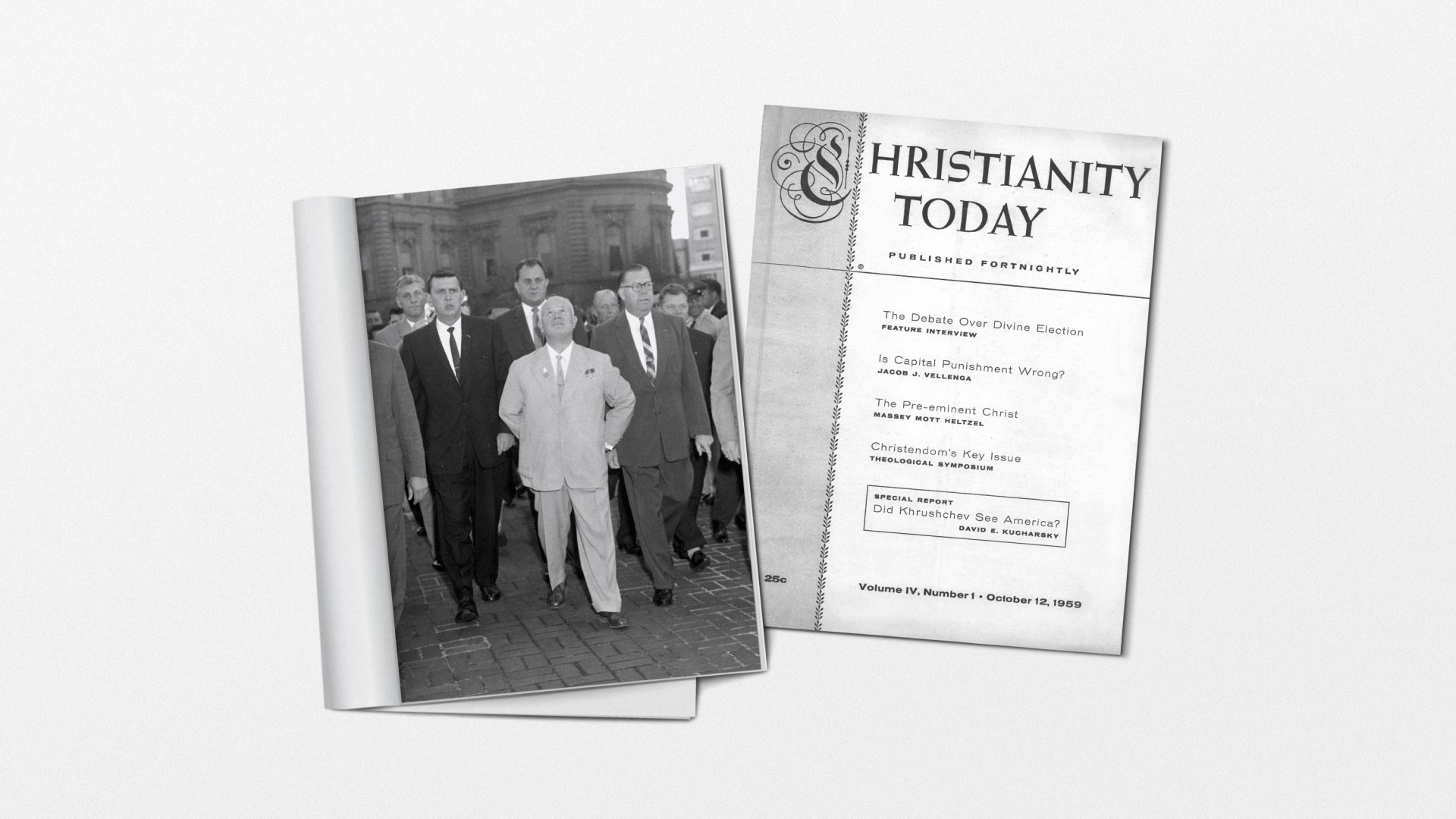
A CT magazine cover from 1959 and a photo of Khrushchev.
Christianity Today November 7, 2025
Illustration by Christianity Today / Source Images: Getty

The great ideological conflict of the Cold War can feel abstract from the vantage point of history. In 1950s America, however, the threat of Communism loomed large. And Americans got the opportunity to hear directly from the world’s top Communist in 1959 when Soviet Union Prime Minister Nikita Khrushchev came to the US

CT paid attention—and noticed one American leader who highlighted the spiritual deficit of Communist ideology. 

Minutes after his silvery TU-114 appeared on the blue Maryland horizon, Khrushchev—one of the most celebrated international visitors since the Queen of Sheba—was reflecting his high priority for economics. … 

“It is true that you are richer than we are at present,” the Red leader told a state dinner in the White House the same evening. “But then tomorrow we will be as rich as you are, and the day after tomorrow we will be even richer.” 

The next 12 days bore out clearly what his first utterances hinted at: that Khrushchev was toeing the Marxist line which merges the dialectic with economic determinism as the comprehensive key to reality.

Preoccupation with economics characterized Khrushchev’s entire tour of the United States. … 

Khrushchev viewed little during his stay that was distinctively Christian or that would underscore America’s great spiritual heritage. … It was left to Eisenhower to salvage something for the cause of Christian witness, and many clergymen feel his deeds on the final day of Khrushchev’s stay represented the most devout gesture during his entire term of office. Eisenhower not only broke into top-level talks with Khrushchev to attend a Sunday morning worship service, but invited the Red leader to accompany him. Khrushchev declined, explaining that an acceptance would shock the Russian people. But the impact of the President’s spiritual priorities was firmly registered.

Some Americans wanted to defuse the conflict with the Soviet Union, arguing that political leaders should go to great lengths to prevent the possibility of nuclear war. CT countered with a word of caution: Christians should understand that the biblical idea of peace is not the same as the vision that politicians promised.

The potentials of destruction in nuclear warfare are such that there is a crescendo of demand for some type of organization or machinery that will insure peace in our time.

But these appeals for peace on the part of political and ecclesiastical leaders involve considerations which few people are prepared to face.

Peace is not something that man can will for himself. It is a God-conferred blessing based upon obedience to God-ordained moral laws. Man cannot defy these laws and claim the blessings of peace. …

Part of man’s confusion today is due to his failure to understand what peace really means. The average person of the world desires peace only so he may continue, unharmed and uninterrupted, in serving the devil.

Our Lord made it plain that the peace of which he spoke had little in common with that concept of peace held by the world. He affirmed that he had come not to bring peace but a sword and that the peace he gives is foreign to, cannot be understood by, nor conferred at the behest of the world. And an understanding of this is possible only to those who are taught by the Holy Spirit.

People might feel like the advent of the atomic bomb, the Cold War, and the Space Race changed everything, but humanity’s spiritual needs are the same in every age. A Fuller Theological Seminary professor argued that was why evangelicals should not pursue peace at any price

It is a fundamental of biblical anthropology that “there is no peace … to the wicked” (Isa. 48:22; 57:21).

It is utter folly to talk about the possibility of world peace when such lawlessness as we now see on this earth prevails. How can one talk of world peace when one third of the entire population of the globe has succumbed to the cruel, God-defying system of Marxian communism? … There is no more possibility for this earth to have peace when it wars against God, than it is for the human soul to have peace when it is at war with God. 

The best way to respond to Communism became a fault line in American religion. CT reported on emerging divisions and potential Protestant realignment. 

The National Council of Churches urged churches to study its recommendations of U. S. recognition and U. N. admission of Red China. Cleveland delegates could hardly have suspected that their proposals would lead, in some quarters, rather to a study of the NCC and the question of its value to the churches. Some church bodies have decided that they did not require a year’s study before making a pronouncement on the Red China issue. The American Baptist Convention, meeting June 4–9 in Des Moines, Iowa, was one of these.

Indeed, this lively issue provided the only extended debate of the sessions. After a number of staccato-like two-minute speeches, with delegates still wishing to speak, the convention voted narrowly, 245 to 234, in support of U. S. policy which denies diplomatic recognition to Red China and opposes its admission to the United Nations.

Evangelicals were also concerned about developments in contemporary capitalism, however. New research in marketing and advertising raised fear of subliminal messages and psychological manipulation. CT reminded readers that the gospel shouldn’t be packaged and sold like another product. 

The use of guise and disguise in contemporary advertising is also provoking a long look at the religious use of persuasive techniques seeking the spiritual commitment of the masses. … In The Hidden Persuaders—a book now in its third or fourth printing, with built-in reader appeals of its own, and publisher’s advertisements alert to motivational devices—Vance Packard causticly indicts this “engineering of consent.” Packard touches the pulpit only in a passing way; neither the term “religion” nor “church” is found in his index. But what he says inevitably raises questions about the field of religious promotion. …

Without special lighting, microphones, and other electronic gadgets, many a pulpiteer today would feel quite cheated, and even lost. Perhaps, right there, is an occasion of stumbling. Do we perchance rely on gadgets more than on spiritual factors for effective proclamation? … 

The work of the Holy Spirit remains the one indispensable factor in our effective presentation of the Gospel. The test of a “good commercial”—does it hurry a potential buyer to a sales transaction?—cannot therefore be pressed. Preaching is a hopeless pursuit apart from the life-giving power of the Divine Spirit. The outpouring and programming of the Spirit are entrusted neither to advertising agencies nor to church publicity clinics nor to ministers who have read Dale Carnegie. Christian virtues like love, joy, peace, gentleness, and faithfulness simply cannot be verbalized into Christian experience. Preaching reaches for genuine spiritual decision, and this cannot be engineered. … 

The Gospel stands—once for all given to the saints. Only the package dare be changed, yet never by way of concealing the content.

Technological progress also raised new ethical issues. A Catholic statement condemning birth control occasioned reflection on the morality of contraception

The declaration was only a logical extension of Catholicism’s well-known stand against use of contraceptives. But timed for release on Thanksgiving morning, the 1,516-word statement (formulated a week earlier at the 41st annual meeting of U. S. Catholic bishops) won headlines across the country.

Within hours birth control had become a major U. S. controversy which soon took a political turn. Senator John F. Kennedy, leading Catholic presidential aspirant, said he thought it would be a “mistake” for the United States to advocate birth control in under-developed countries. President Eisenhower said this would never happen while he is in office.

Reaction from Protestant quarters found a division of opinion on the morality of birth control itself.

Among evangelicals, the hullabaloo perhaps served to crystallize some convictions. Prodded by controversy, many went anew to the Bible for a re-examination of views on the legitimacy of sex severed from its procreative role.

Despite some sympathy for Catholic teaching on contraception, CT expressed concern about the church’s interest in political influence. Looking ahead to Democratic Sen. John F. Kennedy’s possible presidential campaign, a Methodist minister argued that Catholic involvement in America politics was changing quickly.

The penchant of the Roman Catholic for politics is well known. It extends both to laymen and clerics. The nexus of many a municipal political machine has been a close liaison between parish priest and diocesan bishop, on the one hand, and the boss, on the other. New York City, Boston, and Chicago offer ready examples. In New York City where 80 per cent of the Catholics regularly vote the Democratic ticket, no Protestant would have a chance to be mayor. …

On the national scene Roman Catholic political power is a formidable front unparalleled by organized Protestantism. The Catholic role has been that of king maker rather than king. While there has been an unwritten rule that the presidential nominee of the Democratic party must not be Catholic, there has been an equally prevailing rule that the chairman of the national committee must always be Catholic.

Now the Catholic genius for politics is taking a new direction. It turns from king-maker to king. It would like, perhaps, to achieve in the nation what it has already achieved in New York, Boston, and Chicago. It is challenging the prevailing rule (disastrously disregarded once) that no major party nominee can be of Roman Catholic faith. A groundswell within this communion advocates abandonment of the traditional taboo. This sentiment converges on Senator John F. Kennedy of Massachusetts, whose assets in seeking the Democratic nomination are his youthful charm and his father’s unlimited financial resources.

Turning to Protestantism, CT noted increasing debates about women’s ordination in 1959. The growing discussions seemed to skip important questions, though. 

It is quite understandable that this question of feminine ordination to church offices should have arisen in our modern era. Feminism, or the modern theory of “women’s rights,” has impressed us so thoroughly with what women have been able to accomplish, that one is likely to feel boorish if he obstructs the modern advance. In fact, one feels that there is a kind of inevitability about opening offices to women. … 

Few people have inquired whether feminine elders and ministers would not be something different from feminine doctors and lawyers. The assumption is that if women have achieved success and status in secular professions, why should they not have the same opportunities in the church? There is a curious reasoning process here that involves two fundamental fallacies: first, that everything included in the modern feminist movement is unquestionably good (“Give the little woman credit for anything she can get, man”), and second, that our modern day demands that we think like modern men. … 

There is general agreement that churches ought to be governed in thought and practice by the teaching of the Word of God. This means that there must be no easy capitulation to modern ways of thinking simply because they are modern. Rather, we should endeavor to determine God’s will and way. 

Editors also returned the critical question of Scripture and its inspiration.

The doctrine of inspiration continues to be in many ways the critical issue underlying all other issues in the Church today. A variety of statements vie with one another for assent. Labels are often attached to those who have no desire to follow any particular school. Judgments are passed in terms of traditional or less traditional alignments. Yet behind all other problems, concerns, or assessments, the primary question is still, as always, that of the biblical teaching itself. What are, in fact, the essential demands of the Bible with regard to its own inspiration? What are the basic factors without which no doctrine can claim to stand by the biblical and apostolic norm to which all attempted theological statements must be subject?

News

After Hurricane Melissa, Jamaican Baptists Look to Rebuild from the Ruins

Churches step in as shelters, aid sites, and sources of hope after the island’s strongest storm.

Flooded roads and damaged houses visible from a drone.

Jamaica begins recovery efforts after Hurricane Melissa.

Christianity Today November 6, 2025
Rob Witzel / Courtesy of Send Relief

A map hangs in the office of the Jamaica Baptist Union, with colored thumbtacks marking each of its 340 member churches: white for those that remained intact, yellow for those that suffered damage, and red for buildings hit hard or destroyed by Hurricane Melissa.

The red and yellow dots follow the path of the Category 5 storm that barreled across the island last week, ripping off corrugated steel roofs, uprooting palm trees, soaking homes, and forcing the church network into action.

Pauline Dawkins-Cole cried driving through her home parish of Saint Elizabeth, Jamaica, once a place “thriving with life.” The hurricane left homes and buildings crushed, including churches where her father used to preach. “We don’t even understand how to process this,” the 66-year-old said.

In the early days of recovery, Baptist union leaders sent WhatsApp messages and made phone calls to check in on pastors as they readjust their bearings to communities they barely recognize after the strongest hurricane in their country’s history.

Baptists set up donation accounts and drop-off sites at their Kingston headquarters—spared from the full brunt of the storm—and at three other churches around the island. General secretary Merlyn Hyde Riley fields calls from ministries eager to help, coordinating incoming supplies and volunteers.

“You see all these organizations … but there is no better humanitarian relief organization than the global church,” said Jason Cox, vice president of the Southern Baptist Convention’s Send Relief, who traveled to Jamaica the weekend after the hurricane.

Rob Witzel / Courtesy of Send Relief

Across the island nation of 1.9 million Christians, pastors assess building damage, local needs, and their capacity to rally help. In hard-hit areas to the south and west, the devastation was relentless, with up to 90 percent of the population displaced and some completely unreachable.

On Saturday, Riley couldn’t get in touch with the pastor of Sharon Baptist Church in Santa Cruz, a town located on the route between Kingston in the southeast to Black River on the southwest coast. When Cox pulled up to the cream-colored brick church, a patch of its red metal roof peeled back, pastor Jacob Powell was there, sitting in shock and sorrow as he charged his phone in his car.

“The devastation in this area was more than we imagined would have taken place,” he said. “Our churches have been destroyed. … Several of our members who live around here, their homes have been destroyed. … Just so many are suffering at this time.”

In rural areas, communication is a commodity people long for in the wake of a disaster, just like the tarps, food, and water his church plans to distribute from its fellowship hall.

That day, the news hadn’t been good for Powell. Rescuers discovered the body of a woman missing from his congregation who had drowned in the storm. The official death toll climbed to 75 people across the Caribbean.

As Cox and his team traveled with their Starlink unit—which uses the SpaceX satellite to deliver broadband to rural areas—he saw how crucial internet access could be for ministry outreach and aid amid disaster. Partners in Cuba sent a picture of one of 50 new generators Send Relief had shipped ahead of the hurricane: It sat in a sanctuary wrapped in a tangle of phone chargers, each belonging to a church member eager to hear back from loved ones.

Dawkins-Cole met a man who survived the storm and caught a ride to safety in Kingston but still hadn’t heard from anyone in his family back on the other side of the island eight days later. She was in the capital stocking up on supplies for food packages distributed through churches—mostly dry goods like rice, flour, milk powder, ramen—and took his number to help track down his relatives when she returned to Saint Elizabeth Parish this weekend.

Like many Christians on the island, Dawkins-Cole saw God’s providence and mercy in the storm. As she and her relatives deliver supplies to communities in need, she has prayed for revival and renewal, particularly among younger Jamaicans.

A woman in a mask stands in a church sanctuary scooping flour into a bag.Rob Witzel / Courtesy of Send Relief
Volunteers prepare food packages for families affected by Hurricane Melissa.

In the cities, lines snake outside the banks and Western Unions, which ran out of cash at one point, Cox said. Farther out, water, debris, and downed power lines still cover the roads. In some smaller towns, traffic backs up as bulldozers clear the dirt. Rural areas still face the threat of mudslides.

“You always hear people in disaster relief say, ‘I’ve never seen anything like this,’ but I’ve never seen anything like this,” said World Vision’s Mike Bassett, who watched flooded rivers overtake streets and flow through homes in Cambridge, Jamaica, south of Montego Bay.

The hurricane ruined crops and drowned livestock, meaning many farmers lost access to food and income. The storm did its worst in the town of Black River, where Melissa wiped out church after church and home after home and displaced nearly all its residents.

Bassett, national director of domestic humanitarian and emergency affairs at World Vision, worries about all the water. The organization is rushing to provide bottled water and mobile purification units to ensure desperate people don’t drink the unsanitary floodwaters.

At the end of each of day of traveling to deliver supplies and find churches to open as shelters or distribute aid, Bassett lies in bed and decompresses, thinking about the “loss of life, infrastructure, livelihood, and homes” he’s seen. But then God brings to mind the people.

“I’ve been seeing Jesus show up in the kindness of strangers,” he said. “They’re out there helping. They’re still smiling even though their home is damaged or destroyed.”

The Jamaica Baptist Union quickly adopted the tagline “from ruin to renewal” and keeps pointing the 40,000 members of its churches to look beyond the current brokenness to the hope of rebuilding.

Pastor Michael Shim-Hue preached on Sunday at Calvary Baptist Church in downtown Montego Bay, his pulpit lit by the hole the hurricane ripped in the roof of the sanctuary. He thanked God and called on the church to come together, assuring them that God will carry his people along as they recover.

Looking around at destruction everywhere, stores closed, and generators running, people don’t know what their next few days could look like, much less the long path to rebuild.

“The pain is real. It is great. I don’t know when the people will come back to normalcy, don’t know when their lives will be straightened out,” said Powell, standing in the midst of his damaged church compound and wearing a hat that read “Jesus Saves.” “If they don’t get assistance from somewhere, it’s going to take a long time.”

Church Life

When Songs Undermine Orthodoxy

Church songs need to be true, not necessarily catchy.

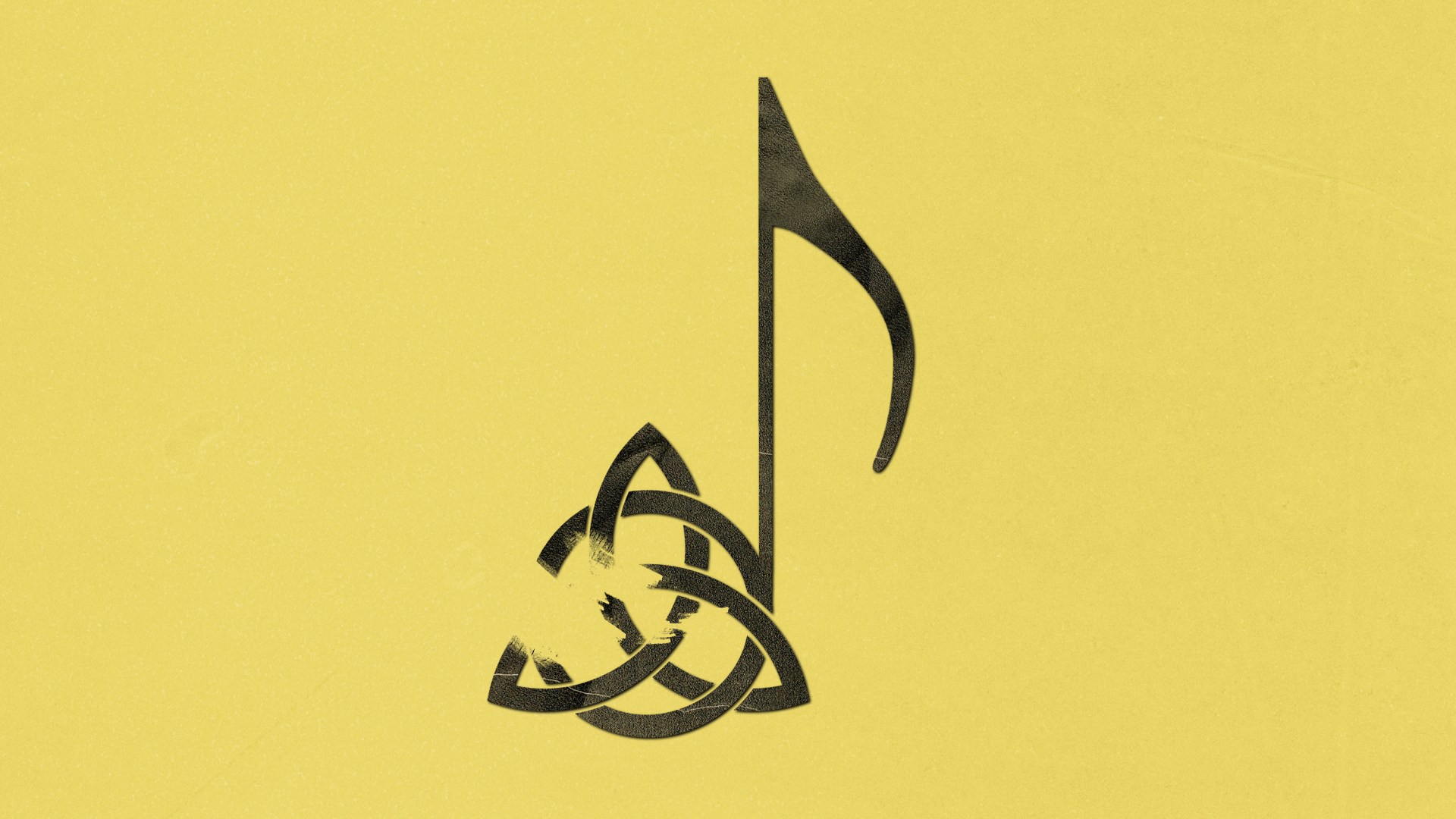
A music note and a smudged symbol of the Holy Trinity.
Christianity Today November 6, 2025
Illustration by Christianity Today / Source Images: Getty


When training preachers, I remind them that terribly delivered sermons do not do any lasting damage. If a message is confusing, badly structured, poorly illustrated, or tedious, it may not be ideal (and it certainly is a missed opportunity), but it is unlikely to do serious harm to listeners. Most people will simply forget it.

The sermons to watch out for, rather, are the ones that are clear, dynamic, funny, vivid, creative, passionately delivered—and wrong. (The internet is full of examples.) Compelling falsehood poses far greater risks to the church than boring truth.

The same is true for songs. In fact, it is probably even more true of songs, because while sermons are delivered once, songs are sung repeatedly—in the church, in the car, in the kitchen, by children and adults alike. Unsingable songs have very low impact. A poorly written poem set to a cloying melody is soon forgotten. But a musically soaring, lyrically fluent, emotionally resonant composition, brilliantly performed in front of a huge crowd and professionally produced, can convey its theology to millions of people. This reverberation is wonderful when its theology is good, as it so often is—but it’s more of a problem when it is not.

I am not talking mainly about the songs that cause all the evangelical kerfuffles. The kerfuffles can be helpful because they cause people to think carefully about whether to use the songs in question. Clearly, pastors and churches have to decide whether they believe that God did not want heaven without us (which I do), or that the love of God is reckless (which I don’t), or that the wrath of God was satisfied at the cross (which I do), or that the earth will soon dissolve like snow (which I don’t).

They must decide whether to avoid popular hymns because of one dubious line (Will Christ really come with shouts of acclamation “to take me home”?), because they have concerns about the church from which the song comes, or because the songwriter later committed egregious sin or apostasy. We can and should debate these matters. Controversy makes us stop and think, which in turn prevents us from swallowing bad theology without realizing it.

The examples I have in mind, however, undercut Trinitarian theology without the singers or even the songwriter realizing it. On several occasions, I have attended events whose leaders, worship team, and delegates are thoroughly orthodox on the Trinity, but a song was introduced with lyrics closer to Oneness theology.

For example, Bethel Music’s “No One Like the Lord” (2025) begins: “There is one on the throne / Jesus, holy.” It continues:
Worthy is the Lamb
Who was slain and seated on the throne …
And the elders, creatures bow,
Giving praise to him and him alone

The song is powerful, sweeping, and melodic. I am confident the songwriters believe in the Trinity and are trying to reference the glory due to God. The problem is that Revelation 4–5 say something quite different. There is indeed one who is seated on the throne, but he is clearly distinct from the Lamb who was slain (5:7). The elders and living creatures bow down and praise the one on the throne as worthy (4:9–11), and they also bow before the Lamb (5:8–14).

But the two persons are not identical. This is vital to our view of God. We do not praise the Lamb “alone”; we praise Father, Son and Spirit. Revelation chapter 5 concludes with all creation saying, “To him who sits on the throne and to the Lamb be praise and honor and glory and power forever and ever!” (v. 13, emphasis added). When songs are doing the liturgical heavy lifting—as they often are in low-church evangelicalism—this is a problem.

Let me give you another example: “Who Else,” a song by Gateway Music from 2023. “Who else is worthy?” runs the chorus and answers, “There is no one, only you, Jesus.” Admittedly, this could mean that Jesus is the only one worthy to open the scroll in the same chapter (5:9). But the song does not mention this, and in context, it implies that Jesus is the only one worthy of being thanked and lifted up, rather than seeing how much of Scripture induces us to bring thanks to the Father. Without perhaps intending to, these songs typify Oneness theology in a nutshell.

To some this will all sound insufferably pedantic, if not mean. To others it will sound indefensibly sloppy, if not heretical. I hope it is neither. I have no doubt that these songwriters believe in the Trinity. Yet their lyrics unintentionally undercut that belief in ways that will confuse those who sing them. And the more popular the song, the more that matters.

We long to worship God as he has revealed himself to be. There is a beauty to praising the Father through the Son by the Spirit, and both the songs of Revelation and the prayers of the New Testament give us plenty of examples of how to do this well. So whether we are praying or singing, and whether our words are scripted or spontaneous, let us address God in all his Trinitarian splendor.

Andrew Wilson is the teaching pastor at King’s Church London and a columnist for Christianity Today. He’s the author of several books, including Remaking the WorldIncomparable, and God of All Things


News

Europe’s Christian Pacifists Reconsider Peace by Arms

Some once committed to nonviolence see rearmament as a necessary deterrent.

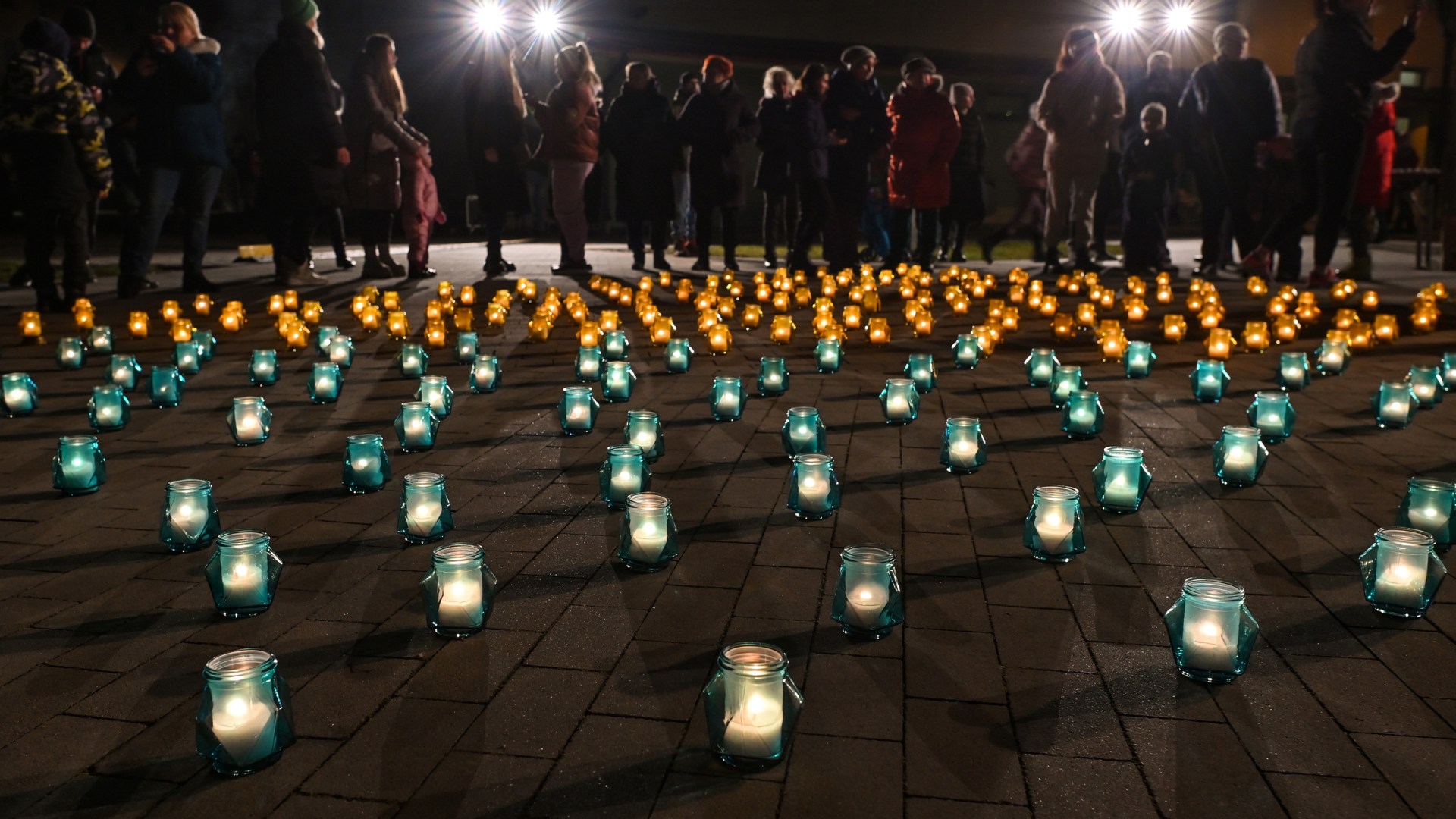
People at a 'Light for Ukraine' vigil in Poland in February 2023.

People at a 'Light for Ukraine' vigil in Poland in February 2023.

Christianity Today November 6, 2025
NurPhoto / Contributor / Getty

Over the last ten centuries, Nikolaikirche—a Protestant church in Eisenach, Germany—has witnessed its share of war and civil strife, dictators and destruction. But this year, in the encroaching darkness of early autumn, its Romanesque stone arches are bathed in candlelight, emanating from stations set up to invite visitors to pause and say a prayer—for peace, for an end to violence, for reconciliation.

The event, held annually in conjunction with the Community of the Cross of Nails and the Coventry Cathedral in England, reminds participants of Jesus’ emphasis on reconciliation and of Christian convictions around finding diplomatic solutions to serious conflicts, said Gabriele Phieler, a pastor and retired superior of a Protestant social welfare organization located next door to the Nikolaikirche.

Questions of war and peace are never easy, especially when European nations are increasing their military capabilities, acquiring more advanced weaponry, and boosting defense spending. In the last month, the continent has witnessed continued and intensified Russian attacks on Ukraine, which have killed civilians and damaged infrastructure. Europe is responding by bolstering its own defenses and considering new, controversial strategies like using frozen Russian assets to fund Ukraine’s military needs.

Given the fear of further Russian aggression, some German Christians want to do more to protect the country. But tonight, as the flicker of flames plays across centuries-old walls where Christians have gathered in times of turmoil and reconciliation alike, Phieler hopes attendees will simply come together to pray and trust in God for peace.

Over their history, European churches have blessed armies and supported wars in the name of God. At the same time, a countertradition of Christian pacifism has persisted. From Anabaptists, Mennonites, and Quakers in the 16th and 17th centuries to the Catholic peace group Pax Christi after World War II, various believers in Europe have argued that following Christ means rejecting violence.

Russia’s invasion of Ukraine in 2022 has brought that tradition under strain. Eastern European nations like Poland, Estonia, or Romania worry about future aggression. The region’s pacifist networks are now urging negotiation and reconciliation while others traditions insist on military support, reviving an old European argument over what Christian peacemaking really looks like.

Public debates reveal a polarized landscape. Initiatives opposing arms shipments to Ukraine, led by figures such as Left populist German politician Sahra Wagenknecht and journalist Alice Schwarzer, draw support from some Christian pacifists.

But others once committed to peace feel Russia’s invasion of Ukraine is prompting Christian pacifists to rethink what it means to pursue peace.

“We are simply faced with naked aggression. There must be some sort of deterrence. To keep the peace, we need security guarantees,” said Christian ethicist Alexander Maßmann.

Through his popular column Evangelisch Kontrovers, Maßmann has acknowledged the harsh realities that challenge idealistic pacifism. Maßmann, who once opposed military buildup, now sees deterrence as a moral necessity. “The international situation is not what we thought it would be,” he said. “We are simply faced with naked aggression.

“To keep the peace, we need security guarantees—and rearmament is helpful in that sense,” Maßmann said.

Looking back in recent decades, Germany’s Protestants, particularly under the leadership of Margot Käßmann, former chair of the Evangelical Church in Germany (EKD), had leaned toward a more pacifist stance.

Käßmann advocated for diplomacy and nonviolence, calling for an immediate cease-fire in Ukraine and an end to arms deliveries. She stressed that “God is not a party to war” and warned that growing militarization poses a threat to the future.

Yet in recent years, Russian aggression has prompted some within the church to reconsider. While Käßmann and like-minded voices continue to emphasize restraint, other Protestant leaders argue that refusing military assistance could leave civilians exposed to violence.

This tension illustrates a broader reassessment: Pacifism remains a guiding principle, but some see armed support as a practical necessity at times. The challenge, they say, is balancing historical commitments to peace with urgent demands for protection.

Maßmann points to the 2007 German church memorandum, which neither endorsed categorical pacifism nor unqualified just war theory—it contended instead that “military action can be justified under certain circumstances, yet it remains sinful.” Advocates like Maßmann suggest this approach allows Christians to navigate modern security dilemmas without abandoning a moral commitment to peace.

Across contemporary Europe, citizens find their ethical convictions challenged by geopolitical realities.

Maßmann said people fear that some form of a military-industrial complex might arise, making it harder to bring the long-term view of peace back into the frame and leaving Christians and citizens alike to weigh the costs of both action and inaction.

He worries that Christians could lose sight of their theological foundations. “It would be sobering if we had to surrender to realpolitik,” Maßmann warned. Instead of rejecting all force, he urged pacifists to consider “how we make those things serve peace and law in the longer run.” For now, that might mean choosing rearmament and war.

Even so, Maßmann cautioned against unchecked militarization. “There’s a real danger that a military-industrial complex might arise,” he said. The challenge for Christians, he added, is to keep any buildup under democratic control—and to “keep the vision of peace alive in our debates.”

The German Evangelical Alliance (EAD) has not yet commented on German arms deliveries to Ukraine. In a Q&A on the alliance’s website, its recently appointed political commissioner, Johann Matthies, said though he is personally committed to pacifism, he has never gone so far that he wanted to see the German military disarmed.

Rather, he said the crucial question Christians must ask in a time of rearmament and potential war is whether they themselves will “carry a sword”—either by serving the military or by voting for political platforms that promote rearmament. That question, Matthies said, is a matter of personal conscience. “Everyone must answer this question for themselves in conversation with God.”

While advocating for international diplomacy, Matthies said that failing to do everything possible for Ukraine’s air defense is not only “politically shortsighted,” but also, to Ukrainians under attack, quite “cynical.”

For Micael Grenholm, however, pacifism remains the only biblical—and practical—response to the specter of further European conflict.

A Swedish Pentecostal scholar and peace advocate, Grenholm works with Pentecostals and Charismatics for Peace and Justice, a movement that promotes nonviolence and conscientious objection.

Grenholm’s position stems from Gospel directives to love enemies and turn the other cheek. “I didn’t really argue with the text,” he said. “That’s how I became a pacifist.”

Grenholm said his conviction grew through the study of early Christianity, where figures such as Tertullian, Origen, and Justin Martyr emphasized nonviolence and refusal to join the Roman military. That tradition, he argues, sits alongside contemporary studies that argue violence is costly and nonviolent action is more effective.

Acknowledging the “naked aggression” Maßmann believes demands a response from pacifists, Grenholm also sees a place for noncooperation, sabotage, and other resistance that “doesn’t involve violence against human beings.” A Spanish study documented over 200 examples of nonviolent actions during Russia’s invasion of Ukraine that helped slow its progress and prevent an all-out capitulation by Kyiv.

Bolstered by his faith and such studies, Grenholm frames Christian pacifism as a “principled, effective, and Christ‑centered” form of resistance.

“Jesus isn’t telling his followers to give up in the face of oppression or military violence,” he said, “but pointing to another way that is a stronger, more successful force in opposing evil.”

Books

How to Forgive When You’re Deeply Offended

A new book from Bible teacher Yana Jenay Conner offers a blueprint for living out a difficult spiritual practice.

The book cover on a pink background.
Christianity Today November 6, 2025
Illustration by Christianity Today / Source Images: Getty, Harvest House Publishers

The pages of Scripture are soaked with forgiveness. In book after book, the Bible traces God’s redemptive plan to forgive those who repent of their sins and place their faith in him. As people who have been freely forgiven through the work of Christ, we are to reflect our heavenly Father by forgiving those who sin against us. 

But many times, forgiving is easier said than done. It’s more lovely to hear about God casting our sins into the sea of forgetfulness than to extend that type of grace to those we find at fault. Those who have been walking with God for a while may be able to forgive small offenses without much strain. But when bigger tests inflict deep wounds on the heart, forgiveness may only be offered over a tear-soaked Bible through gritted teeth. 

Living Beyond Offense: Doing the Hard Work of Forgiveness God's Way

Living Beyond Offense: Doing the Hard Work of Forgiveness God's Way

240 pages

$13.89

Bible teacher Yana Jenay Conner wants to help guide Christians through what to do after offense has been served to us on a platter. In Living Beyond Offense: Doing the Hard Work of Forgiveness God’s Way, Conner takes readers through her own journeys of forgiveness and offers a helpful blueprint that disentangles the topic from its close cousins, reconciliation and trust. 

The author is quick to say that she sees herself not as an expert but a “fellow weary traveler” attempting to shine the light of Christ in the wilderness of suffering. Conner’s suffering included an 11-year journey of forgiving and ultimately reconciling with her once-absent father, who struggled with alcoholism. His absence led to suppressed feelings that went unaddressed for years, Conner writes, and culminated in a fear of abandonment that infected her other relationships. 

Conner knew God was calling her toward forgiveness, but she didn’t entirely understand why she should forgive or how. She sets out to address both questions in a way that’s accessible to readers encountering the topic for the first time and still insightful for those who need a refresher. 

As with any good exegete, Conner builds the foundational pillars of her book from the Scriptures. Sin warped God’s creation and marked our relationships with what Conner calls “self-conscious, self-centered self-preservation.” Christ came to reshape us into peacemakers who mirror him (Matt. 5:9) through “self-giving, others-centered sacrificial love.” 

Christ’s version of shalom (Hebrew for “peace” or “wholeness”) is revealed not just in fixing our enmity with God or the fractures in our societies, she writes, but also in living in relationship with each other. What we see today, however, are people who are shalom avoidant or shalom demanding.

Those in the first group, Conner writes, run away from uncomfortable situations and seek the absence of conflict, as with the person who ghosts a dating partner when it’s time to define the relationship. The second group is focused on settling debts and holding real or perceived offenders to account (the impetus behind cancel culture). 

Some readers might quibble with the labels, but I thought the categories were a helpful and accurate description of personality types and cultural attitudes. 

Conner correctly identifies both approaches as harmful and presents the biblical case: Forgive offenders of their debts, practice mercy, and choose not to retaliate, knowing that God, the ultimate judge, will avenge all wrongdoing and execute justice. 

Our culture often pits forgiveness against justice, casting the former as a weakness that evades accountability. Biblical forgiveness which is offered freely is not a license to abuse, nor is it the denial of justice. However, it does force us to trust in God and his plan—and his promise to accomplish it according to his righteous wisdom. 

Conner calls on readers to “humbly confront” offenders (Matt. 18:15–17) and seek to restore damaged relationships with the awareness that true reconciliation is shared work between different parties, not one person trying to glue broken pieces back together. Forgiveness is for everyone. But “reconciliation is for the repentant few,” she writes.   

The author stands on solid theological ground for most of the book, but I was not convinced by one of her interpretive moves. In her explanation of Jesus’ command to turn the other cheek, she says it’s more than a command to forgo retaliation.

“He is commanding them to humbly confront their offender by inviting them to reexamine the hierarchy they’ve created in their mind and to treat them as a fellow image-bearer,” Conner writes.

“While they would get slapped again, at least this time, with their right cheek protected, it would be an openhanded slap among equals” instead of a “backhanded slap” that would be deemed highly offensive in the Jewish honor and shame culture.

Conner’s interpretation of the text mirrors the one employed by some theologians including the scholar N.T. Wright. But since there is no distinction between a front hand and a backhand slap in the biblical text, I felt it required more argumentation than the book provided.

In another section of the book, Conner surprisingly pushes back on the idea of forgiving for the sake of internal freedom. Though the adage “Forgiveness is a gift you give yourself” is true in many ways, she accurately notes that the Bible’s primary encouragement to forgive comes from the fact that we as believers have been forgiven and in turn should forgive others (Eph. 4:32).  

The book is compassionate toward survivors of abuse, and Conner notes that she has counseled such individuals. For those on their own tender journeys of forgiveness, she recommends a counselor or trustworthy resources that can provide tools of support. 

But she also notes the extent to which therapy-speak (words like toxic, narcissistic, trauma) has infiltrated our culture, and she gives a much-needed call to discern between abuse and human-inflicted hurt that doesn’t cross that line. Furthermore, she exhorts readers to do the introspective work of figuring out when a perceived offender has run afoul of God’s commandments versus our own preferences and desires. 

Being a “shalom-maker,” as Conner calls it, is challenging. After we say, “I forgive,” feeling forgiveness can be tough, especially when memories of the offense pop up again and again. 

In my own life, forgiveness can feel incomplete until I pray for the offender—in some cases, repeatedly, until every taste of bitterness is washed away. I wish Conner spent a little more time on this area. But she does a respectable job of laying out the different ways God helps us in the journey: through his Word, his Spirit, and the counsel of Spirit-filled believers.

Overall, the book is an excellent guide that teaches readers how to navigate their own forgiveness journeys while looking to the author’s example. 


Ideas

Have We Kissed Purity Goodbye?

Contributor

We don’t need pledges or rose metaphors. We do need more reverence and restraint.

Wilted roses in a trash bag.
Christianity Today November 6, 2025
Illustration by Elizabeth Kaye / Source Images: Getty

If you grew up in purity culture, you probably remember the rose.

A preacher holds up a perfect red flower, full and fragrant, and passes it through the crowd. As the bloom makes its way around the room, he warns of the degrading power of sexual sin. He cautions against “giving pieces of yourself away.” By the time the rose returns to the front, it’s drooping, torn, missing petals. Like a prosecutor presenting evidence to a jury, the pastor holds up the flower and asks the question no one will answer. “Who wants this rose?” The ensuing silence is the point.

The rose illustration is emblematic of purity culture, the evangelical sexual-ethics movement that took hold in the 1990s amid soaring teen pregnancy rates. Offering father-daughter dances, spaghetti-strap prohibitions, and seminal titles like I Kissed Dating Goodbye, purity culture at its best proclaimed solid biblical teachings on sex, marriage, and modesty.

At its worst, it appealed to shame to protect the sacred. Too often, it preached self-control motivated by fear, equated virginity with virtue, and confused holiness with reputation. Its weight lay heaviest on women—how they dressed, who they tempted. Even when motivated by good intentions, purity culture left many believing they could lose God’s love with a single mistake.

Today, people who grew up signing pledges and internalizing object lessons—the rose, chewed-up bubblegum, tape that’s lost its stickiness—are naming what purity culture did to them. The guilt. The anxiety. And the church has started to listen. Writers, pastors, and therapists have worked to untangle desire from shame, to show that sex isn’t dirty and that grace isn’t fragile. Let me be clear: This reckoning is good and necessary. It’s helped many Christians rediscover a God who loves wounded people, not perfect performances.

But I fear that in the process of tearing down purity culture, we may have kissed purity itself goodbye. And that’s a problem.

You might think I sound like a boomer nostalgic for the days of modesty charts and curfews. I’m not. I’m a zoomer from the cesspool. My generation is porn addicted, drug dependent, dopamine sick, irony poisoned, attention fractured, and spiritually starved. We’ve traded repression for indulgence, and the result isn’t freedom—it’s decay.

Does Jesus still love my generation? Of course! But the youth pastors were halfway right. We really can become damaged roses.

If the 1990s and early 2000s gleamed with silver purity rings, today’s fingers slip over “for you” pages instead. Every scroll, swipe, and stream is saturated with sexual imagery—thirst traps disguised as authenticity, confessions that double as exhibition, and entire industries built on monetizing the human body. Pornography has become the air we breathe. Studies show that 73 percent of teens have consumed porn and 87 percent of young men watch porn weekly.

Porn aside, we’ve absorbed a worldview that treats the body as endlessly editable and desire as endlessly expressive. Sex before marriage is assumed. Cosmetic surgery is casual. Hookup culture is celebrated as empowerment. Even Christian spaces aren’t immune. Churchgoers hype the same music, the same aesthetics, the same algorithmic sexuality as everyone else.

The irony is that the “sexual freedom” meant to liberate us has only left us lonelier. Sociologists note that young adults are having less sex, entering fewer relationships, and marrying later than any generation before them. The more our culture obsesses over pleasure, the less capable we seem of connection. We’ve been trained to consume rather than commit, to perform rather than belong.

Recently, British influencer Lily Phillips went viral after admitting to sleeping with more than a hundred men in a single day—a story she later recounted with visible regret. “Sometimes you’d disassociate,” she said tearfully. “In my head right now, I can think of like five, six guys, ten guys I remember.” The sexual revolution promised empowerment, but it has delivered exhaustion—a generation of people who can’t tell the difference between intimacy and exposure.

Even secular thinkers are starting to admit this. In The Case Against the Sexual Revolution, journalist Louise Perry argued that newfound sexual “freedom” has made women less safe, less happy, and more disposable. She concludes her book with a piece of advice for her young readers: “Listen to Your Mother.” It turns out the Christian sexual ethic—once derided as prudish—is one of the last coherent frameworks for love, dignity, and belonging.

Purity, rightly understood, isn’t about fear. It’s about reverence. It’s not about suppressing desire but directing it. Paul writes, “It is God’s will that you should be sanctified: that you should avoid sexual immorality; that each of you should learn to control your own body in a way that is holy and honorable” (1 Thess. 4:3–4). The problem isn’t that we desire too much; it’s that we’ve forgotten what desire is for.

Our desperate need for purity runs deeper than sex. It’s apparent in our humor, our language, our appetite for outrage. In many conservative circles, it’s become fashionable to use once-banned words like retard and gay as weapons. Public figures toss them around like badges of bravery against “wokeness,” and their followers applaud the “courage” to say what others won’t. Even young Christians have joined in, mistaking cruelty for conviction.

But Scripture names this plainly: sin. “On the day of judgment,” Jesus said, “people will give account for every careless word they speak” (Matt. 12:36, ESV). Paul wrote, “Do not let any unwholesome talk come out of your mouths, but only what is helpful for building others up” (Eph. 4:29). James warned that the tongue is “a fire, a world of evil,” capable of blessing God and cursing his image bearers in the same breath (James 3:6–10).

We’ve confused bluntness with bravery, irreverence with realism, profanity with power. But how we speak about people—especially our enemies—reveals the kind of god we actually worship. The tongue, James says, cannot be tamed. Maybe that’s why purity still matters: not as repression but as restraint.

From shock-jock pastors to Taylor Swift’s raunchy lyrics, from poisoned memes to videos of a father gunned down in broad daylight—our culture is anything but pure. We live in an era where everything sacred has been reduced to a spectacle.

Nothing will make you long for purity quite like living without it. Spend enough time in the digital swamp, and you start to feel the brain rot, the moral vertigo. “The eye,” Jesus said, “is the lamp of the body. If your eyes are healthy, your whole body will be full of light” (Matt. 6:22). We’ve trained our eyes to crave darkness.

“The mouth speaks what the heart is full of” (Luke 6:45), and in the digital age, our feeds reveal our hearts. The internet has normalized voyeurism and cynicism. To refuse them is to remember that purity isn’t repression—it’s clarity. It’s the quiet discipline of guarding what you see and what you let shape you. “Above all else,” Proverbs 4:23 says, “guard your heart, for everything you do flows from it.”

Louise Perry’s questioning of the sexual revolution has led her somewhere she didn’t expect: faith. Recently, Perry announced that she has become a Christian—not just in a cultural sense but in a real, supernatural way. What began as a sociological interest in Christian sexual ethics has evolved into a belief in the Christ behind it.

The very purity our culture mocks is now drawing people back to God—because Christian purity, rightly understood, isn’t repression. It’s restoration. It doesn’t deny the body; it dignifies it. It doesn’t erase desire; it redeems it.

As someone who’s grown up entirely online, I’ve seen more than I ever needed to—and I know I’m not alone. So many of us feel exhausted and overexposed. We want a cleaner joy. We want guarded hearts, filtered eyes, sheltered souls. We’d rather be “prudes” than products.

We’re damaged roses who Jesus loves. We want to bloom again.

Luke Simon is the codirector of student ministries at The Crossing in Columbia, Missouri, and an MDiv student at Covenant Theological Seminary. He has written on Gen Z, technology, masculinity, and the church. You can follow him on X.

Theology

The Church Better Start Taking Nazification Seriously

Columnist

Tucker Carlson hosted neo-Nazi Nick Fuentes on his podcast. The stakes are high for American Christians.

Nick Fuentes
Christianity Today November 5, 2025
Illustration by Christianity Today / Source Images: Youtube

This piece was adapted from Russell Moore’s newsletter. Subscribe here.

Last week, after Tucker Carlson platformed neo-Nazi apologist Nick Fuentes on his podcast, the Heritage Foundation’s president Kevin Roberts issued a statement defending Carlson. Roberts denounced what he termed a “venomous coalition” of conservatives who called out the interview because they oppose any “no enemies to the right” posture that includes Nazism. In the days since, some Heritage Foundation staffers have told reporters that the controversy revealed for them how many of the youngest staffers and interns actually agree with Fuentes. This comes only weeks after text messages from multiple Young Republicans groups were leaked, showing racist, antisemitic, and pro-Hitler messages.

This matter is crucial for the future of the country, but the stakes are even higher for the church. It is well past time for the church of Jesus Christ to take this seriously. And the first step to seeing how to do so is to ask, “Why do so many evangelical pastors and leaders not take it seriously now?” Already some constantly online young men who profess to be evangelicals are winking and nodding with HH references and “noticing things” memes while commending the ideologies of Nazis such as Carl Schmitt. Some older leaders don’t take it seriously because they think the numbers of these young men are so few, and some because they think the numbers are so many.

Those who think the numbers are too few will wave away concerns with phrases like “Online is not real life,” usually pointing out that very few of these social media trolls are preachers or pastors. They will note that those who are preachers are typically in front of tiny congregations and spend most of their time podcasting and posting back-and-forth arguments online all day. That is true—and is utterly beside the point.

Those who say such things do not understand how almost every fad—good, bad, and neutral—that has swept through evangelicalism has taken hold. These trends start out in small groups of people that are not large enough to be taken seriously by “successful” leaders. These small communities then cultivate the fads until a couple people with bigger platforms adopt them. And then, seemingly suddenly, they are everywhere. Power evangelism, prayer walking, seeker-sensitive services, laughing revivals, New Calvinism—all of these (and again, some of these things are good, and some are not) happened that way.

Journalist Jonathan V. Last once described how systems fail: “When the bad guys win, it’s always because they are enabled by the weakness and wishful thinking of people in a position to stop them.”

The greater problem is with the evangelicals who say nothing because they think the numbers are too great. They will pivot the discussion and say that “this is what you get” when some objectionable thing happens elsewhere—as though we were talking about kindergartners. Whatever your theology proposes about the age of accountability, I think we can all agree that a 25-year-old is well past the bar. Others will argue that, though they wouldn’t have done it this way, there’s a vibe shift in this direction that we have to recognize.

During World War II, American journalist Dorothy Thompson described this type as “Mr. B” in her famous essay “Who Goes Nazi.” She wrote, “He fits easily into whatever pattern is successful. That is his sole measure of value—success. Nazism as a minority movement would not attract him. As a movement likely to attain power, it would.”

The mentality which suggests that laughing at sexual abuse or using denigrating slurs for those with disabilities or wink-wink-nod-nod sending around Nazi memes is evidence of a “vibe shift” is perhaps understandable for a pagan who believes the zeitgeist is lord. But for a Christian who has read any page of the Old or New Testament, that’s incomprehensible.

Jesus said, “For false christs and false prophets will arise and perform great signs and wonders, so as to lead astray, if possible, even the elect” (Matt. 24:24, ESV throughout). The description of the Beast of Revelation is of near-universal popularity and success: “Who is like the beast, and who can fight against it?” (Rev. 13:4).

When the popular will becomes the standard of truth, we move from silliness in the best of times to cruelty in worse times and to the death camps in the worst of times. This is a call, as Jesus put it, for “endurance and faith” (v. 10). You can call that a “vibe shift” if you want.

The vibe-shift view is precisely what led the Confessing Church of 1934 to stand up against the German Christians, the religious party associated with Adolf Hitler. The Confessing Church’s statement said, “We reject the false doctrine that the Church could and should recognize as a source of its proclamation, beyond and besides this one Word of God, yet other events, powers, historic figures and truths as God’s revelation.” Karl Barth, the primary author of the Barmen Declaration, would write later to churches in Nazi-occupied France, who seemed to be wobbling in their commitment to resist publicly or forcefully Nazi ideology:

I cannot think that your judgment of today about the fundamental situation between Hitler and the rest of us is different from a year ago just because in the meantime Hitler has had so many good days (vividly reminding us of Job [21] and Psalms [10] and [73]) and France, together with all those other countries, so many bad days.

Barth continued,

If that were your attitude, you would have surrendered, not merely to the German arms, but to that German philosophy which in 1933 broke out like a plague among the German people themselves. In that case, Hitler would have conquered not only your country but your souls.

During the years of Nazi domination of Germany, writer Thomas Mann, an expatriate, broadcast a series of radio addresses to his fellow Germans, pleading with them to resist what was happening to their country. Among the atrocities, he included what he said had to be “the strongest and most ghastly phenomena of National Socialism [Nazism].” He described it with a word we don’t use much anymore, vitiate, which means “to debase” or “to corrupt.” Mentioning such glorious words as peace and patriotism, Mann wrote that Nazism “has vitiated all ideas which were supported by the best men in the world and has made them something in which no decent person wants to partake anymore.”

Conservatives alarmed at the steps toward the normalization of Fuentes and a Nazified young right understand this. They know this awful ideology will evacuate all the principles they wish to conserve of the meaning of words like peace and patriotism. But why do I say the stakes are even higher for the church? After all, the church does not have nuclear codes and cannot build death camps. It can only empower with its support—or its silence—those who do.

The question is whether the gospel of Jesus Christ is true. If it is, as I firmly believe, then what happens if words like evangelical or church or salvation or (I shudder to write) Jesus are filled up with the meanings of an antichrist alt-gospel? In that case, what’s on the line for generations is a matter of eternity.

We have a choice. The Bible will not sit alongside Mein Kampf. The cross will not yield to the swastika. We must ask right now: Jesus or Hitler? We cannot have both.

Russell Moore is editor at-large and columnist at Christianity Today and leads its Public Theology Project.

Church Life

Are ‘Unreached People Groups’ Still a Thing?

Three experts discuss whether the popular concept has a future in missions discourse.

A small composition of three illustrations, each representing a different culture.

Illustration by Jisu Choi

In this series

Two years ago, I stood amid thousands at a missions conference in Bangkok as people prayed and sought God for discernment about how and where to be witnesses for Christ. The speakers challenged the crowd, who hailed from around Asia, to go to places where the gospel hadn’t yet been heard. 

While approximately 40 percent of the world has yet to hear the Good News, most missionaries go to predominantly Christian or post-Christian contexts rather than to unreached people groups, Lausanne’s State of the Great Commission report noted last year.

But what do we mean when we use the term unreached people groups? The International Mission Board defines it as an ethnolinguistic group where evangelicals comprise 2 percent or less of the population. It’s a term that missions mobilizers and missionaries often use to point to the urgent and unfulfilled task given in the Great Commission (Matt. 28:18–20).

Missiologists such as David Platt critiqued the term in 2019, arguing that the 2 percent threshold should not be the primary determining factor and that believers ought to focus on reaching unreached places as well. 

Some have come up with alternative terms like unengaged unreached people groups (less than 2 percent evangelicals with no existing missionary efforts) or frontier people groups (less than 0.1 percent evangelical with no indigenous Christian movement). Others, including Brooks Buser, president of missionary training organization Radius International, and Chad Vegas, pastor of Sovereign Grace Church, pushed back against the criticism in 2020, noting that the apostle Paul gave “strategic primacy” to preaching in places where the gospel had not been heard (Rom. 15:20).

As technological advancements make us increasingly interconnected and as global migration patterns surge, can we still say a person or people group is “unreached”? Is the term unreached people groups still relevant and useful for missions in modern times? Can anyone be considered unreached if the Holy Spirit is always reaching people (Acts 17:26–27)? And is the term a help or hindrance for mission work in a Majority World context?

CT invited three experts to assess these questions from different angles: Chris Howles, a cross-cultural missions mobilizer, to weigh the effects of globalization, urbanization, and migration; Samuel Law, a Majority World missions researcher, to discuss the role and status of missionaries today; and Matthew Hirt, an author and lecturer, to examine Scripture’s proclamations about geography and evangelism. 

We hope these essays probe your assumptions, enlarge your perspectives, and embolden you to do what King David sang in 1 Chronicles 16:24: “Declare his glory among the nations, his marvelous deeds among all peoples.”

Isabel Ong is Asia editor at Christianity Today.

Apple PodcastsDown ArrowDown ArrowDown Arrowarrow_left_altLeft ArrowLeft ArrowRight ArrowRight ArrowRight Arrowarrow_up_altUp ArrowUp ArrowAvailable at Amazoncaret-downCloseCloseEmailEmailExpandExpandExternalExternalFacebookfacebook-squareGiftGiftGooglegoogleGoogle KeephamburgerInstagraminstagram-squareLinkLinklinkedin-squareListenListenListenChristianity TodayCT Creative Studio Logologo_orgMegaphoneMenuMenupausePinterestPlayPlayPocketPodcastRSSRSSSaveSaveSaveSearchSearchsearchSpotifyStitcherTelegramTable of ContentsTable of Contentstwitter-squareWhatsAppXYouTubeYouTube