When Charlie Kirk was assassinated, the images spread quickly: candlelight vigils across the country. Young men in polos and cross necklaces stood shoulder to shoulder, heads bowed. People carried signs with messages like “We are all Charlie.”
To many in the press, Kirk was a partisan provocateur, a combative media personality. But the mourning revealed something harder to dismiss. It showed that for a generation of young men—myself included—he was more than a pundit. He had become a figure to reckon with. For Christians in particular, he was an example of what it looks like to hold unpopular social views with conviction and to speak openly about saving faith in Jesus Christ.
Even Gavin Newsom admitted Kirk’s influence. In a 2025 interview, the progressive governor of California, known for his sharp clashes with conservatives on everything from abortion to speech, let slip that his teenage son was a fan of Kirk. It startled people. How could the son of one of the nation’s most prominent liberals look up to the right’s most polarizing voice? But in truth, it shouldn’t have been surprising.
For years, Kirk commanded attention. His clips ricocheted across TikTok and X, igniting arguments in group chats and dorm hallways. By early 2025, his personal YouTube account had more than 3 million followers, his podcast regularly broke into Spotify’s top political shows, and his TikTok clips pulled millions of views each month. Turning Point USA, the organization he founded, now spans more than 3,500 schools with over 2,000 active student groups (with reports pointing to a surge in membership after his death).
You didn’t have to be a supporter to watch him. Many weren’t. But you paid attention because he made himself impossible to ignore. By the time of his death, he wasn’t just a political commentator. He was a cultural symbol.

The question worth asking is why. Why did so many young men—conservative, contrarian, or just curious—lean in when Kirk spoke? The easy explanation is politics. Gen Z men are trending more conservative than Gen Z women, and the gap is widening. According to Pew Research Center, 52 percent of Gen Z men lean Republican, compared to just 37 percent of Gen Z women. But numbers alone don’t explain the connection. I think there’s more.
For one, Kirk embodied free speech. My generation grew up in an environment where speech carried real social risk. Say the wrong thing, ask the wrong question, or invite the wrong guest, and the consequences could be swift. That atmosphere bred caution. But it also bred hunger—for something different, something less sanitized. A 2019 study of college campuses found that 71 percent of Zoomer men saw protecting free speech as more important than fostering inclusivity, compared to only 46 percent of Gen Z women. Less safety, more sparring.
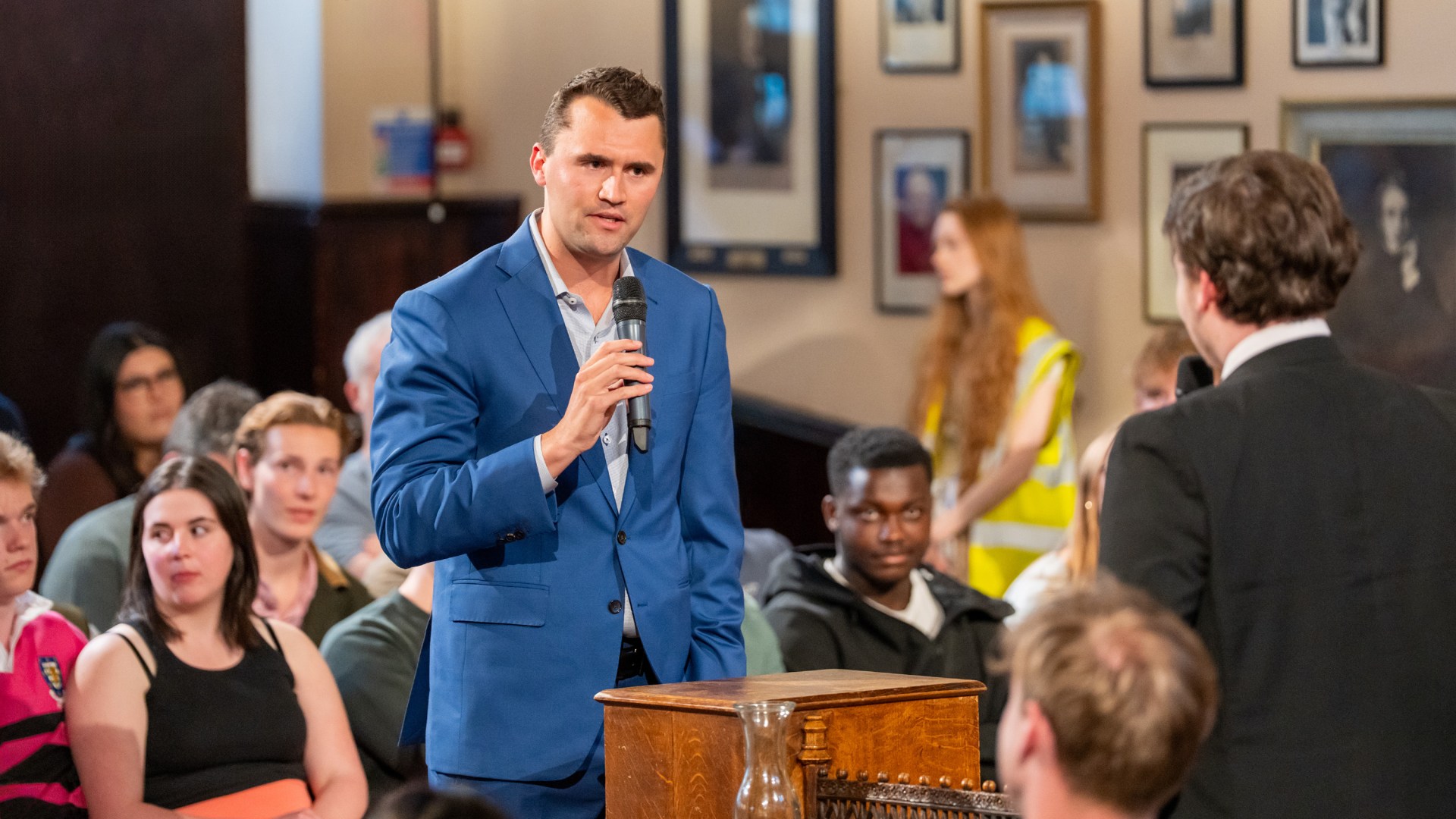
Kirk leaned hard into that instinct. His signature format was simple: sit beneath a banner that read “Prove me wrong” and let the argument play out in public. He sparred on race, gender, religion, and politics—sometimes sharp, sometimes sloppy, but always open. Critics called his views offensive, even dangerous, especially on transgender athletes, progressive sex education, or activist orthodoxy. But for many of us, the outrage itself only confirmed a deeper problem: Raising certain questions was considered off-limits. Kirk refused to play by those rules. He dramatized free speech as a live contest of ideas, and whether or not you agreed with him, he forced you to engage.


He also embodied conviction. He didn’t hedge or soften his positions to broaden appeal; he underlined them. Traditional marriage. Pro-life advocacy. America’s Christian roots. Rejection of critical race theory and gender ideology. These were not the positions of someone watching the polls. They were unpopular in many circles, and he knew it, but he held them anyway. At a time when public figures pivot with every headline, that steadiness stood out. Even those who disagreed with him often admitted the appeal of clarity. In an age of curated ambiguity and corporate moral posturing, it was refreshing to hear someone speak with his chest.
He also offered agency. Social psychologist Jonathan Haidt has described agency as a core drive, especially for young men—the need to feel they can act in the world, not just comment on it. That need has only sharpened in a culture where nearly every conversation is framed around global crises too big for one person to solve. Climate change, systemic injustice, broken politics—the scale is paralyzing. The constant demand to “fix the world” leaves many young men exhausted, convinced before they even start that they’d fail.
Kirk’s countermessage was a bit more doable: Get married. Have children. Plant yourself in a church. Take responsibility for something close to you, something that lasts. In an age where many delay adulthood and treat responsibility as optional, he called young men into permanence.
And in his later years, Kirk grounded his call in faith, speaking more directly about Christ. He quoted Scripture on stage, not just in churches but at political rallies. He talked about sin, salvation, judgment, and grace. He told crowds that the chaos in America wouldn’t be healed by winning elections or flipping the Supreme Court but by repentance and renewal. He urged young men not just to vote but to pray, not just to build households but to anchor them in the gospel.
In another era, this kind of talk might have sounded like a liability—too religious, too moralistic, too much of a distraction from the “real” issues. But not now. Gen Z men aren’t turned off by faith; many are drawn to it. Perhaps this is part of the reason why, the Sunday after his death, there were anecdotes of an uptick in church attendance.
We are coming of age in a world saturated with content and starved of meaning, a world fluent in therapy speak but hesitant to name truth, goodness, or sin. In that context, hearing someone talk about eternal things feels different. Serious. Like they actually believe it.


And maybe that’s what made Kirk stand out the most. So many young men today are soaked in online irony, where everything is mocked, so nothing has to be believed. It’s a posture that breeds isolation, keeps lives on pause, and, in its darkest form, produces instability—even assassins.
This is the ultimate divide in America: not political or demographic but existential. The divide between a boy who hides on a roof and a man who stands in the square. The divide between frogs and fathers, nihilists and believers.
Whatever you thought of him—provocateur, preacher, politician—Charlie Kirk believed. He believed in ideas worth debating, truths worth standing for, a Savior worth praising. And though his voice has been silenced, the longing that made us listen has not. Charlie Kirk is gone, but what my generation longs for remains.
Luke Simon is a content strategist for The Crossing church in Columbia, Missouri, and MDiv student at Covenant Theological Seminary. He has written on Gen Z, technology, masculinity, and the church. You can follow him on X.