Inkwell

The Pedestrian Lore of City Life

The daily apocalypse of my London commute began to dazzle me with moments of deep humanity.

Inkwell October 16, 2025
Image by Inkwell. City of London, March 2025.

I’m no small-town girl, but I’d never lived in a big city before London. 

Well, except for Los Angeles. But Los Angeles is a car city. You can cruise through it in the safety of your climate-controlled two-ton metal box, with background music that you choose. 

Once, late at night, I stopped at a gas station off an unfamiliar exit to fill up my car. As I stepped out to open the latch to my gas tank, I was met by a gas station attendant looking at me incredulously. “What are you doing?” he demanded. “Get back in your car and drive.” This was not the place for me—at least not tonight. I hopped back in my car and drove straight out of there.

But that’s the thing about car cities. You can always retreat to a place where there is a barrier between you and the world. You may encounter thousands of people on Interstate 5, but it’s with a buffer between you of steel and rubber. 

There is no such buffer in a walking city. In a pedestrian city, you see the world face-to-face.

For the first few months after we moved to London, I felt tired all the time. Maybe it was the move, I thought. It is exhausting to pack and unpack all your possessions, and for every ordinary part of your day to be new. 

Or perhaps it was the gloom of London weather. We moved to London in December, and after the lights and red ribbons of Christmastime came down, the city plunged into months of the biting, deep cold of winter. Or perhaps my tiredness was a symptom of something more psychological.

As the months wore on, I realized that my tiredness had a simpler cause: I was exhausted by the sheer number of human beings I encountered on an average day. To travel to the university where I work, I take two trains. If I travel at peak hour, I sometimes find myself standing chest to back with dozens of strangers. 

As we poured out of the Central line at Holborn, I thought about how we must look from above. A great snaking river of people, rushing in the same direction, finding our way through the twists and turns of the underground station like a stream of water finds its way down a hill. Sometimes it felt like I was a part of one giant organism, with hundreds of wills and destinies momentarily aligned with the common goal of breaking out of the station and pouring onto the Kingsway.

It was not merely the volume of people I encountered that exhausted me but the volatility. You never know what you’ll encounter in a city. Once, I saw a man standing bewildered with a bowler hat full of vomit. Was it his own or someone else’s? No one stopped to investigate. Instead, as if a force field with a radius of five feet surrounded him, people simply avoided him with one accord and without comment. 

I’ve also found myself in the middle of a rave on the tube, between people shouting at each other or wearing costumes. I often see people on their way to protests with handmade signs. Very often, there will be people with opposing signs in the same carriage.

My tiredness in those first months did not always come from the volatility or danger. Sometimes it came from my heart being touched by sweetness or sadness. 

There was the woman who appeared to be having a schizophrenic episode. She was dressed well, professionally even, and was harmlessly chattering away to an invisible companion. No one reacted to or even avoided her. They had seen someone like her before, and they will again. She reached her stop, stood, and gestured to no one beside her to exit as well. I wondered if her family worried about her. I was glad people were patient with her.

I was wearied by encountering human beings every day, face to face, no buffer.

The German sociologist Max Weber famously describes the modern world as being characterized by Entzauberung der Welt—the disenchantment of the world. Medieval people, says Weber, experienced the world as a place charged with spiritual potency, with meaning engraved in every flower and turn of the seasons. Modern people are more pragmatic and circumspect, viewing a flower as just a flower.

Philosopher Charles Taylor describes the average person walking around in the modern world as the “buffered individual,” someone who sees themselves as sealed off—separate from the world and the people outside of them. Alison Milbank adds that this is a “turning away from the supernatural toward the psychological.” We struggle with “inner demons,” not real ones.

The buffered modern self contrasts with the medieval “porous” person who is like a sponge, their moods and personalities influenced by the movement of the stars and the spiritual world believed to be humming around them. Modern people are, by contrast, sealed off, unmoved. Taylor’s description of the buffered self resonates with many people, who lament the resulting lack of meaning.

But breaking out of this disenchantment is not easy, not only because it is the default outlook of the modern person, as automatic as brushing our teeth in the morning. No, it is difficult because it is frightening. 

To believe that the world is subject to the influences of benevolent and malevolent spiritual forces would mean we’re not as in control as we think we are. Taylor writes that the person who “no longer fears demons, spiritus, magic forces, who is disembodied from the social world … enjoys a kind of mental invulnerability in his or her private castle.”

To carry  forward, we stay buffered because we feel safer in our self-chosen fortress than in openness to the world. I’d written about Taylor’s idea of the buffered self, but moving to London helped me understand what it meant in a more visceral, experiential way. 

It was funny. If you’d asked me whether I’d rather live in a place that didn’t require me to own a car, I would have agreed wholeheartedly. It’s better for the environment, for exercise, for community, I would say. And if you’d asked me whether I’d rather be a buffered or a porous individual, à la Taylor, I’d probably answer “porous, of course.” 

But for all this, I found the transition to London much more uncomfortable than I expected—like getting doused in cold water. And like a dry, hardened sponge, I began to soften.

As I did, I realized something: The buffer of a car does not actually ensure my protection. The steel and rubber may give me an illusion of safety, but it is just that, an illusion. 

I am, in fact, far more likely to die in a car crash than I am walking to or from work or taking the tube. I am far safer in my constant exposure to people, however unsettling my fellow human beings may sometimes be, than I am in the invulnerability of the private castle that is my car. 

I can’t help but think this is true on a broad societal level too. As we become increasingly buffered from each other, with layers of newsfeeds, opposing identities, and tribalistic defenses, our society becomes more volatile, more violent. While we might find each other confusing, upsetting, and annoying sometimes, when face to face, we find ourselves softened like sponges, more open to each other.

As I became used to my porous, pedestrian life, I also began to be dazzled by moments of deep humanity. One springs to mind: a grandfather with his grandchild, his soft brown face framed in soft white hair and a beard. He wore a long grey tunic and rested a protective hand on the shoulder of his grandson.

When I was a little girl, I read a book that included illustrations of monks with tonsured heads and Jewish men wearing kippahs. Strengthened by the baldness of my father, I concluded that all seriously religious father-figures either covered or shaved their heads. The man’s delicately embroidered Muslim cap reminded me of my childhood conviction: Here stands a pious and paternal figure. His grandchild sat calmly beside him, at peace because he was with a peaceful guardian. We exited at the same stop, the grandfather guiding the child with a gentle hand on his shoulder, the short gait of the child matching the slow gait of the old man.

How can I describe the effect this simple scene of love had on me? In his book Man Is Not Alone, the rabbi and civil rights activist Abraham Heschel writes:

In every man’s life there are moments when there is a lifting of the veil at the horizon of the known, opening a sight of the eternal. Each of us has at least once in his life experienced the momentous reality of God. Each of us has once caught a glimpse of the beauty, peace and power that flow through the souls of those who are devoted to Him.

I’ve come to think of the London tube as my daily apocalypse, a place where I may sometimes encounter the lifting of the veil. In all the world, I think we are most likely to see God in the face of other people, beings who bear God’s image.

One of the great conversion stories of the 19th century is A Christmas Carol by Charles Dickens. It takes place in the old City of London, which I pass through on my way to work each week. After a harrowing night where he is visited by three spirits who show him the error of his enclosed and selfish life, Ebenezer Scrooge awakes with a profound relief that his life is not over yet, that he can repent and live better. What he does next has always struck me as simple but profound:

He walked about the streets, and watched the people hurrying to and fro, and patted children on the head, and questioned beggars, and looked down into the kitchens and houses, and up to the windows, and found that everything could yield him pleasure. He had never dreamed that any walk—that anything—could give him so much happiness.

The evidence of Scrooge’s salvation is portrayed in a walk through the city, in his openness and curiosity toward his fellow human beings, and in the joy he feels in their varied lives, even those that do not concern him. 

Living in London has given me a taste of this. It has made me realize that I am perhaps more like Ebenezer Scrooge than I’d care to admit, how enclosed and buffered much of my life has been. This new outlook constitutes, if not a re-enchantment, a breaking of the spell that keeps me buffered and disconnected.

Like Scrooge, I find myself astonished that a walk—or even a ride on the tube—can give me so much happiness.

Joy Marie Clarkson is the author of You are a Tree and Aggressively Happy. She is a research associate in theology and literature at King’s College London and the books and culture editor at Plough Quarterly. She writes weekly on her Substack.

News

‘Is That the Same Charlie?’

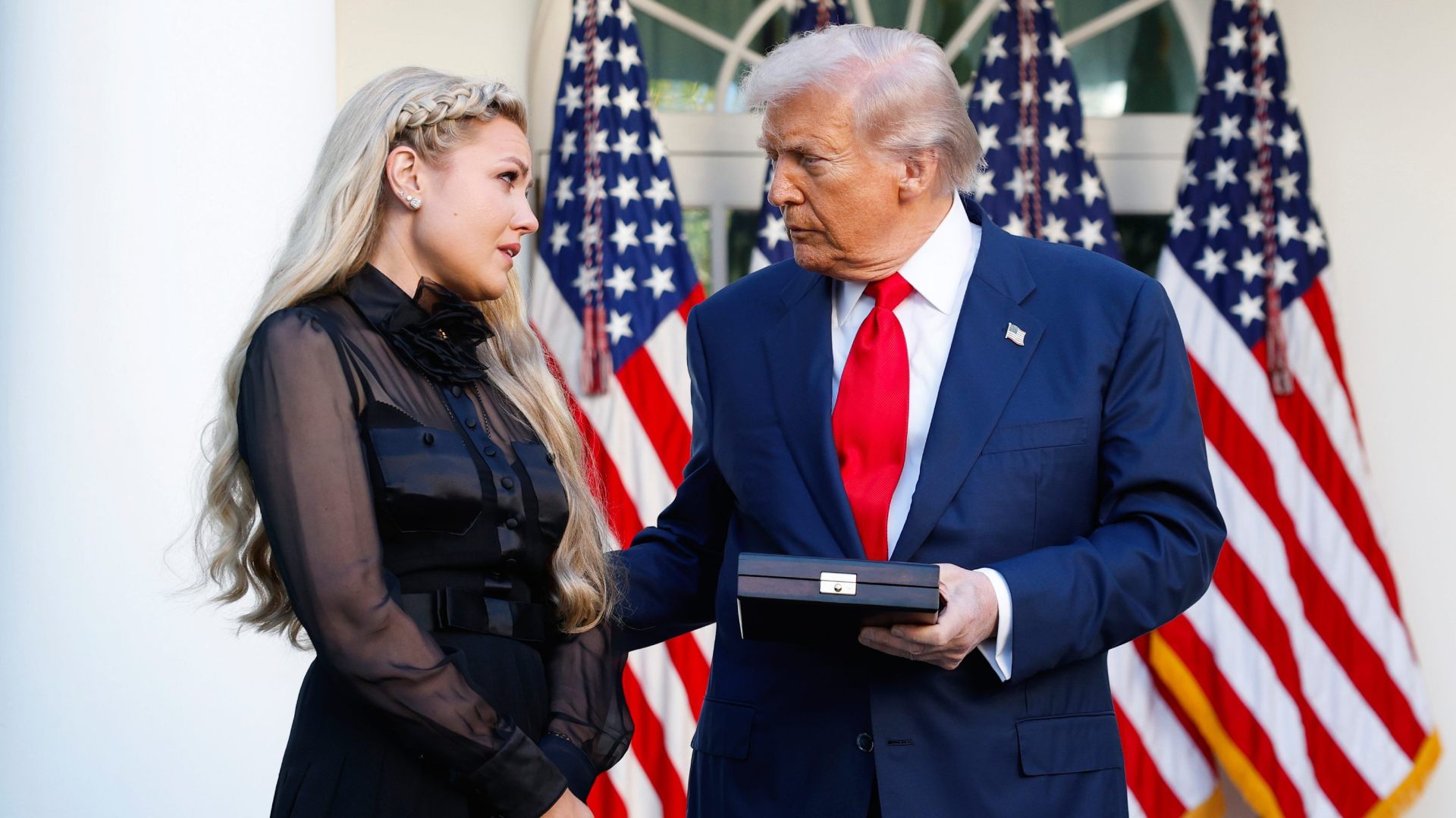
Awarding Kirk the Medal of Freedom, President Trump questioned his widow’s emphasis on his willingness to forgive and love his enemies.

President Trump Awards Charlie Kirk the Presidential Medal of Freedom

Erika Kirk accepts the Presidential Medal of Freedom on behalf of Charlie Kirk

Christianity Today October 15, 2025
Kevin Dietsch / Getty Images

President Donald Trump posthumously awarded the Presidential Medal of Freedom to Charlie Kirk in a ceremony on what would have been his 32nd birthday Tuesday. 

The medal, bestowed at the president’s behest, represents the highest honor the US government grants a civilian. Kirk was a staunch Trump ally who inspired many young Americans to get involved in conservative politics.

“We’re entering his name forever into the eternal roster of true American heroes,” Trump said to the audience of politicians, conservative activists, and Kirk’s family and friends gathered at the White House Rose Garden.

In his remarks, the president once again characterized the Turning Point USA founder differently than his widow, Erika Kirk, did. She received the award on her husband’s behalf. Trump described Kirk as a tough political fighter who “didn’t like losing.”

“I heard he loved his enemies. And I said, ‘Wait a minute, is that the same Charlie that I know?’ I’m not sure. But I didn’t want to get into it,” Trump said, referring to Kirk’s memorial service last month. 

In her eulogy last month, Erika Kirk forgave her husband’s killer and said that Charlie wanted the best for those who opposed him. At the time, Trump said he didn’t have the same attitude.

On Tuesday, she once again reiterated Kirk’s posture toward political adversaries. “Surprisingly enough, he did pray for his enemies, which is very hard, but he did,” Erika Kirk said at the ceremony. “I saw him do it. He never did it in front of anyone else, but I can attest to that.”

John Fea, a historian at Messiah University, said Erika Kirk’s “willingness to forgive her husband’s killer is what the gospel is all about. … She beautifully displayed the heart of Jesus Christ at the memorial service.”

Fea said he’s seen from other political figures an impulse to “give lip service to ending political violence while continuing to play the blame game.” He called the president’s comments saying he personally hated his opponents a striking example: “In Trump’s fusion of evangelical Christianity, nationalism, and MAGA politics, the latter two win out over the gospel.”

Kirk’s fatal shooting last month at a Utah college intensified concerns around divisive political rhetoric and retaliatory violence. The tragedy galvanized Republicans, who said they wouldn’t let Kirk’s efforts to mass-mobilize younger generations go to waste. Turning Point USA has doubled since Kirk’s assassination, with TPUSA chapters on college campuses going from 900 to 1,690, according to TPUSA spokesman Andrew Kolvet.

While some evangelicals have lauded Kirk’s public witness and attributed a recent bump in church attendance to his legacy, others (including Black clergy) have denounced his killing while critiquing certain inflammatory statements.

Fea noticed in the wake of the event that Kirk’s Christian fans have seemed “torn” by his widow’s stance: “They praise her for offering forgiveness to the shooter, but their social media feeds are filled with anger against the ‘left,’ who they believe is responsible for his murder.”

Michael Wear, president and CEO of the Center for Christianity and Public Life, said he hopes the grief and sadness many Christians feel doesn’t get lost amid public figures’ attempts to utilize the tragedy for political ends.

“Just because there’s disagreement on exactly how positive Kirk’s influence was doesn’t mean that there isn’t broad Christian agreement in rejection of his murder and in basic appreciation for him as a brother in Christ,” Wear said. He hopes this consensus won’t be compromised by “a whole political machinery that sees that common ground and wants to take advantage of it by expanding the parameters of what honoring Charlie Kirk has to look like.”

Last month, the US Senate approved a resolution marking October 14 as a national day of remembrance for Kirk. The resolution does not make the day a national holiday but encourages “programs, activities, prayers, and ceremonies that promote civic engagement and the principles of faith, liberty, and democracy that Charlie Kirk championed.”

A similar bill introduced in the House remains stuck in committee. The Congressional Black Caucus opposed the recognition as “an attempt to legitimize Kirk’s worldview—a worldview that includes ideas many Americans find racist, harmful, and fundamentally un-American.”

Attendees Tuesday included Vice President JD Vance, several cabinet members, and conservative media personalities including Sean Hannity and Tucker Carlson, Jack Posobiec, and Benny Johnson. Several pastors also attended, including Greg Laurie of Harvest Christian Fellowship and James Kaddis of Calvary Chapel Signal Hill.

Laurie said on social media that a cross engraved on the back of the medal is “in recognition of Charlie Kirk’s strong faith in Christ.”

During the award ceremony Trump discussed Middle East geopolitics, the US–Mexico border, the 2024 presidential election, and the assassination attempt. Erika Kirk thanked him for recognizing “a life lived for defending freedom…. That’s what Charlie fought for until his last breath.”

Theology

Gaza Has More to Do with Your Life Than You Think

Columnist

Biblical references to Gaza show that once-hostile frontiers are a pathway of grace.

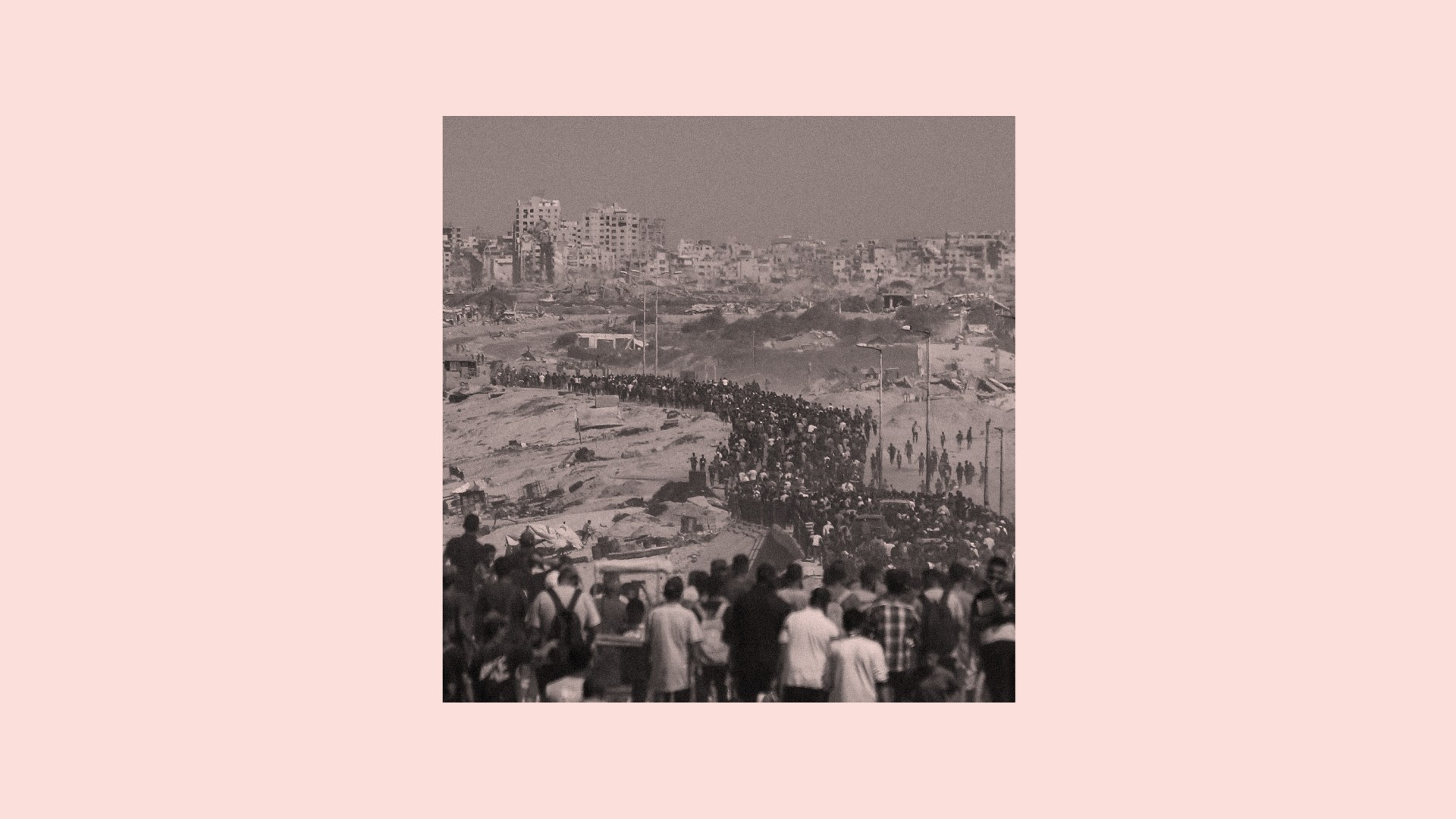
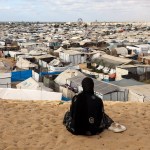
A view of the Al-Rashid road toward Gaza City on October 10, 2025.

A view of the Al-Rashid road toward Gaza City on October 10, 2025.

Christianity Today October 15, 2025
Illustration by Christianity Today / Source Images: Getty

This piece was adapted from Russell Moore’s newsletter. Subscribe here.

After two years of bloodshed since Hamas attacked Israel on October 7, 2023, the war in Gaza seems to be over. The living hostages are back home, as President Donald Trump and Hamas and Israel hammered out in a cease-fire agreement. In that, all of us can rejoice, even if the peace will be fragile—and even though wounds from the loss of so many innocent lives, both Gazans and Israelis, will take decades if not centuries to heal. Christians around the world might be tempted to think this matter is now over, at least for us. Gaza, though, has more to do with our own gospel story than we might think.

It’s natural for people to pay more attention to a place when it’s somewhere they’ve lived. A missionary I know who worked in Africa for many years is especially attuned to news headlines about the continent in a way many others might miss. Even though I live in Nashville now, my ears perk up every time I hear any news from my hometown on the Mississippi Gulf Coast. For Christians, Israel and Gaza are places we have “been”—since, by union with Christ, we are part of his story and thus the story of his ancestors (1 Cor. 10:1–6).

Gaza is first referenced in the Bible as a border, the edge of Canaanite territory, the far southern boundary of what the Israelites would later call the land of promise (Gen. 10:19). Gaza comes up in the Book of Joshua, again as a kind of liminal space between the people and the world outside. It’s also the setting for the final scene of Samson’s story, in which the defeated and blinded man pulls down the pillars of a building. The account is unsettling in that it is a meeting place of deliverance and tragedy. Violence and redemption somehow cling to each other in the wreckage of a collapsing house.

By the time we get to the prophets, the word for Gaza seems, at first read, to be only judgment. Amos denounces Gaza for cruelty and injustice in selling an entire community into slavery (1:6–7). Zephaniah seems to be just as harsh, but that’s not the whole story. He also envisions a day when a place of violence is instead a place of pasture (2:4–7). Even in judgment, we see that tragedy is not the end of the story.

Reading such passages without the full context of Scripture could lead to distortion. We could start to identify present-day Gaza as the one-to-one equivalent of where the ancient Philistines lived. But that would be to ignore how judgment and mercy function in redemptive history. Judah, too, is judged—the northern kingdom as well. All of us in Christ are those who were once “far off” and have been “brought near” (Eph. 2:13, ESV throughout). In fact, the one explicit mention of Gaza in the New Testament makes this clear.

In the Book of Acts, Luke writes that God directs the disciple Philip to take the road that goes south from Jerusalem to Gaza. There he meets an official of the Ethiopian royal court, reading the Book of Isaiah (Acts 8:26–39). There on the road, the gospel crosses one of its first borders. The Gentiles are enfolded into the people of God. The once-hostile frontier becomes a pathway of grace. What was thought of as the edge of the map becomes the entry point to the kingdom.

That doesn’t give us a blueprint for what should come next geopolitically, nor does it tell us how to draw borders or maintain cease-fires. But it does remind us what kind of God we pray to for peace and justice. The Gaza on the maps at the back of our Bibles is a kind of liminal space—a threshold. But again and again, that’s where God is at work. Over and over, God redeems the very places where the world seems to have come apart.

Justice and mercy are often clearly marked out by a border in our minds. And yet the gospel we believe binds both of them together in the Cross. Justice without mercy is vengeance; mercy without justice is sentimentality. The gospel is altogether different. Since we have experienced that reality, we ought to be aware that what often seem to be the borderlands of history—the Gazas, literal and metaphorical—are not outside the reach of grace. Often, they are precisely where grace starts to make itself known.

Many of us have frequently recounted the time the Old Testament patriarch Jacob wrestled with God in the night, leaving him with a new name (Israel), a blessing, and a limp (Gen. 32:22–32). What we often forget is that Jacob was in that in-between space because he was scared of his approaching brother, Esau, who had been in many ways rightfully angered by Jacob’s deceptions. And yet when the brothers met, there was no vengeance or violence. Jacob said that seeing Esau’s face was “like seeing the face of God, and you have accepted me” (33:10).

Only the most naive would think Middle Eastern peace can be accomplished in one fell swoop. That wasn’t the case even in Scripture. The lines of Jacob and Esau continued to erupt in conflict toward one another. But their meeting foreshadowed a greater peace to come. We, like our Middle Eastern ancestors (most of us by adoption), are still in the borderlands. We can see from afar the shalom on the other side of this world of blood and death (Heb. 11:13). But we can see it, if only by faith.

The road from Jerusalem to Gaza is still there. It is still desert. But on such roads the Spirit of God still bears witness to hope. In the borderlands—not just on our maps but in our lives—we might see no road out of where we are. But surely back there, on the road we cannot see, goodness and mercy are following us still. We should pray that way.

Russell Moore is editor at-large and columnist at Christianity Today and leads its Public Theology Project.

Church Life

Happy 76th Birthday, Joni Eareckson Tada!

First in a series called Long Obedience in the Same Direction.

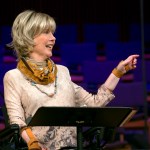
An image of Joni Eareckson Tada.
Christianity Today October 15, 2025
Image courtesy of Joni and Friends.

From 2007 to 2019 I interviewed 200 prominent Christians in front of student audiences. My favorite all-time guest was Joni Eareckson Tada in 2012. Today CT is beginning a profile series named after Eugene Peterson’s classic book about discipleship. No one I know has a more wonderful record of “long obedience in the same direction” than Joni.

The bare facts of her life are well-known. At age 17 she misjudged the shallowness of the water and dove into the Chesapeake Bay. She has had quadriplegia for almost six decades. She has also written more than 48 books (mostly relying on voice-recognition software), painted beautifully with a brush between her teeth, and led Joni and Friends, an organization that among other things has provided more than 227,000 wheelchairs to those in need around the world.

For me, the most stunning part of the interview came when I asked Joni what she thought her life would have been like had she not broken her neck. Here’s what she said:

I believe what happened to me was an example of Hebrews 12 discipline. I do. I’ve had Christians ask, “How can you say that of God? That’s awful for you to say he would discipline you by making you a quadriplegic.” No, no, no. Read Hebrews 12: God disciplines those he loves. Had I not broken my neck, I’d probably be on my second divorce, maxing out my husband’s credit cards, planning my next ski vacation. I wouldn’t be here extolling the glories of the gospel and the power of God to help a person smile, not in spite of the problems but because of them.

But please read on. Her words are so lovely.

Do you still have flashbacks of the accident?

Absolutely. Some background for the people here: This was the dreadful moment when I took a dive and my head hit the bottom of the sandbar. That snapped my head back, crushing my spinal cord, leaving me face-down in the water. It’s a horrific image. Just think about it: if you were paralyzed totally, face-down in the water, and you hadn’t taken a deep breath. It’s so shockingly unthinkable. When I was first injured, I couldn’t even think about it because it was so overwhelming.

Peroxide in your hair saved your life?

Yes. The day before I had gone to the drugstore and picked up a bottle of Nice’n Easy midnight summer blond, and I peroxided my hair as 17-year-olds did back then. Had my hair not been shockingly blond, my sister Kathy would never have seen me face-down in the water. She told me later on, “Joni, you were a mousy blond, and that water was dark and murky. Only because of the peroxided hair did I even see you.” God sometimes uses the incidental choices we make to change our lives.

As you were lying in the hospital bed, did you have faith in God?

As a 14-year-old I had embraced Jesus as my Savior but had confused the abundant Christian life with the great American dream: I was a Christian and would lose weight, get good grades, get voted captain of the hockey team, go to college, marry a wonderful man who made $250,000 a year, and we’d have 2.5 children. It was me-focused: What can God do for me? I almost thought I had done God a great big favor by accepting Jesus. And to be frank, I had made some immoral choices. I finally got that boyfriend I was hoping would show up, but we were doing some things together that were wrong.

Did you feel that way at the time?

In April 1967, I came home from a sordid Friday-night date, threw myself onto my pillow, and cried, “Oh, God, I’m embarrassing you. I’m staining your reputation by saying I’m Christian yet doing one thing Friday night and another Sunday morning. I’m a hypocrite. I don’t want to live like this. I want you to change my life. I’m powerless to do it myself. Please do something in my life that will jerk it right-side up, because I’m making a mess of the Christian faith in my life, and I don’t want that. I want to glorify you.”

Then I had the diving accident about three months later. In the hospital I was thinking, Wait a minute. You took that prayer that seriously? God, I was disobedient, but I’m one of your children. How can you deal with your children so roughly? This is the way you answer prayer for a closer walk with you? You’ll never be trusted with another of my prayers.

As you lay in that hospital bed, did you have suicidal thoughts?

When first injured, I was overwhelmed with the prospect of being paralyzed for the rest of my life. I used to lie in bed and wrench my head back and forth violently on the pillow, hoping to break my neck up at some higher level and pass out. I was hoping that when I was strong enough to sit up in a wheelchair, they’d give me a power wheelchair so I could careen off a high curb and kill myself that way. But a person can only live with that kind of despair for so long. And thankfully, Christian friends of mine were praying.

Eventually God used those prayers to turn my despair Godward. It’s in the Psalms: Why are you downcast, O my soul? Put your trust in God (42:11). God began to bring back to my mind and memory those verses of Scripture that I had memorized.

When were you able to pray again with faith?

Finally, under the power of other people’s prayers and hints and whispers of the Word of God, I prayed one short prayer that changed my life: “Oh, God, if I can’t die, show me how to live.” That was probably the most powerful prayer I had ever prayed. My depression began to lift and the despair to dissipate.

That took time. If at that time there had been an assisted-suicide law, would you have asked someone to kill you?

Oh my goodness, yes. When I was depressed in the early part of my hospitalization, I begged my girlfriends to bring in their mothers’ sleeping pills, their fathers’ razors, anything. I’m grateful there was no physician-assisted-suicide law around back then. I would have tried very hard to mount some court challenge to change the definition of terminal illness so that it might include spinal cord injury. I would have done anything to put me out of my misery. I was so miserable.

What a different world we live in now, because there really are people with disabilities trying to change the court definitions of terminal illness in states like Oregon and Washington. At our ministry we’re working hard to prevent that from happening and to give hope in Christ so these people, like me, will find a way out of depression.

Does depression still ensnare you at times?

Are you happy? I make myself be happy. I make myself sing, because I have to. The alternative is too frightening. My girlfriends will tell you: In the morning when I wake up, I know they’ll be coming into my bedroom to give me a bed bath, do my toileting routines, pull up my pants, put me in the wheelchair, feed me breakfast, and push me out the front door.

I lie there thinking, Oh God, I cannot face this. I’m so tired of this routine. My hip is killing me. I’m so weary. I don’t know how I’m going to make it to lunchtime. I have no energy for this day. God, I can’t do quadriplegia. But I can do all things through you as you strengthen me. So, God, I have no smile for these girlfriends of mine who are going to come in here with a happy face. Can I please borrow your smile? I need it desperately. I need you.

I hate the prospect of having to face the day with paralysis. I choose the Holy Spirit’s help because I don’t want to go down that grim, dark path to depression anymore.

That’s the biblical way to wake up in the morning, the only way to wake up in the morning. No wonder the apostle Paul said, Boast in your afflictions. Don’t be ashamed of them. Don’t think you have to hide them and gussy yourself up before God in the morning so that he’ll be happy with you and see that you’re really believing in him. No, no, no. Admit you can’t do this thing called life. Then cast yourself at the mercy of God and let him show up through your weakness because that’s what he promises—2 Corinthians 12:9.

Who are the people with handicaps?

Maybe the really handicapped people are the ones who wake up in the morning, hit the alarm, take a quick shower, scarf down breakfast, give God a speedy tip-of-a-hat of a quiet time, and then zoom out the door on automatic cruise control. Like, “I accepted you as my Savior, Jesus, way back when. I put my sins on the counter in exchange for an asbestos-lined soul. I got this Christian thing figured out. I’ll check in with you now and then, but I can pretty much do it on my own.” God says if you live this way he’s against you. James 4:6—he’s against the proud, those who’ve got it all figured out, but he gives grace to the humble.

The humble are …

People who wake up in the morning knowing they can’t do this thing called life without the divine help of the Savior. That makes my disability such an advantage. I’m so blessed to have it force me into the arms of Christ every morning, because I know my human inclination is not to go to the Cross every morning. It’s to turn my head on the pillow and pull the covers up and not face the day.

What you’re saying about hard mercy makes a lot of sense to Christians—but what about non-Christians who ask you to put together a good God with terrible occurrences? How do you talk with them about God’s sovereignty in your personal situation?

Always with what the Bible calls reasonable sweetness, savoring my conversation with salt. I get into an elevator with a bunch of people who see the lady in the wheelchair smiling and humming “Amazing Grace.” They can connect the dots: lady in wheelchair singing “Amazing Grace.” It’s a compelling support for the gospel. If people want to get into discussion with me about the sovereignty of God, I will tell them front and center that God doesn’t like spinal cord injury. He takes no pleasure in multiple sclerosis or children born with spina bifida.

John Piper talks about how God looks at suffering through two lenses. He looks at the isolated incident of suffering through a narrow lens and loathes it. His heart loathes it when you go through a divorce. His heart aches when you give birth to that child with multiple disabilities. He hates the isolated lens of suffering. But he delights in the wide-angle lens. He sees the mosaic. He sees how it all fits together into this incredible pattern for not only our good but the good of all those around us, and for his glory.

I’m grateful that God is sovereign. His fingers hold back a deluge of evil in this world. I’m grateful that he only allows to slip through his sovereign fingers that which he’s convinced will help our souls and fit us better for eternity.

What about those who are suddenly murdered and don’t have the opportunity to learn as you learned?

It’s impossible to conjecture what is in God’s heart. The Bible calls suffering a mystery for good reason. Our thoughts are not God’s thoughts. We can’t see the big picture. Why doesn’t God just eradicate suffering all together? If he were to eradicate suffering, he’d have to eradicate sin, in which suffering has its roots. And if he were to eradicate sin, he’d have to eradicate sinners.

Jesus could have not only established the kingdom at the cross, but he could have fulfilled it right then and there. He could have ushered in the completion of the kingdom of God. Bang. Close the curtain on sin and suffering and Satan. Send them all to the lake of fire with his hordes, and that’s it.

Had God done that, you and I would never have the chance to hear the gospel. So God gives the Devil a stay of execution. It means there’ll be holocausts and genocides and wars and rape, things that God hates. But out of it all, the core of his plan is to rescue people, to draw them to his side, to win those who by his favor will be granted an eternity of joy and peace and service to God.

Have you come across Christians who said that if you only had great faith, God would heal you?

Yes. I would read those passages of Scripture which seemed to guarantee that God would heal. When I was released from the hospital, I remember going to crusades of Kathryn Kuhlman, a famous faith healer, a Benny Hinn sort. I hoped that somehow God’s healing spirit would visit the wheelchair section, that those of us who were the tough cases would suddenly jump up out of our wheelchairs—but the spotlight was always on the other side of the stadium.

How did you feel when the ushers came at the end to escort you away, unhealed?

I remember sitting there looking up and down this line of people on crutches, walkers, and wheelchairs and thinking to myself, Something’s wrong with this picture. I must not be looking deep enough into God’s Word, because I know these people believed. I certainly believed. I was calling up my girlfriends, saying, “Next time you see me I’m going to be running up your sidewalk. God’s going to heal me.”

So I went back into God’s Word and began to see things I never saw before—such as in the Gospel of Matthew where Jesus says, If your eye causes you sin, pluck it out. If your hand sins, cut it off. Better that you go into life maimed than enter hellfire (5:29–30). That little portion of Scripture clued me in to God’s priorities. God would have us go through life maimed if that means spiritual health and well-being. That is the deeper healing that he’s looking for. So I quit banging on heaven’s doors to get me healed. I began submitting to his Word.

When you were in the hospital room, in despair about having, were some comments people made—with good intentions—hugely irritating?

I had many well-meaning friends my age who said well-meaning things, but they were uninformed, because the Bible says, “Weep with those who weep” (Rom. 12:15, ESV). Many friends would say to me, from Romans 8:28, “Joni, all things fit together to a pattern for good.” Or from James 1:3, “Welcome this trial as a friend.” Or from Romans 5, “Rejoice in suffering.”

These are good and right and true biblical mandates, but when your heart is being wrung out like a sponge, sometimes the 16 good biblical reasons as to why all this has happened to you sting like salt in the wound. When people are going through great trauma, great grief, they don’t want answers. Because answers don’t reach the problems where it hurts in the gut, in the heart.

What does help?

When I was a little girl, I remember riding my bike down a steep hill. I made a right-hand turn. My wheels skidded out on gravel, and I crashed to the ground. My knee was a bloody mess. My dad comes running out. I’m screaming and crying. Although I didn’t ask why [I had fallen], if I had, how cruel it would have been for my father to stand over me and say, “Well, sweetheart, let me answer that question. The next time you’re going down the hill, watch the steepness. Be careful about the trajectory of your turn. Be observant of gravel.”

Those would all have been good answers to the question “Why did this happen?” But when people are going through great trauma and great grief, they don’t want to know why. They want Daddy to pick them up, press them against his chest, pat them on the back, and say, “There, there, sweetheart, Daddy’s here. It’s okay.” When we are hurting, that’s what we want. We want God to be Daddy: warm, compassionate, real, in the middle of our suffering. We want fatherly assurance that our world is not spinning out of control.

When you were in the hospital, what from your friends did sink in?

One night my high school friend Jackie, with whom I shared boyfriends, milkshakes, and hockey sticks, came into the hospital late one night, like 2 in the morning, past visiting hours. The nurses were on break. No one was in the hallway. She crept up the steps of the hospital, snuck in the back way, came into my six-bed ward. I was with five other spinal-cord-injured girls who were all asleep. My friend came sneaking into the room, crawling on her hands and knees. She came over to my bed, stood up slowly, and lowered the guardrail of the hospital bed. Just like high schoolers will do on pajama sleepovers, she climbed into bed next to me, snuggled real close, and softly began to sing: “Man of sorrows, what a name, for the Son of God who came, ruined sinners to reclaim. Hallelujah, what a Savior!”

I get choked up thinking about it. She gave me something that night that was priceless. She helped me encounter Jesus Christ in a warm and personal way. That’s how precious the body of Christ is to healing the hearts of those who are hurting, to come up close to them, to infuse into their spiritual veins life, hope, healing, health. That’s what Jackie gave me that night. She gave me Jesus in a real and personal way. That’s really what I needed. So don’t you dare be caught rejoicing with those who weep. Weep with those who weep.

Church Life

Does Oman’s Ban on Evangelism Increase Its Religious Liberty?

An interfaith center challenges persecution group Open Doors’ designation.

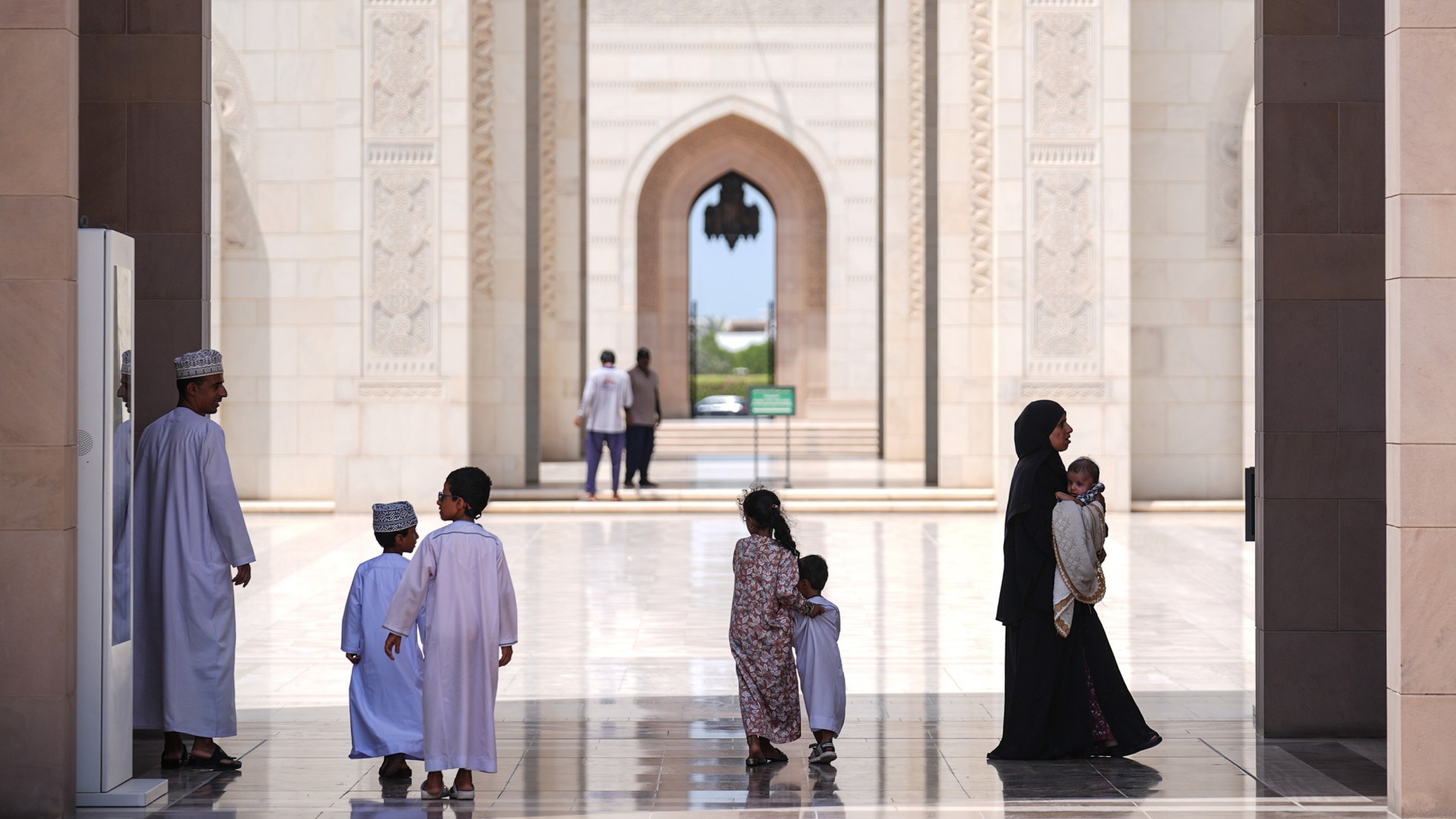
A view of Sultan Qaboos Grand Mosque in Muscat, Oman on August 30, 2025.

A view of Sultan Qaboos Grand Mosque in Muscat, Oman on August 30, 2025.

Christianity Today October 15, 2025
Anadolu / Contributor / Getty

In 2018, authorities in Oman escorted two American college students off a local university campus as they alleged the students were sharing their faith with Muslims. Omani law prohibits proselytism, and its constitution defines Islam as the state religion and declares sharia law as the basis of legislation.

Depending on the nature of their offense, the students could have faced up to 10 years in prison. Alternatively, they could have been found in violation of the law forbidding religious teaching without a government permit—as they were in the country on a tourist visa—and deported. Instead, they were let go with a warning.

Michael Bosch, a persecution analyst with Open Doors, said many foreign Christians who work with Omani converts from Islam have had to leave the country. For security reasons, Open Doors does not give numbers or details of these cases, yet it believes the Omani law hinders religious freedom.

However, Justin Meyers, director of Oman’s al-Amana Center (AAC), an interfaith ministry partnering with the Reformed Church in America, believes the law actually protects the religious freedom of its diverse population. (Part 1 of this series explained AAC’s background.)

After the students’ arrest, the Ministry of Religious Affairs called Meyers, asking him to talk with the students. Realizing they were from his home state of Michigan, Meyers first called local pastors he knew. One contact identified one of the students but had no idea he was in Oman. The sending organization had instructed him not to name the nation of his visit, the student told Meyers, lest he be inadvertently exposed—and possibly killed.

Open Doors ranks Oman No. 32 in its annual World Watch List (WWL) of countries where it is hardest to be a Christian. Its most recent report included an article about a female Omani convert to Christianity living in the US who stated on social media that if she were in her home nation, she would be killed or imprisoned for her faith.

Yet Oman is not on any lists of religious liberty offenders created by the US State Department or the Commission on International Religious Freedom. The State Department’s annual report cites Open Doors’ complaint about the treatment of converts and the monitoring of churches, but also that Christian groups had not reported any incidents of abuse or surveillance.

Meyers counseled one of the students, whom he was able to connect with, to respect the laws of Oman. Both students finished their six-month stays without further incident. Several years later, with the publishing of the 2025 WWL, the Omani government called Meyers again. Would he invite Open Doors for a visit so that officials could address their complaints?

The Open Doors report praised AAC for creating a more tolerant attitude among Omanis toward Christians while citing the Oman government’s support for AAC as an example of the country’s efforts to improve diplomatic relations with the West. Meyers has resided in Oman since 2013, serving as AAC executive director since 2021.

Open Doors had not consulted him and did not immediately respond to the Omani government’s invitation to visit—but Open Doors and AAC have since begun discussions about how to work together.

Since the death of former sultan Qaboos bin Said in 2020, Bosch explained, the new government has intensified its efforts to discover Christians who secretly share their faith. Previously, the authorities only identified those working directly with Omani converts. Now, the interrogation is broader, as authorities try to find networks and funding sources, Bosch said.

According to Open Doors criteria, “dictatorial paranoia” and “Islamic oppression” are two key drivers of local persecution. Although apostacy is not a criminal offense, converts could lose custody of their children under sharia-influenced personal status codes. But another driver is “clan oppression.” Within Oman’s tribal society, converts face shunning from society. And although the report recognizes that violence is not encouraged by the culture, some have been attacked for their faith.

Persecution, Bosch emphasized, is any act of hostility toward faith.

Mohammed al-Shuaili, associate director of AAC, said that Oman’s laws against proselytizing are expressly meant to prevent religious hostility. Two-fifths of the population are migrant workers, including many Christians and Hindus from the Indian subcontinent. The constitution prohibits religious discrimination, and these vulnerable communities are protected from Muslims who might pressure them to convert to Islam.

Oman designates four official groupings of Christian worship, including Catholic, Orthodox, Protestant, and recently approved Mormon churches, all of which must register with the government. The nation additionally hosts four Hindu temples, a Buddhist temple, and a Sikh house of worship. Open Doors agrees that believers from these religions—as well as non-Omani converts from Islam—are generally left alone unless they evangelize.

But another factor behind the anti-proselytization law is the diverse nature of Islam in Oman, Shuaili said. While the government does not publish statistics on religious demography, the US State Department estimates the Muslim population is evenly divided between Sunnis and the local historic Ibadi sect, alongside a sizeable Shiite community. While sectarian violence plagues countries like Iraq and Pakistan, all mosques are open to all Muslims in Oman.

Before the government began monitoring mosques in the 1980s, Shuaili remembers hearing anti-Christian sermons. These have since ceased, he said. The US State Department stated that religious content must be approved and fit within “politically and socially acceptable” parameters.

“My two best friends are Sunni and Shiite,” said Shuaili, an Ibadi Muslim. “Our history of pluralism is hundreds of years old.”

The Omani respect for religious diversity stems from the Ibadi faith, he believes. The sect originated in the late seventh century during the Islamic civil war between followers of Muhammad’s nephew Ali, who became known as Shiites, and those of Mu’awiya, the governor of Syria who usurped Ali’s power as the community-chosen caliph. This party eventually became known as Sunnis.

A third group, who supported Ali until he agreed to arbitration with Mu’awiya, led to the creation of Ibadi Islam. Known as Kharijites, they believed Ali compromised Islam by negotiating with Mu’awiya, an apostate leader who rebelled against Allah’s caliph and relied on tribe over faith. Often associated with extremists today, the Kharijites fought both parties fiercely. But a moderating faction within the Kharijite movement, led by Abdullah bin Ibadh, became disturbed at the violence and schism within Islam.

Named after this leader, the Ibadis recognized Ali’s right to rule and Mu’awiya’s sin. But they refused to label a fellow Muslim an apostate over political or theological differences of opinion. As others counseled either revolt or retreat into isolated communities, Ibadis urged living together and permitted intermarriage between the sects. In similar spirit, Shuaili said he would prefer that a doubting Muslim adopt Christianity, rather than abandon faith in Allah altogether.

He attributes much of the Omani rejection of conversion to its traditional conservative tribal culture. His own mother, he said, struggled to accept his marriage to a woman from a different clan.

Meyers said that if any Sunnis or Shiites tried to convert fellow Muslims on a college campus to their sect, the law would have applied to them as it did the Michigan students. He knows of Omani converts to Christianity who live quietly without persecution, and officials have repeatedly assured him of the government commitment to uphold religious freedom.

But no one, they tell him, can force a father to accept a child who rejects the family faith. Meyers noted that’s the same conflict some families in western Michigan face too.

Back in Oman, some foreign evangelicals come on false pretenses, Meyers said, seeking legitimate residency to enable their propagation of Christianity. Others, in their zeal for Scripture, have left Bibles on the doorsteps of Omani homes. Muslim residents are offended, he said, not just at the impersonal imposition of another religion but by the sacrilegious treatment of a holy text.

Meyers said he has come to “deeply appreciate” the prohibition of proselytism that, he believes, does not curtail religious freedom but rather enhances it.

One Pakistani Christian told him he feels safer in Oman than he would in his own country. At AAC, Meyers explains the Christian faith and its differences from Islam without opposition. Al-Amana also hosts the Arabia-wide ecumenical Gulf Christian Fellowship, and local clergy thank the sultan for interfaith harmony.

Bosch believes these Christian leaders are in a delicate position. While he believes it’s important that the government ensures the freedom of worship for its many communities, the International Covenant on Civil and Political Rights—which Oman has not signedestablishes the right to “impart information and ideas of all kinds.” This includes all residents in Oman who wish to share their faith.

“Practicing your religious rites is only a part of freedom of religion,” Bosch said. “Interfaith dialogue is important, but there are two stories to tell.”

Despite their different priorities, AAC and Open Doors are discussing how best to engage the government about Oman’s entry in the next World Watch List. A detailed understanding, however, has yet to be finalized.

News
Excerpt

After Hostage Release, Peace Remains Uncertain

Israel and Gaza wait for results of cease-fire agreement.

People waiting for the release of Israeli hostages at Hostage Square in Tel Aviv on October 13, 2025.

People waiting for the release of Israeli hostages at Hostage Square in Tel Aviv on October 13, 2025.

Christianity Today October 15, 2025
Menahem Kahana / Contributor / Getty

Early Monday morning, Hamas released 20 Israeli hostages in the first phase of a fragile cease-fire plan orchestrated by President Donald Trump and leaders of the Arab world. Phase one includes a partial Israeli withdrawal in Gaza and a flood of aid into the region. It also requires Hamas to dismantle and disarm, an aspect of the plan Hamas currently refuses.

Mike Cosper, senior contributor for The Bulletin, sat down with Haviv Rettig Gur of The Free Press to talk about the tenuous nature of the peace. Here is an edited and condensed excerpt of their conversation.

What is the mood among Israelis today?

Overjoyed. We haven’t slept properly. 

There is also tragic relief. Our betrayal of our people is finally over. Because of our history, safety began here in Israel. When Hamas took 251 of our people, we betrayed them deeply. The sense of betrayal has been an overwhelming feeling. The relief is truly palpable. People were weeping in front of the television screens on my street when the news came out. 

Israelis are extraordinarily optimistic about the future. They believe they can withstand their enemies and fight back. Then, you ask: What about Israel’s own political leadership? Optimism and trust crashes in the polls. Seventy percent of Israelis don’t want the war to end immediately, because they don’t trust Netanyahu to be capable of managing it and winning it. There’s this sense of distrust. 

What’s happening now in regions where Hamas has emerged from the tunnels and is resuming a public presence in Gaza?

Hamas has killed many hundreds in Gaza to maintain its rule while it sat in the tunnels. Not a single civilian has been allowed to step foot into that bomb shelter system in the last two years. Now, Hamas gunmen have emerged from these systems and are out in force on the streets with their guns. 

In multiple places, local families and clans independently created order in their territory when Hamas was hiding in tunnels. Hamas is conducting gun battles with those clans now and has issued warnings that it is going to arrest and kill those who criticized them.

We already have seen the disappearances of several dozen critics of Hamas. If you’ve criticized Hamas on social media, they will now come for you. They have announced that they’re going to execute these people. 

There are almost no Christians in Gaza because of Hamas, so very few have died in this war. Under Islamist regimes, Christians flee. In Syria, in the most ancient communities in the world, 80 percent are gone. The rest are keeping their heads down. 

What happens if, after the hostages are home, Hamas does not agree to decommission arms and digs in its heels?

International pressure on Israel not to resume the war will be enormous—real sanctions could be on the line. That would really hurt the Israeli economy. Any Israeli government will think five times before resuming the war. 

The world will also say that all Gaza needs is rebuilding. However, a terrible enemy promises to rebuild its war capabilities to drive Gaza into yet another war. Hamas sought out this war and will seek out another. Their ambitions are the result of 150 years of theological discourse that produced Hamas in a particular stream of Sunni Islam in the Arab world. 

If this occurs, Israel will struggle to get back to the war. The Israeli population is exhausted—in the military and at home—from two years of war. If there are no hostages in Gaza, it’ll be harder for the Israelis to explain a return to war. 

What that means is Hamas will essentially have retaken Gaza, and it’ll be very hard to redevelop Gaza, to rehabilitate. Gaza is a 25-mile territory with 400 miles of tunnels. It’s in every neighborhood. Nobody has ever been as entrenched as Hamas in Gaza. 

If Israel doesn’t return to war, that is an immense relief to Gaza. On the other hand, nobody on earth is willing to fight and die for Hamas to be destroyed. Nobody on earth is willing to die for Gazans. Nobody on earth is willing to die for a future in which Gaza isn’t ruled by Hamas, except Israelis. Gaza will be ruled by Hamas. 

If Hamas isn’t removed, Gaza has no future. That’s true if the Israelis are good people in a bad situation, and it’s true if the Israelis are the evil incarnate on earth. 

I don’t need people to love Israel. It was a terrible, terrible war. There are thousands of dead kids in Gaza. There’s no way there wasn’t a better way to fight this war. That should be the reaction for every war. It certainly should be the reaction for a war of urban warfare. 

This is a terrible, painful war in which the Israelis needed to be very careful; and you can come at them for not being careful. I don’t have any complaints of people who come at the Israelis about the war. However, those who support Hamas are guaranteeing another war. That’s the bottom line.

Listen to the full episode, which released on Tuesday, October 14.

Church Life

Evangelism Isn’t Allowed in Oman. Sharing Is.

A Christian-led interfaith group helps both Muslims and Christians explain the value of their faith.

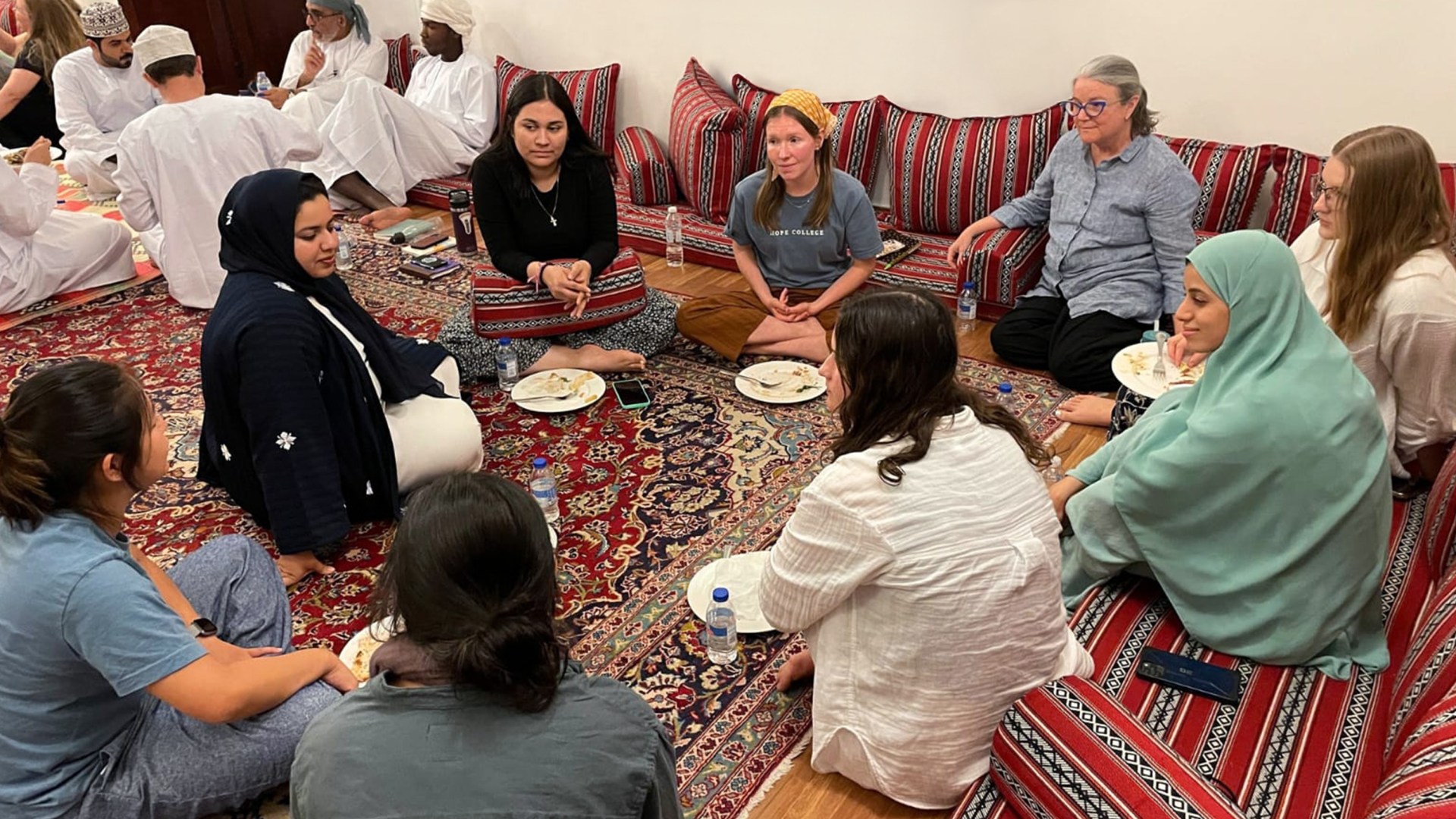
American Christians and local Muslims eating lunch together in Oman.

American Christians and local Muslims eat lunch together in Oman

Christianity Today October 14, 2025
Image courtesy of Justin Meyers.

In the ancient city of Muscat in the Sultanate of Oman on the northeastern shores of the Arabian Peninsula, several American Christian college students and local Muslims sat cross-legged on an oriental rug around printed passages from the Bible and the Quran. In the traditional Omani reception room lined with plush red mattresses and matching pillows, they discussed the phrase in John chapter 1 “the Word became flesh” and its Islamic parallels.

Two senior leaders—one Christian and one Muslim—guided the proceedings. They instructed the Americans to not place copies of the holy texts on the floor and assured the Omanis that these papers would not be thrown in the trash. Their primary goal that May afternoon was to avoid debating or comparing the texts academically, but rather to engage in a process called “scriptural reasoning.”

Though the concept was developed in the 1990s by Christian, Muslim, and Jewish philosophers, the term scriptural reasoning is a bit of a misnomer. Participants read and reflect on the selected passages with inquisitive curiosity, not logic. The point is self-discovery—and sharing—of one’s personal reasons for faith.

The Christians approach the Bible with love and reverence, describing the message they see within. Muslims do the same with the Quran, and the two groups exchange observations and ask questions, seeking to understand the passages’ meanings from the other side. Both Christians and Muslims listen attentively, free from the burden of convincing the other.

In Oman, where proselytization is illegal, al-Amana Center (AAC) uses exercises like scriptural reasoning to help bridge divides between Muslims and Christians, Arabs and Americans. Leaders said such activities by the current incarnation of the Reformed Church in America’s (RCA) 130-year ministry in Oman, now an independent partner institution, builds trust and mutual respect.

Justin Meyers, executive director of AAC, led the May session of scriptural reasoning. The students came from Hope College, a small Christian school from Michigan, as part of a senior seminar course involving an immersive exploration of Arab and Islamic culture. AAC’s Arabic teacher, Mohammed al-Shuaili, led the Muslim contingent and had already done this exercise dozens of times.

“It becomes hard to tell the Bible and Quran apart,” Shuaili said. “Scriptural reasoning brings people together, to discover the common threads.”

The scriptural reasoning website offers 34 topics—including things like modesty, fasting, and reconciliation—and looks at how passages in the Hebrew Bible, New Testament, and Quran discuss these themes. Shuaili said he especially appreciated its focus on Abraham’s hospitality.

Meyers, an RCA pastor from Grand Rapids, described how Christians get to experience the impact of quranic recitation while Muslims discover the beauty of the biblical text. By creating safe spaces for religious conversation, he said, interfaith relations are strengthened in Oman, the Persian Gulf region, and the world.

Oman’s nearly 5 million people are a diverse mix of Sunni, Shiite, and Ibadi Muslims as well as Christians (4%) and Hindus (5%), mostly from the substantial immigrant community.

While appreciating sincere Muslim engagement with the Bible, many evangelicals may view scriptural reasoning as a step down from evangelism. Shuaili’s response suggests he equates the two religious texts and downplays the differences. In a good-humored comment of commonality, he said he expects to see Meyers in heaven one day, where they can play pickleball together. But at no time, the scriptural reasoning website emphasizes, is anyone called to compromise their faith commitment.

Prior to AAC, Shuaili was a strict and traditional Muslim who would have never interacted with believers of other religions. This indicates the promise of interfaith relations to better integrate communities, but is Christian-Muslim dialogue a proper substitute for the RCA’s once-vibrant missionary heritage?

Open Doors ranks Oman at No. 32 on its World Watch List of nations where it is hardest to be a Christian. (Part 2 of this series discusses why AAC disputes this ranking.) Yet while Open Doors’ annual report praised AAC for “helping to create a more tolerant attitude towards Christians,” it also said that the center is “very much intended to boost Omani diplomatic ties.” With churches monitored and proselytizing illegal in the country, the report said that government support for AAC’s interfaith dialogue helps Oman keep a “friendly face” toward the world. 

The AAC website states it differently. The center began in 1987 when the RCA closed the al-Amana American school in Muscat. At a time when Americans were growing increasingly distrustful and fearful of Islam and the Arab world, the denomination repurposed its building for interfaith activities to better educate American Christians and contribute to peace between East and West. Dozens have come every year since, except during the COVID-19 lockdown.

The RCA first arrived in Oman in 1893 as part of the Arabian Mission that also ministered in modern-day Iraq and Kuwait. Samuel Zwemer, the “Apostle to Islam,” was an early member. Though few Muslims converted, Omanis today still recall with appreciation how later missionaries Sharon Thoms and his son Wells served thousands through their selfless medical care.

But as the region experienced an oil boom, the Omani government nationalized the RCA’s hospital in 1973. Christian institutions, once the only providers around, suffered a double blow: As costs and local competition increased, it became harder to maintain their service. They also suffered personnel shortages, as denominational priorities shifted and fewer members were called to missions.

Meyers came to AAC in 2013 as associate director, seeking to imitate Jesus in his peacemaking convictions. He said other Christians criticized him for not “standing with the truth” by condemning Islam and for not trying to convert his friend Shuaili. Meanwhile, Shuaili faces criticism from his Muslim peers for befriending a pastor and associating with Christians, whom they believe have an “outdated version” of the true faith of Islam.

They pushed forward anyway, primarily with non-Omanis. An Emirati imam in Abu Dhabi protested that scriptural reasoning did not sufficiently honor the Quran, until a senior cleric said he should give it a try. Jewish rabbis have joined as well. A delegation of Nigerian pastors and imams visiting Oman decided to continue meeting after returning home—for a joint meal, not a religious debate.

Shuaili grew up in a village near Nizwa, 90 miles southwest of Muscat. One of the oldest cities in Oman, Nizwa was the home of the founder of Ibadi Islam who aimed to moderate between nascent Sunnis and Shiites. Within this conservative religious ethos, Shuaili ignored video games and devoted himself to quranic study during his teenage years.

Shuaili understands the reluctance of the Emirati cleric to scriptural reasoning. Muslims are trained to repeat the various Islamic interpretations of scholars, not to offer their own reflections on the text. Shuaili was incredibly nervous that he would say something wrong the first time he participated. But over time, combined with teaching Arabic to AAC students, he grew more comfortable meeting the diverse international participants.

“I can earn three times my salary elsewhere,” Shuaili said. “But here my job has meaning.”

Meyers became executive director in 2021 and shortly after appointed Shuaili as associate director. It was the first time AAC had a Muslim in leadership. But he “will never have my job,” Meyers said, as it’s important for AAC to be Christian-led. In Arabic, al-Amana means “sacred trust,” a principle he honors in his attitude toward his RCA forerunners, his local hosts, and his Lord and Savior.

Meyers said that he is public about his faith and seeks to represents Christ in everything he does. By honoring the Omani law against proselytizing, he seeks to respect social peace between religious groups, which he says the law desires to preserve. This enables him to lead activities like scriptural reasoning, explaining the tenets of Christianity to curious Muslims with no implied pressure for anyone to change their religion.  And any Omani who shows further interest in converting he refers to the official churches in Muscat.

Yet Christians should honor the good in Islam, Meyers said, such as trust in Allah’s sovereignty, gratitude for his blessings, and humility in prayer. Meanwhile, Christians should build up a positive understanding of the gospel rather than tear down a rival faith. An earlier Arabian Mission pastor, James Cantine, had a similar opinion, which he wrote about in his 1912 essay “The Nearest Way to the Moslem Heart.” Cantine believed Christians could demonstrate the love of Jesus by building hospitals and schools.

Today, much of the Muslim world no longer needs those services. Peacemaking and interfaith dialogue can be the new vehicles, Meyers believes, and like the RCA missionaries of old, he is keen to bless the Omanis. Prior to COVID, he estimated that 95 percent of AAC activity did not involve local citizens, only expats and immigrants. Today, the organization serves 300 people a year and has increased Omani involvement to about 40 percent. A favorite activity is Interfaith Photovoice, where participants capture religious images and share their meaning.

Meyers and Shuaili visited three Omani universities in the past year, speaking with college officials and attending an intercultural fair. Students in return visited AAC, hanging out with foreign visitors. AAC has also reversed the immersive experience, taking some Omanis to Hope College, where they discovered the joy of barbecue and church potlucks.

Additionally, the center has hosted Omanis at the Muscat-based Protestant Church of Oman. Meyers lectured to local businessmen about the history of al-Amana, who then placed the center on the tourist map of Muscat’s Old City. And Shuaili joined him to assist the Omani Cultural Center in its soon-to-be-released documentary about Thoms and the Arabian Mission.

Author Lewis Scudder writes that the Arabian Mission workers eventually “Arabized,” discovering the sincerity of local people and the sophistication of classical Islamic philosophers. Without giving up the uniqueness of Jesus, they moved away from comparative gospel presentations that pitted Christianity against Islam, which locals only found hurtful.

“We have to first know the Muslim heart and the things he holds dear,” Cantine wrote. “We want to enter into his life and forget the things in which we think our own civilization is superior. … It is only by such a way of self-denial and service that we can get near enough to show forth the things that commend our faith.”

Meyers hopes to build on this legacy to create a staff of equal parts Omani and Christian expats. He said the government allowance to expand their work with local citizens was built on 12 years of trust, and he has no plans to leave. He calls his wife the “saint of the mission,” and his two boys feel at home.

“I came to Oman and said, ‘Peace,’ receiving ‘peace’ in return,” Meyers said, referring to Luke 10:5–6. “They let me stay and speak of my faith.”

Part 2 discusses the foreign Christians Open Doors says Oman does not let stay and how Ibadi Islam sheds light on Omani culture.

News

Good News About Christian Hospitals in Africa

Study author praises staff members who “stay where their presence matters most.”

Surgeons operate in a pediatric ward in Benin.
Christianity Today October 14, 2025
Pascal Deloche/ Godong / Universal Images Group via Getty Images


A new study is shedding light on a rarely researched area: faith-based health care in low-resource settings. 

The study, published in JAMA Surgery, found dramatically lower surgical mortality rates at faith-based hospitals in East, Central, and Southern Africa than at public and private hospitals in the same regions.

The postoperative mortality rate at faith-based hospitals was 57 percent lower than it was at public hospitals and 47 percent lower than at private hospitals.

The study examined more than 100,000 surgical cases across 85 teaching hospitals in those regions of Africa from 2005 to 2020. Two physicians affiliated with Brown University’s medical school and an African surgeon at Tenwek Hospital, a mission hospital in Kenya, led the research. The Brown physicians also work at Tenwek, which serves a low-income population in rural Kenya.

“The point is not to pit sectors against one another,” said Robert Parker, one of the study’s authors from Brown University and Tenwek, in an email to CT. “It is to identify specific practices that save lives and help decision makers and hospital leaders invest in supervision, infection-prevention, early recognition, and critical care capacity where patients need them most. … Especially in rural settings, the need is so great that this is not a competition.”

The study comes at a significant moment for African health. Poorer nations face the headwinds of US aid cuts and the prospect of increased child and maternal mortality. And in the longer term, population growth threatens to outpace the number of African health workers.

On top of that trend, high-income nations have been aggressively recruiting African health workers away from the continent to fill their own gaps. Between 2021 and 2023, Zimbabwe lost 4,000 nurses and doctors—a large percentage of the country’s health workers.

The authors of the study have worked in public, private, and faith-based hospitals between the three of them, Parker said. Initial reactions to the study were mixed, he added, with faith-based colleagues appreciating the recognition of their work and colleagues in public hospitals questioning whether the surgical outcomes in different hospitals were comparable. 

“But as we have talked there has been a shared understanding that all of us are working within difficult systems,” he said. “We are all caring for patients who often present late after long periods of illness.”

Keir Thelander, executive vice president for the Pan-African Academy of Christian Surgeons (also known as PAACS), served for a decade as a surgeon at Bongolo Hospital, a Christian hospital in Gabon.

Thelander said the data shouldn’t be read as a condemnation of public or private hospitals, which face systemic issues like staffing or equipment shortages. But he said the study was evidence that faith-based teaching hospitals are valuable additions to their countries’ health systems overall.

PAACS supports the training of surgeons in Christian hospitals across Africa.

“Not all our graduates stay in faith-based institutions,” Thelander said. “We are overall helping strengthen the surgical systems. We’re all trying to contribute to solving this provision of surgical care. We’re not in competition. We’re on the same team.” 

Public health research has not closely examined faith-based institutions, which often play an outsize role in poor and rural areas of many African nations.

“Somehow, faith-based providers of health and education had disappeared off the policy and evidence map,” researchers wrote in a Lancet article back in 2015 about African health systems. “The slowly emerging evidence on [faith-based health providers] suggests that they are not simply a health systems relic of a bygone missionary era, but still have relevance and a part to play (especially in fragile health systems), even if we still know little about exactly how they function.”

This 2025 surgical study itself noted, “There are limited data about the overall impact of faith-based hospitals on surgical mortality in the region.”

Parker told CT that data at faith-based hospitals is often tough to gather because the facilities are “remote and under-resourced, so data systems have not been the first priority.”

Postoperative mortality in African hospitals is a “systemic issue,” the researchers said in the study, and is “often attributed to factors such as inadequate health care infrastructure, limited access to essential surgical services, and insufficiently trained health care personnel.”

The study controlled for factors like case complexity and removed obstetric and gynecological cases from the data because faith-based hospitals tend to provide more of that care, and those cases had a lower mortality rate.

These outcomes come even as faith-based health centers tend to serve lower-income patients, who often come to the hospital in bad shape and as a last resort.

A survey published in The Lancet in 2015 showed faith-based health providers served the largest percentage of the poorest quintile in the 14 sub-Saharan countries surveyed.

It continues to be the case, Parker said, that faith-based facilities are in remote and under-resourced areas.

“What stands out to me in the data and in daily work is the dedication of staff in faith-based hospitals,” said Parker. “Many could choose easier or more lucrative posts, yet they stay where their presence matters most. They are motivated by professional duty, faith, compassion, and a sense of calling. That spirit shows up in patient care in ways that are hard to quantify, and this analysis suggests it may be making a real difference.”

Ideas

Children Are Born Believers

Research shows that kids are naturally attuned for belief in God. We adults could learn from that.

A mom and her child and a bright glow.
Christianity Today October 13, 2025
Illustration by Kate Petrik / Source Images: Getty

One night while chasing my five-year-old nephew at x0.33 speed—to give him the steady assurance of being faster than me—a branch broke off from an overhead tree and smacked the ground next to him.

He immediately hid behind an oak tree and donned a serious demeanor. I joined him in peering around the side of the trunk.

“Did you hear that?” he asked.

“What was it?”

“I heard a noise.” He paused. “Do you see them?”

“See what?”

The dinosaurs.”

I smiled and said I did. We spent the next 30 minutes crawling and ducking and covering from giant clandestine lizards roaming our Midwestern backyard.

My nephew’s automatic belief that something preternatural had caused the branch to fall wasn’t nonsense; it was actually a byproduct of the way his mind was supposed to work.

Research from cognitive scientist Justin Barrett shows that humans come into the world assuming there’s some kind of supernatural source behind everything. But while dinosaurs might get the credit every now and then, if you press a child, they’re far more likely to credit a divine source. As such, Barrett argues, we’re all more or less “born believers.” And this has a load of implications for us big kids too.

You might think, Well, sure, kids can think anything is real. Santa Claus and the Tooth Fairy, for example. But regardless of how impressionable we think children are, they don’t accept everything they hear. No matter how hard you try to convince them that broccoli tastes good, for example, there’s a high probability they’ll hang on to their skepticism.

So it’s not that kids are merely naïve. It’s more that they’re naturally attuned to believe that things happen for a reason—and their go-to reason is typically related to something divine. This is one of the reasons children perpetually ask, “Why?” They spontaneously interpret events as if they’re a product of divine intelligence. The “Why?” helps piece together their slowly developing puzzle of reality.

If you ask preschoolers if raining is what a cloud “does” or if it’s “what a cloud was made for,” they’ll almost unanimously say the cloud was made for the sake of raining. Kids “view natural phenomena as intentionally designed by a god. Not coincidentally, they therefore view natural objects as existing for a purpose.”

In other words, it’s as if children assume there’s some kind of force out there that designs every little thing in our universe for a specific reason. Developmental psychologist Deborah Keleman thus argues that children are “intuitive theists.” It’s a theism so innate that even kids raised in overtly atheistic homes still tend to assume there’s a divine presence guiding their world.

While many cognitive scientists attribute this natural “God awareness” to evolutionary processes, theologians like John Calvin would insist it comes from the sensus divinitatis (“a sense of deity”). It’s the idea that all humans possess a nagging sense that there is some kind of god out there, and this divine radar holds up surprisingly well across cultures, time, and geography. Atheism is thus actually “not a battle just against culture, but against human nature,” in the words of evolutionary biologist Dominic Johnson.

The more I learned about intuitive theism, the more I realized I could relate. I grew up assuming that God was real and that Jesus was a decent candidate for that God. But I threw those beliefs out the window when I turned 13, mainly because secular musicians swayed me to think Christianity was uncool. Then when I finally did accept Christ at 18, it felt like a return to the wonder of childhood—falling into a serene “second naïveté,” to borrow Paul Ricœur’s famous phrase.

Now, none of this research suggests that kids are born with a salvific comprehension of the Judeo-Christian YHWH, the Father of Jesus from whom the Spirit proceeds (John 15:26). It simply demonstrates that we’re not born atheists—at least, not functional atheists. Instead, atheism is something people are gradually formed toward, thanks to inundation within a culture where the doubting-Thomas mentality is treated as the intellectual standard.

If doubt is the norm, this makes it all the easier for our childlike sense of enchantment to dull as we get older. Many of us gradually replace wonder and mystery with mere logical conclusions to unmeaningful causations. It’s not necessarily a natural evolution; the scholar David Kling says it’s more like slowly unlearning, overriding, and suppressing our “default setting.”

Yet even though we can dull this default quite a bit, it doesn’t turn off completely. Surprisingly, the psychologist Jesse Bering found that even atheistic adults, when faced with events of enormous fortune or misfortune, will implicitly admit that “everything happens for a reason.”

I was skeptical about this anecdote the first time I heard it— probably because I myself have been a bit too conditioned toward the doubting-Thomas mentality. But the more I mulled it over, the more it made sense. When we’re confronted with something disastrous or remarkably fortuitous, it dials down our knee-jerk beliefs about a cold, random universe, even if it’s just momentary. Wonder in any form—positive or negative—can dislodge our stubborn opinions, granting a brief return to childlikeness.

All of this research, of course, brings to mind the way Jesus praised children throughout the Gospels.
And they were bringing children to him that he might touch them, and the disciples rebuked them. But when Jesus saw it, he was indignant and said to them, “Let the children come to me; do not hinder them, for to such belongs the kingdom of God. Truly, I say to you, whoever does not receive the kingdom of God like a child shall not enter it.” And he took them in his arms and blessed them, laying his hands on them (Mark 10:13–16).

I’m sure Jesus wasn’t praising children on account of their flawless ethical sensibilities (spending an afternoon with a two-year-old will unveil this theological truism). Instead, as New Testament scholar William L. Lane notes, Jesus praises the children simply because they unabashedly accept Jesus’ reality without reservation.

Jesus blesses the children not on account of “their virtues, but for what they lack,” argues scholar James R. Edwards. Young kids lack sophistication, self-consciousness, and anxiety over fitting in or aligning with majority opinion. They haven’t developed a sense of self-importance, the desire to feel like the smartest in the room, or the illusion of control over an unpredictable universe.

All to say, Jesus’ praise may have partly been aimed at the way a child’s brain is perfectly poised to shamelessly draw toward the wonder of the kingdom.

Even though adulthood and rationalism and the scientific method might bend us to see the world as less theistically designed, as followers of Jesus we know that these methods can’t unveil the fullness of reality as it really is. Jesus’ invitation to children is an invitation to adults too. It’s an invitation to remove the guardrails that prevent our minds from noticing God behind everything—even a fallen branch.

It’s tempting to assume there’s a loss of spirituality among today’s younger generations. But a recent study from The International Journal for the Psychology of Religion found that“nones” (those who don’t identify with any religion) don’t have any less spiritual longings than those who attend church. They just tend to channel those longings into different avenues, preferring “personalized means of discovery to those offered by traditional religions.”

In other words, the awareness of God, the sensus divinitatis,is alive and well today. The younger generations just might need some help pointing it in the right direction.

And even for those who have been faithfully attending church for years, there’s always a need to fall back into the wonder of a second naïveté—to become and see the world like children once again, reminded of the beauty of life with God in a fresh way.

A few weeks ago, our friends came over and brought their kids. Their family had gotten in a (relatively minor) car crash recently, so I asked their four-year-old about it. “God protected us” is all she volunteered before going back to playing.

I admire that response a lot. I probably would’ve taken a beat to acknowledge the factors like seat belts and airbags that led to their safety before announcing the God conclusion. Maybe I have a lot to learn from her.

Griffin Gooch is a writer, speaker, and professor currently working on his doctorate at the University of Aberdeen. He writes most frequently on Substack.

Ideas

Fighting Fire with Plants

Vegetative buffers taught me how to better respond to issues that so often divide us.

Green plants on a fiery background.
Christianity Today October 13, 2025
Illustration by Elizabeth Kaye / Source Images: Pexels, Unsplash

We were not created to bear the weight of sin in this world. Yet judging by our constant engagement with every breaking news story, we often seem hell-bent on trying.

Virality has become a social virus that has warped our sense of reality. As the flu brings about a fever, this virus has its own set of symptoms: an unquenchable desire to know and respond to stories or to argue about the caricatures of people we create from piecemealed clips and comments. This social sickness spreads in isolation in front of our screens, yet it is highly infectious.

When major breaking news hits, virality feeds on polarization, vengeance, and selfish ambition like oxygen. It is propelled by the winds of racism, xenophobia, self-righteousness, and apathy across the political spectrum.

I need not tell you, dear reader, that even Christians fail to lean on spiritual antibodies that can slow, resist, and destroy this virus. When it spreads, the type of sincere love that marks our faith (Rom. 12:9–20) goes missing. Instead of abhorring evil, many celebrate or downplay it. Satan’s schemes come at us like fiery arrows and find the flesh ready to indulge them (Gal. 5:16–26). The shield of faith the apostle Paul mentions in Ephesians 6:16, meanwhile, has no dings because it’s rarely lifted.

At the beginning of this year, when the headlines focused on the inaugural prayer service at the Washington National Cathedral, I found myself gripped by virality. I texted a friend and lamented that even a value like mercy for refugees and immigrants had become a politicized concept to a large chunk of the country. “We should .. not assume we can appeal to their better nature. Because they may be devoid of one,” I wrote (emphasis added).

But I was wrong—and full of despair. I was so discouraged by the state of my country that I lost sight of my own better nature. My own shield of faith lay on the floor while I spent my time entertaining a gladiator-style, rhetorical culture war. Defeat of an ideological enemy, I thought, was the only path forward.

My friend pointed out I was being tempted to fight fire with fire. And in a way, I was. I often thought of the path forward in the image of backburning, a technique that allows fire crews to stop the spread of wildfires by lighting a controlled blaze ahead of a fire’s path. The strategy is intended to eliminate any vegetation that can fuel the flame.

In my mind, the technique was analogous to the strategies deployed during past movements like the clergy-led Black Freedom Struggle: purposeful, nonviolent, and controlled tactics meant to stop destruction by meeting it head on. But I no longer think this kind of cultural backburning sufficiently captures what was carried out by my ancestors, nor is it what is needed to stop the corrosive cultural wildfires that increasingly animate the United States and other countries.

Recently, I discovered another strategy to fight wildfires: a green firebreak. It doesn’t rely on fire to fight fire, but rather green vegetation—a barrier of plants that are often seen surrounding a field of crops or houses in fire-threatened areas.

Experts will tell you these firebreaks are strategically planted to serve as a preventative and protective boundary against a blaze. If a fire does break out, it can lower the destruction that occurs.

Green firebreaks are effective for a variety of reasons, but one attribute stands above them all: moisture. The water stored inside plants can help quench a flame. And as you might imagine, they are planted preemptively and cultivated before destruction knocks.

As a metaphor for social action, these firebreaks mirror what Howard Thurman, a philosophical mentor to Martin Luther King Jr., calls “the springs of creative thought.”

Thurman was concerned with redirecting our spiritual resources to cultivate communities that can be reservoirs of love, not hatred. He thought about how to become a firebreak, instead of a fire starter, and how to mold a people characterized by life instead of death (Rom. 8:1–11). Ultimately, he pushed his listeners closer to Jesus’ all-encompassing answer to our cycles of decay: “Love your enemies” (Matt. 5:44).  

Our culture needs a contemporary resurgence of this type of work. With the rise of social media, the weight of world’s sins feels like an ever-present reality. We scroll and see horrific episodes—from children murdered in schools to public assassinations to families living in rubble—and then go about our lives.

This pattern can quickly lead to apathy or lure us into waging an endless fight in the flesh. It can be tempting to fight caricatures with caricatures, self-righteousness with self-righteousness, or always be as loud as “the other side”. But fighting fire with fire can “intensify fear,” King once said. As a result, opposing sides get engulfed in a cycle of cultural warfare that continuously stirs up division instead of quenching it.

A better future is possible, but it will only come through life-giving communities and institutions committed to creating cultural green firebreaks.

I have seen this work succeed in the Black church and the Institute of the Black World, a think tank that sought to create community for Black faith leaders and intellectuals during the social turmoil of the late ’60s.

We can glean inspiration and tenacity from former slaves, including my ancestors, who lived in Black freedmen’s towns and “freedom colonies” founded as safe havens. We can also learn endurance from the Southern Christian Leadership Conference, a civil rights organization that believed in nonviolent direct action and played a central role in the Black Freedom Struggle.

But initiatives and communities like these need to be intentionally imagined, cultivated, and sustained. They should also primarily be characterized by what they are for, instead of simply being motivated by what they are against.     

In this way, I can agree with a self-identified Black conservative whom I recently heard express fatigue over complaints about the past. “I don’t wake up every morning and have racism and all of these negative things on my mind,” she said. Neither do I.

Instead, I wake up and choose to till calloused ground, treat barren soil, and cultivate my own community through my research, my relationships, and my work. It’s the reason I can look forward to our future glory with a hope-filled heart (Rom. 8:18–30). I pray you choose a similar path too.

Tryce Prince, a social theorist of race and religion, is the director of the Carl Spain Center on Race Studies & Spiritual Action. He is a contributor to the forthcoming podcast The Good Culture Show and the book Religion Matters: What Sociology Teaches Us About Religion In Our World. Prince writes broadly at First Sunday.

Apple PodcastsDown ArrowDown ArrowDown Arrowarrow_left_altLeft ArrowLeft ArrowRight ArrowRight ArrowRight Arrowarrow_up_altUp ArrowUp ArrowAvailable at Amazoncaret-downCloseCloseEmailEmailExpandExpandExternalExternalFacebookfacebook-squareGiftGiftGooglegoogleGoogle KeephamburgerInstagraminstagram-squareLinkLinklinkedin-squareListenListenListenChristianity TodayCT Creative Studio Logologo_orgMegaphoneMenuMenupausePinterestPlayPlayPocketPodcastRSSRSSSaveSaveSaveSearchSearchsearchSpotifyStitcherTelegramTable of ContentsTable of Contentstwitter-squareWhatsAppXYouTubeYouTube